Flag of Belgium
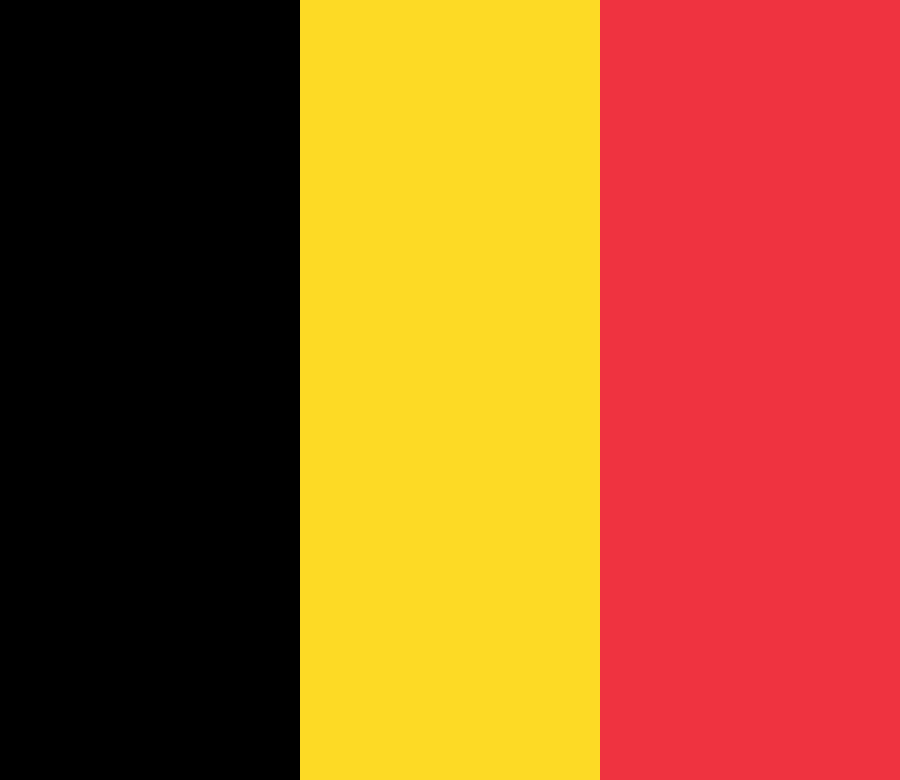
The Belgium flag is a vertical tricolor of black, yellow and red in equal bands. Its colors come from the arms of the Duchy of Brabant, a golden lion on a black shield, and it dates from the Belgian Revolution of 1830-31.
What the flag of Belgium looks like
The flag of Belgium has three vertical bands of equal width: black at the hoist, yellow in the middle and red at the fly. It is almost square. The official proportions are 13:15 (2.6 m tall for each 3 m wide), which makes the flag slightly wider than it is tall. This is unusual: unlike the flags of Switzerland and Vatican City, it is not a perfect square, but it is close to one.
A flag in the more common 2:3 shape is the civil ensign, the correct flag for civilians at sea, and flags in that shape are also widely produced.
The three colors are black, yellow (sometimes called gold) and red. There is no emblem on the national flag. Royal and military versions add a crown, the monogram of the king or other symbols, but the plain tricolor is the flag people see in daily life. You can see a small version on the Belgium flag emoji page.
Belgium flag colors
Color codes measured from the official design. Use HEX for the web and CMYK for print.
HEX
#FDDA25RGB
253, 218, 37CMYK
0, 14, 85, 1 HEX
#000000RGB
0, 0, 0CMYK
0, 0, 0, 100 HEX
#EF3340RGB
239, 51, 64CMYK
0, 79, 73, 6 Belgium flag meaning and symbolism
The colors of the Belgian flag do not have an official meaning of their own. They were taken from the coat of arms of the Duchy of Brabant, a historical state in the Low Countries, whose arms show a golden lion with red claws and tongue on a black field. Black, yellow and red are those colors, so the flag is a heraldic reference to Brabant, not a set of values attached to each stripe.
People have added their own readings over time. A common one links the colors to the national motto, "Unity makes strength", and says the three stripes together stand for the unity of the provinces that formed the new state. Another reads black as strength, yellow as generosity and red as courage, but these are popular interpretations that appear in school books, not official statements.
History of the Belgian flag
Black, yellow and red were first used as a revolutionary combination in the Brabant Revolution of 1789-90 against Austrian rule, when the rebels flew the colors of the Duchy of Brabant. The same colors came back in August 1830, at the start of the Belgian Revolution against the United Kingdom of the Netherlands, when on 27 August 1830 insurgents in Brussels replaced the French flag flying from the city hall with a hastily made tricolor of red, yellow and black horizontal stripes.
The first versions of the flag still had horizontal stripes. On 23 January 1831 the National Congress enshrined the tricolor in the Constitution without fixing the direction or order of the bands, and the flag was given vertical stripes, possibly based on the French flag. On 12 October 1831 it reached its modern form, with the black band at the hoist. Leopold I became the first king of the Belgians in July 1831. The date often given for the flag is 23 January 1831.
The colors have stayed the same since then. Article 193 of the Constitution names them as red, yellow and black. Belgium celebrates its national day on 21 July, the date of Leopold I's oath in 1831.
Belgian flag vs German flag
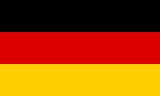
The flags of Belgium and Germany use almost the same three colors, which is a common cause of confusion. The differences are easy to spot once you know them. Belgium's stripes are vertical, with black at the hoist, and the proportions are close to a square. Germany's stripes are horizontal, with black at the top, followed by red and then gold, and the flag is 3:5. Germany's third color is a gold, and Belgium's is a yellow.
The similarity is not because one flag copied the other. Belgium's colors come from Brabant and were chosen in 1830-31. Germany's black, red and gold go back to the early 19th-century movement for a united Germany and were adopted by the Frankfurt Parliament in 1848, then by the Weimar Republic in 1919 and by West Germany in 1949. Belgium's flag is therefore older as a national flag.
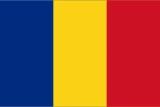
Another flag that looks similar is Romania's, a vertical tricolor of blue, yellow and red. It is the same shape of design, but with blue in place of black.
Regional flags in Belgium
Belgium is divided into communities and regions, and each of them has its own flag. Flanders flies a yellow flag with a black lion, which is the Flemish lion. Wallonia uses a yellow flag with a red rooster, and the Brussels-Capital Region has a blue flag with a yellow iris. These are not alternatives to the national flag, which is flown alongside them on public buildings.
Belgium flag facts
| Country | Belgium |
|---|---|
| Flag adopted | January 23, 1831 |
| Proportions | 13:15 |
| Colors | #FDDA25, #000000, #EF3340 |
| Flag emoji | 🇧🇪 |
| Country code | BE, BEL (ISO 3166) |
| Capital | Brussels |
| Continent | Europe |
| Population | 11,825,551 |
| Area | 30,688 km² |
| National anthem | The Brabançonne |
Belgium flag: frequently asked questions
Why are the German and Belgian flags so similar?
They use black, yellow or gold and red for unrelated reasons. Belgium took its colors from the arms of the Duchy of Brabant in 1830-31, while Germany's colors come from the 19th-century movement for national unity. The main differences are the orientation and the proportions.
Whose flag came first, Belgium or Germany?
Belgium's. Its black, yellow and red flag took its modern form in 1831. Germany's black, red and gold was used in 1848 and became the official national flag in 1919.
Do Germany and Belgium share the same flag?
No. Belgium has vertical black, yellow and red bands in a nearly square flag. Germany has horizontal black, red and gold bands in a 3:5 flag.
Is there a Flemish flag?
Yes. Flanders has its own flag, a yellow banner with a black lion with red claws and tongue. It is used by the Flemish Community and Region and is flown beside the national flag.
What did the Belgian flag look like in 1830?
In 1830 the revolutionaries hastily made a tricolor of red, yellow and black horizontal stripes on 27 August, after the Belgian Revolution began. On 23 January 1831 the stripes became vertical, and on 12 October 1831 the black band was placed at the hoist, giving the black, yellow and red flag of today. That is why the Belgium flag 1830 version looks different.
What is the difference between the Belgian and Romanian flags?
Both are vertical tricolors, but the Belgian flag is black, yellow and red with black at the hoist, in near-square 13:15 proportions. The Romanian flag is blue, yellow and red with blue at the hoist, in 2:3 proportions. Only the first band differs in color.