Flag of Portugal
The Portugal flag is divided vertically into green and red, with the national coat of arms and a golden armillary sphere where the two colors meet. It was adopted after the 1910 revolution that ended the monarchy.
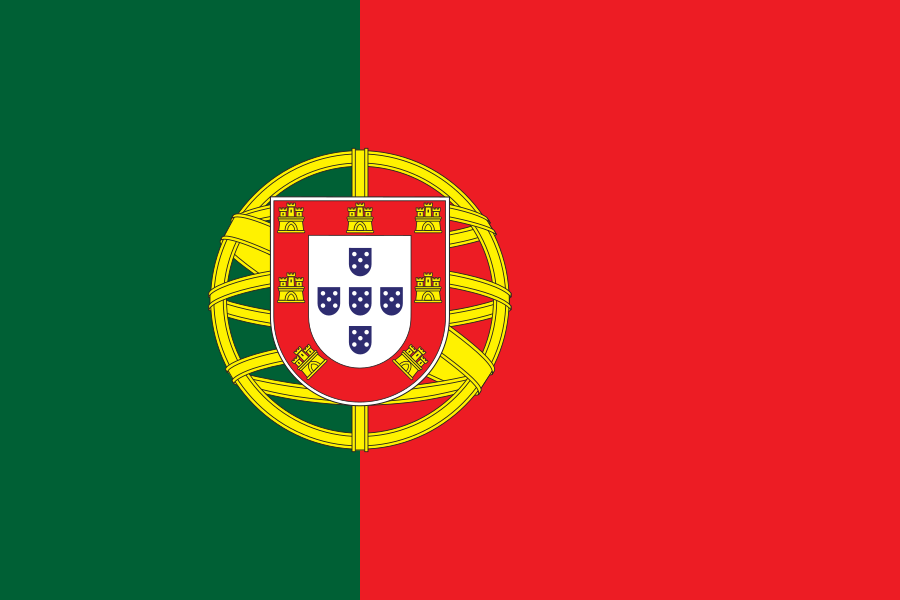
What the flag of Portugal looks like
The flag of Portugal has two vertical fields: green at the hoist, covering two-fifths of the length, and red at the fly, covering the other three-fifths. The proportion of the flag is 2:3. The emblem sits on the dividing line, centered vertically, so that it overlaps both colors.
The emblem has two parts. The background is a yellow armillary sphere, a navigational instrument made of metal rings that shows the celestial sphere. On top of it is the national shield, which is white with a red border. The border contains seven yellow castles. The inside of the shield has five small blue shields (called quinas) arranged in a cross, each carrying five white dots. The crown that topped the royal arms was dropped in 1910.
The uneven split and the armillary sphere make the flag easy to recognize. A smaller version of the same design is used for the Portugal flag emoji.
Portugal flag colors
Color codes measured from the official design. Use HEX for the web and CMYK for print.
HEX
#ED1C24RGB
237, 28, 36CMYK
0, 88, 85, 7 HEX
#006035RGB
0, 96, 53CMYK
100, 0, 45, 62 Portugal flag meaning and symbolism
The designers explained the colors in the early years of the republic. Green stood for hope, and red for the blood of those who died for the nation and for the courage and determination of the Portuguese. Neither meaning is written into law. In practice, green is also seen as a color of the republican movement, and red was the color of the revolutionary banner, which together replaced the blue and white of the old monarchy.
The armillary sphere recalls the Age of Discovery in the 15th and 16th centuries, when Portuguese sailors used it to navigate the oceans. It was a personal emblem of King Manuel I and appears on many early maps.
The shield is the older element. The five blue quinas are said to stand for the five Moorish kings defeated by Afonso Henriques in the legendary Battle of Ourique in 1139, and the white dots represent the wounds of Christ or, in another reading, the thirty pieces of silver (when the central shield is counted twice). The seven castles are linked to fortresses taken from the Moors in the south, especially in the Algarve, in the 13th century.
History of the Portuguese flag
The flag that Portugal has now is more recent than the shield on it. The kingdom's early banners showed the blue quinas on a white field, which appears from the 12th century. Over the following centuries, the royal flag added the red border with castles. By the 19th century, Portugal flew a white and blue flag with the royal coat of arms and a crown.
The monarchy fell in the revolution of 5 October 1910. A committee was appointed to design the new flag, including the painter Columbano Bordalo Pinheiro and writers such as João Chagas and Abel Botelho. Their design was approved by the Constituent Assembly and officially adopted by law on 30 June 1911. There was some debate on the colors: the republicans wanted the red and green of the revolution, while many people had loved the blue and white of the monarchy.
Since 1911 the design itself has not changed, but its details were drawn with more care in later decades. Later regulations fixed the exact shades and the geometry of the sphere and shield.
Portugal flag facts
| Country | Portugal |
|---|---|
| Flag adopted | June 30, 1911 |
| Proportions | 2:3 |
| Colors | #ED1C24, #006035 |
| Symbols | coat of arms of Portugal, field |
| Flag emoji | 🇵🇹 |
| Country code | PT, PRT (ISO 3166) |
| Capital | Lisbon |
| Continent | Europe |
| Population | 10,347,892 |
| Area | 92,225 km² |
Portugal flag: frequently asked questions
What does the symbol on the Portugal flag mean?
The armillary sphere recalls the Portuguese voyages of the Age of Discovery. The shield behind it is the old national coat of arms, with five blue quinas and seven castles.
When did Portugal change its flag?
The current flag was approved on 30 June 1911, after the 1910 revolution that overthrew the monarchy. Before that, Portugal flew a blue and white flag with the royal arms and a crown.
What do the colors of the Portuguese flag mean?
Green is explained as hope and red as the blood of those who fought for Portugal. These readings were given by the flag's designers and are not set in law.
What is the old name for Portugal?
The name comes from the Roman town of Portus Cale, near today's Porto. The area was part of the Roman province of Lusitania, and the Portuguese are still sometimes called Lusitanians.
What are the five blue shields on the flag called?
They are called quinas. According to tradition they stand for five Moorish kings defeated at Ourique in 1139. The dots on each shield are often said to represent the wounds of Christ.