Flag of San Marino
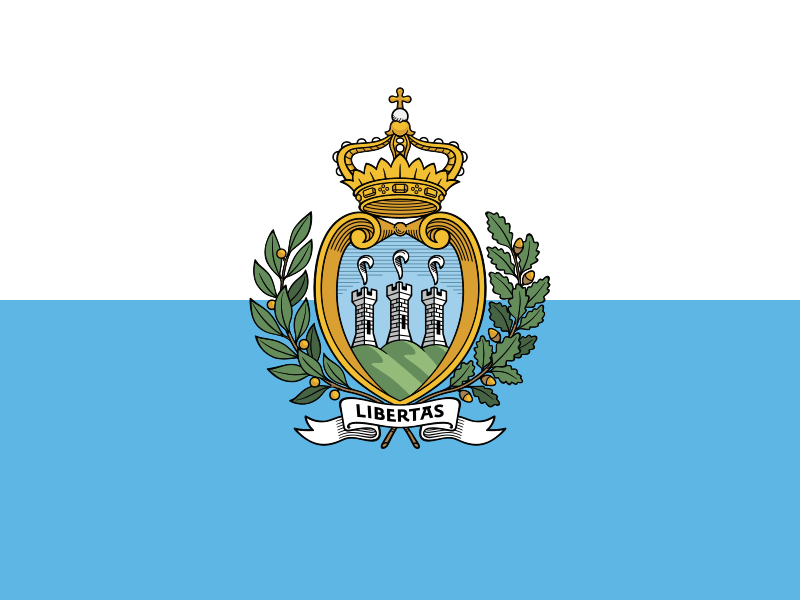
The San Marino flag has two equal horizontal bands, white over light blue, and the national coat of arms in the center. It belongs to one of the world's oldest republics, which is completely surrounded by Italy.
What the flag of San Marino looks like
The flag of San Marino is divided into two equal horizontal bands: white on top and light blue (azure) on the bottom. The proportions are 3:4. The official flag carries the national coat of arms in the center; a de facto civil flag without the coat of arms can sometimes be seen flying.
The coat of arms has a shield showing three towers on three peaks, topped by a closed crown. Around the shield is a wreath of oak and laurel, and below it is a scroll with the Latin word LIBERTAS, meaning “freedom.” You can also see the flag as the San Marino flag emoji and download it from the download page.
San Marino flag colors
Color codes measured from the official design. Use HEX for the web and CMYK for print.
HEX
#FFFFFFRGB
255, 255, 255CMYK
0, 0, 0, 0 HEX
#5EB6E4RGB
94, 182, 228CMYK
59, 20, 0, 11 HEX
#425C3CRGB
66, 92, 60CMYK
28, 0, 35, 64 San Marino flag meaning and symbolism
The two colors represent peace (white) and liberty (light blue). A popular reading also links them to the sky and clouds above Mount Titano, the mountain on which the republic is built.
The three towers on the coat of arms are the three medieval fortresses on the three peaks of Titano: Guaita (the first tower), Cesta (the second) and Montale (the third). They are the symbols of the republic's defense and independence. The word Libertas expresses the principle on which the state has always been based.
History of the San Marino flag
According to tradition, San Marino was founded in the year 301 by Saint Marinus, a stonemason who is said to have come from the island of Rab in present-day Croatia and settled on Mount Titano to escape persecution. It is regarded as one of the oldest surviving sovereign states in the world. It has its own laws and customs and is a separate country from Italy, which was only unified in 1861.
The oldest attested standard of the republic dates from 4 September 1465, and in 1797 the Supreme Council commissioned a white and blue cockade. The coat of arms was standardized by a decree of 6 April 1862, and the flag in its present form was set by the law of 22 July 2011.
San Marino stayed independent when Italy unified, and it joined the United Nations in 1992. The republic celebrates the feast of Saint Marinus on 3 September. Italy is its only neighbor; see the flag of Italy and more flags of Europe.
San Marino flag facts
| Country | San Marino |
|---|---|
| Flag adopted | 1862 |
| Proportions | 3:4 |
| Colors | #FFFFFF, #5EB6E4, #425C3C |
| Symbols | coat of arms of San Marino |
| Flag emoji | 🇸🇲 |
| Country code | SM, SMR (ISO 3166) |
| Capital | San Marino |
| Continent | Europe |
| Population | 34,167 |
| Area | 61 km² |
San Marino flag: frequently asked questions
What does the San Marino flag symbolize?
White stands for peace and light blue for liberty. The three towers on the coat of arms are the three fortresses on the mountain's peaks, and the motto Libertas means freedom.
Why is San Marino not Italy?
San Marino is a separate, independent republic that has existed since, according to tradition, the year 301. It is older than Italy. It chose to remain independent when Italy unified in the 19th century.
Where is San Marino?
San Marino is a small landlocked microstate in southern Europe. It is surrounded entirely by Italy and lies in the Apennine foothills, near Rimini and the Adriatic coast.
Which country is older, San Marino or Italy?
San Marino is much older. Its traditional founding date is 301, while the Kingdom of Italy was proclaimed in 1861.
What flag is the San Marino flag emoji?
The emoji for San Marino (SM) shows the white and light blue bicolor, usually with a very small coat of arms. See the San Marino emoji page.