Flag of Panama
The Panama flag is divided into four equal rectangles: white with a blue star at the top left, red at the top right, blue at the bottom left, and white with a red star at the bottom right. It was first raised in 1903.
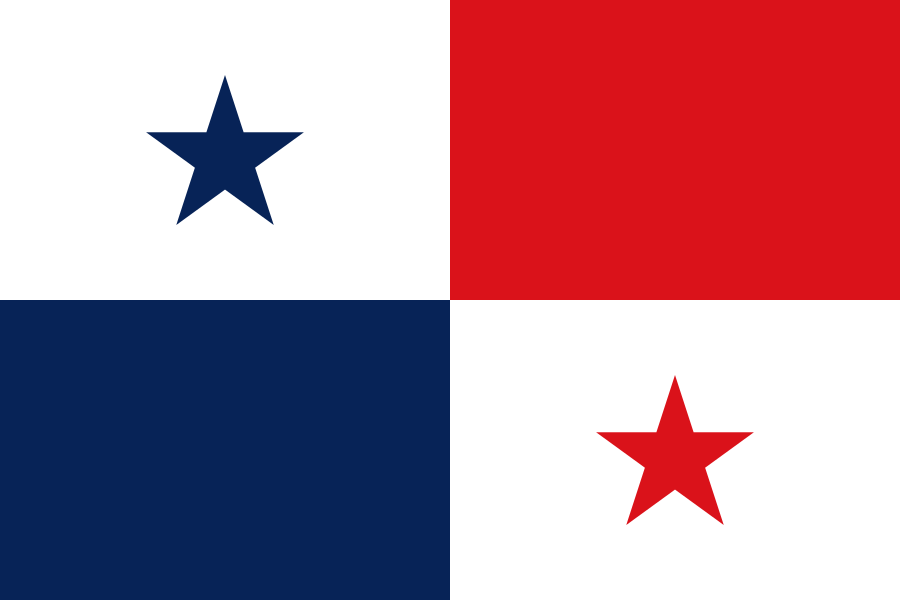
What the flag of Panama looks like
The flag of Panama is a rectangle with a ratio of 2:3, divided into four quarters of equal size. Starting from the top left, going clockwise:
- Top left (hoist): white with a blue five-pointed star.
- Top right (fly): solid red.
- Bottom right (fly): white with a red five-pointed star.
- Bottom left (hoist): solid blue.
The stars are pointed upward, and each sits in the center of its rectangle. The arrangement is checkered: the two white rectangles sit on one diagonal and the red and blue rectangles on the other.
The two stars are the same size and are each placed in the middle of their rectangle, so the design has a balanced, symmetrical look even though the colors are different. Panama's flag is also shown as the Panama flag emoji, and a version for printing is on the download page.
Panama flag colors
Color codes measured from the official design. Use HEX for the web and CMYK for print.
HEX
#FFFFFFRGB
255, 255, 255CMYK
0, 0, 0, 0 HEX
#DA121ARGB
218, 18, 26CMYK
0, 92, 88, 15 HEX
#072357RGB
7, 35, 87CMYK
92, 60, 0, 66 Panama flag meaning and symbolism
The flag's design reflects the political situation when Panama became a republic. At that time two political parties, the Conservatives and the Liberals, were the main forces in the country. The traditional meaning is:
- Blue represents the Conservative Party.
- Red represents the Liberal Party.
- White represents the peace and understanding between the two parties and the hope for a peaceful nation.
The two stars have their own meanings. The blue star is said to represent civic virtue, purity and honesty, and the red star represents authority and law in the country.
Over time many Panamanians have given the colors a more general meaning, with blue for the sea, red for the blood of the nation and white for peace. Panama's own law describes the design but does not fix a single official interpretation, so these explanations are traditional.
History of the Panama flag
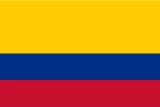
Panama was part of the Spanish Empire and then of Colombia (Gran Colombia and later New Granada and the Republic of Colombia). It declared separation from Colombia on 3 November 1903, with the support of the United States, which wanted to build a canal across the isthmus.
The flag was designed in the days around the separation. The design is credited to Manuel Encarnación Amador, the son of Manuel Amador Guerrero, who became the first president of the republic. The flag was sewn by María de la Ossa de Amador, his mother. Its first public showing took place in the first days of November 1903. A first proposal, reportedly created by the French engineer Philippe Bunau-Varilla, looked more like the American flag, with stripes, and was rejected for a more local design.
The flag was approved by the new authorities, and a law of 1925 set out the details of the design that is used today. Flag Day (Día de la Bandera) is celebrated in Panama on 4 November.
The date of the separation is a national holiday in Panama, and the flag plays a large part in the celebrations of November, known as the "patriotic month" (Mes de la Patria). Schools hold parades, and flags are flown from houses and public buildings throughout the month.
Flags that look like Panama's
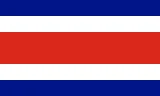
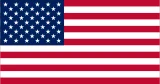
No other national flag uses the same four-quarter pattern. Panama shares its red, white and blue palette with the United States and its neighbor Costa Rica, but the layouts are different.
Panama flag facts
| Country | Panama |
|---|---|
| Flag adopted | 1925 |
| Proportions | 2:3 |
| Colors | #FFFFFF, #DA121A, #072357 |
| Symbols | field, five-pointed star |
| Flag emoji | 🇵🇦 |
| Country code | PA, PAN (ISO 3166) |
| Capital | Panama City |
| Continent | North America |
| Population | 4,570,133 |
| Area | 74,177 km² |
| Currency | United States dollar, Panamanian balboa |
| National anthem | National anthem of Panama |
Panama flag: frequently asked questions
What does the Panama flag symbolize?
Blue stands for the Conservative Party, red for the Liberal Party and white for peace between them. The blue star is said to represent honesty and purity and the red star authority and law.
Why does the Panama flag have two stars?
The stars are blue and red to match the two political parties of 1903. They are also said to stand for civic virtue and law.
Who designed the Panama flag?
Manuel Encarnación Amador, son of the first president, is credited with the design, and his mother María de la Ossa de Amador sewed the first flag in 1903.
What country did Panama originally belong to?
Panama was a Spanish colony, then a part of Gran Colombia and later of Colombia. It separated in 1903.
Did Panama change its flag?
No. Panama has used the same pattern of quarters, colors and stars since independence in 1903. A law of 1925 fixed the details of the design.
What does the Panama flag look like?
It is divided into four equal rectangles: white with a blue star, red, blue, and white with a red star. The proportions are 2:3.