Flag of the Dominican Republic
The Dominican Republic flag is divided into four rectangles by a white cross, two blue and two red, with the national coat of arms in the center. It features an open Bible on its coat of arms, and it dates back to the independence movement of 1844.
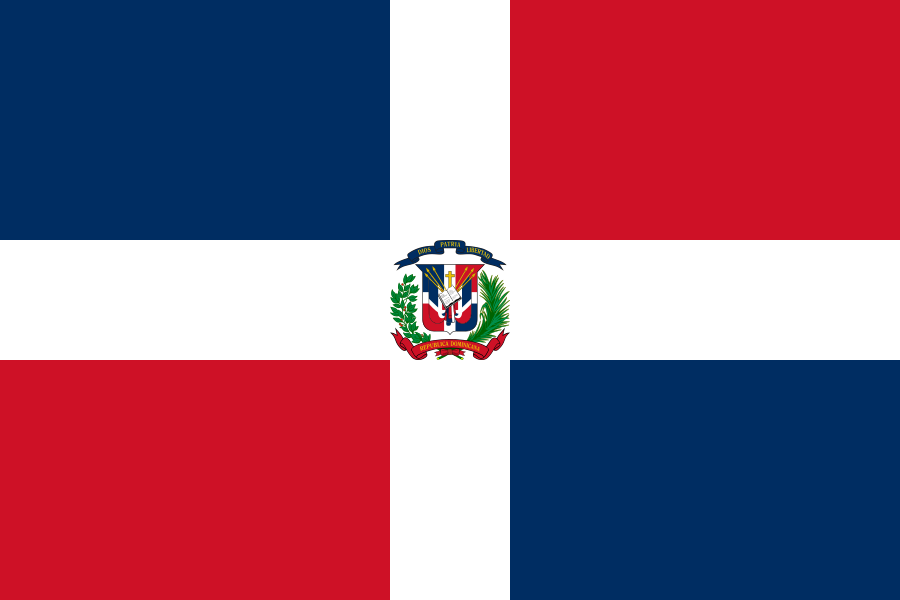
What the flag of the Dominican Republic looks like
The flag of the Dominican Republic has a large white cross that extends to the edges and divides the flag into four rectangles of equal size. The two rectangles next to the hoist are blue at the top and red at the bottom, and the two on the fly side are the other way around: red at the top and blue at the bottom. The flag's proportions are 2:3.
At the center of the cross is the national coat of arms. It is a shield in the colors of the flag, with a Bible open to John 8:31-32 and a small cross above it. Four national flags and six spears (three on each side) are displayed behind the shield. The shield is surrounded by a palm branch and a laurel branch, and above it there is a blue ribbon with the motto Dios, Patria, Libertad ("God, Fatherland, Liberty"). Below, a red ribbon reads República Dominicana.
There are two versions of the flag. The one with the coat of arms is the national flag used by the state, and the one without is the civil version used by the public. In the civil version, only the four rectangles and the white cross appear. A small image is available as the Dominican flag emoji.
Dominican Republic flag colors
Color codes measured from the official design. Use HEX for the web and CMYK for print.
HEX
#002D62RGB
0, 45, 98CMYK
100, 54, 0, 62 HEX
#CE1126RGB
206, 17, 38CMYK
0, 92, 82, 19 HEX
#FFFFFFRGB
255, 255, 255CMYK
0, 0, 0, 0 Dominican Republic flag meaning and symbolism
The usual explanation of the colors is that blue stands for liberty, white for salvation and red for the blood of heroes. Another account of the original 1844 flag says the ultramarine blue stood for God's protection over the country, the vermilion red for the blood shed by the patriots, and the white cross for the peace and unity of the Dominican people.
The open Bible on the coat of arms is the part that attracts most attention. It is open to the Gospel of John 8:31-32, which includes the line "the truth shall make you free", linking faith with the idea of freedom. The Bible and the motto reflect the Christian ideals of Duarte.
The motto "Dios, Patria, Libertad" (God, Fatherland, Liberty) appears on the coat of arms.
History of the Dominican flag
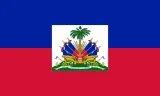
The Dominican flag was designed by Juan Pablo Duarte, the founder of the secret society La Trinitaria, which aimed to free the eastern part of the island of Hispaniola from Haitian rule. Haiti had occupied the whole island since 1822. The first design had a white cross in the center, like the regimental flags of the Kingdom of France, over a blue stripe on top and a red stripe on the bottom, as on the flag of Haiti. The first flags were made by María Trinidad Sánchez, María de Jesús Pina, Isabel Sosa and Concepción Bonó.
The flag was first hoisted on 28 February 1844, the day after the start of the Dominican War of Independence against Haiti; 27 February is Independence Day. It was replaced by the Spanish flag during the annexation to Spain from 1861 to 1865. After independence was restored, the flag was reintroduced with changes: the coat of arms was placed in the center at the intersection of the cross, and the blue and red quarters on the fly side were flipped to create the present alternating pattern.
The use of the flag is regulated by Law 210-19, and since 1962 Flag Day has been observed on 27 February, the same day as Independence Day.
How the flag is used
The Dominican flag appears on public buildings, ships and in schools. Citizens are expected to display it on national holidays such as 27 February and 16 August (Restoration Day). In times of national mourning it is first raised to the top of the pole and then lowered to half-mast. In addition to the national flag, the president has a presidential standard, and the armed forces have their own flags. The Dominican Republic is in the Caribbean, and its flag can be compared with others in the flags of the world section.
Dominican Republic flag facts
| Country | Dominican Republic |
|---|---|
| Flag adopted | November 6, 1844 |
| Proportions | 2:3 |
| Colors | #002D62, #CE1126, #FFFFFF |
| Symbols | cross, coat of arms of the Dominican Republic |
| Flag emoji | 🇩🇴 |
| Country code | DO, DOM (ISO 3166) |
| Capital | Santo Domingo |
| Continent | North America |
| Population | 10,760,028 |
| Area | 48,671 km² |
| Currency | Dominican peso |
| National anthem | National Anthem of the Dominican Republic |
Dominican Republic flag: frequently asked questions
Why does the Dominican Republic flag have a Bible on it?
The open Bible on the coat of arms reflects the Christian ideals of Juan Pablo Duarte. It is open to John 8:31-32, which includes the line "the truth shall make you free".
Why is the Dominican Republic flag unique?
Its coat of arms features an open Bible. The white cross that reaches the edges and divides the flag into four rectangles is also distinctive.
What is the symbol in the middle of the Dominican Republic flag?
It is the national coat of arms: a shield with an open Bible and a cross, flanked by flags and spears, with a palm and a laurel branch and the motto "Dios, Patria, Libertad".
Did the Dominican flag change?
Yes, slightly. The flag was first hoisted in 1844. After the Spanish annexation of 1861-65, it was reintroduced with the coat of arms in the center and the fly-side quarters flipped. The basic cross design has not changed.
How many flags does the Dominican Republic have?
It has one national flag in two forms: the state flag with the coat of arms and the plain civil flag. There are also separate flags for the president and the armed forces.
Who designed the Dominican flag?
The flag is credited to Juan Pablo Duarte, the founding father of the country. Women of the independence movement, including María Trinidad Sánchez and Concepción Bonó, sewed the first one.