Flag of Mexico
The Mexican flag is a vertical tricolor of green, white and red with the national coat of arms in the center: a golden eagle perched on a prickly pear cactus, devouring a rattlesnake. The scene comes from the Aztec founding legend of Tenochtitlan.
What the flag of Mexico looks like
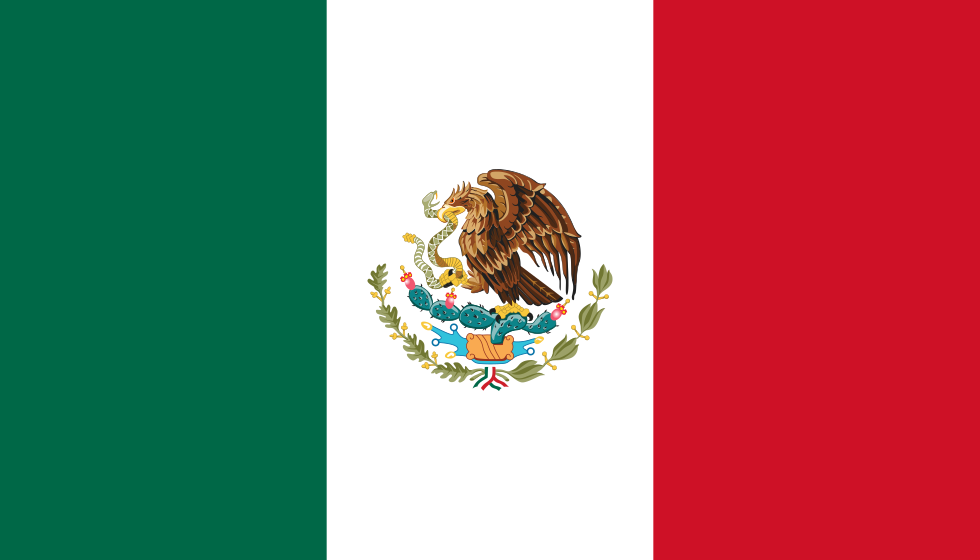
The flag of Mexico has three vertical bands of equal width: green at the hoist (the side nearest the pole), white in the middle and red at the fly. The flag is wider than most, with a width-to-height ratio of 4:7.
The national coat of arms sits in the center of the white band, taking up about three-quarters of its width. It shows a Mexican golden eagle in profile, facing left, standing on a prickly pear cactus (nopal) that grows from a rock rising out of a lake. The eagle holds a rattlesnake in its beak and in one talon. Below it, an oak branch and a laurel branch curve around the cactus and are tied together with a ribbon in the green, white and red of the flag.
Because the emblem is part of the design, the flag is easy to tell apart from the plain Italian tricolor, which has no coat of arms and a different shade of green and red. The Mexican flag is also often shown in emoji form: the Mexico flag emoji reduces it to the three bands and a small emblem.
Mexico flag colors
Color codes measured from the official design. Use HEX for the web and CMYK for print.
HEX
#006847RGB
0, 104, 71CMYK
100, 0, 32, 59 HEX
#CE1126RGB
206, 17, 38CMYK
0, 92, 82, 19 HEX
#FFFFFFRGB
255, 255, 255CMYK
0, 0, 0, 0 Mexico flag meaning and symbolism
The colors were given a religious and political meaning when they first appeared in 1821. Green stood for independence, white for the Catholic faith and purity of religion, and red for the union of Americans and Europeans in the new nation. Later governments, especially after the secular reforms of the 19th century, reinterpreted them. The version taught in Mexican schools today usually reads green as hope, white as unity and red as the blood shed by the national heroes. Mexican law describes the design of the flag in detail but does not fix an official meaning for the colors, so all of these readings are traditional.
The eagle and snake come from the story of how the Mexica (Aztec) people found their capital. According to legend, their god Huitzilopochtli told them to settle where they saw an eagle perched on a cactus. They saw it on an island in Lake Texcoco and founded Tenochtitlan, which lies under present-day Mexico City. The eagle is often read as the sun and the struggle for survival, and the snake as the enemy or the forces of the earth. Many Mexicans simply see the scene as a symbol of the nation's origin.
The oak and laurel branches are usually said to stand for strength and victory.
History of the Mexican flag
The oldest banner linked to Mexican independence is the image of the Virgin of Guadalupe that Miguel Hidalgo carried when he started the independence war in 1810. The green, white and red colors appeared in 1821 with the Ejército Trigarante (Army of the Three Guarantees), led by Agustín de Iturbide. The three guarantees were religion, independence and union.
Under Iturbide's short-lived empire (1821-1823), the flag took its vertical form and placed a crowned eagle on the white band. After the empire fell in 1823, the republic kept the colors but removed the crown and added the snake in the eagle's beak and the oak and laurel branches. During the second empire of Maximilian (1864-67) a more elaborate imperial eagle was used, with griffins on either side and eagles in the corners. The republican flag later returned, and its coat of arms was redrawn several times over the next century, so the eagle appeared in many different styles.
The version used now was adopted on 16 September 1968 as an adaptation of a design approved by presidential decree in 1916, in which the eagle was turned from front-facing to side-facing. It was confirmed by the 1984 Law on the National Arms, Flag and Anthem. Mexico celebrates Flag Day (Día de la Bandera) on 24 February.
Mexican flag vs Italian flag
Mexico and Italy use the same three colors in the same order, which causes frequent confusion. The differences are the emblem, the proportions (Italy's flag is 2:3) and the shades: Mexico uses darker shades, especially of green. The Mexican tricolor is older than the Italian one: when Mexico adopted its colors, no sovereign state in Europe used the Italian-style tricolor, although Napoleon's Cisalpine Republic had adopted a horizontal version in 1797. The similarity once caused trouble at sea, because Mexico's merchant flag had no coat of arms, so both countries later adopted naval flags with different emblems.
Flying a Mexican flag in the United States is legal. The US Flag Code asks that flags of different nations fly from separate staffs of the same height, with the American flag in the position of honor on its own right, but it is a guideline, not a law with penalties for private citizens.
Mexico flag facts
| Country | United Mexican States |
|---|---|
| Flag adopted | September 16, 1968 |
| Proportions | 4:7 |
| Colors | #006847, #CE1126, #FFFFFF |
| Symbols | Mexican coat of arms |
| Flag emoji | 🇲🇽 |
| Country code | MX, MEX (ISO 3166) |
| Capital | Mexico City |
| Continent | North America |
| Population | 132,274,416 |
| Area | 1,972,550 km² |
| Currency | peso |
| National anthem | National Anthem of Mexico |
Mexico flag: frequently asked questions
What does the Mexican flag mean?
The traditional readings are green for hope (originally independence), white for unity (originally religion) and red for the blood of national heroes (originally the union of peoples). The coat of arms shows the Aztec legend of an eagle on a cactus that marked the site of Tenochtitlan.
Why is the eagle eating a snake on the Mexican flag?
The image comes from the legend of the Mexica people, who were told to build their city where they saw an eagle on a cactus. The eagle devouring a snake became the symbol of that founding moment, and it is read as a triumph of the sun over enemies.
Why do Mexico and Italy have similar flags?
Both are green, white and red tricolors, but they developed separately. Mexico's has a coat of arms in the middle, darker shades and a 4:7 ratio, and Italy's is plain with a 2:3 ratio.
Why did Mexico change its flag?
The colors have stayed the same since 1821. Only the coat of arms changed, as governments swapped the empire's crowned eagle for a republican one, and a standard drawing was finally set in 1968.
Is it legal to fly a Mexican flag in the US?
Yes. Anyone may fly a foreign flag on private property in the United States. The US Flag Code recommends that national flags fly on separate staffs of equal height, with the American flag in the position of honor on its own right, but it carries no penalty for private citizens.
What does the Mexican flag look like today?
It has green, white and red vertical stripes of equal width and the national coat of arms on the white stripe. The flag's proportions are 4:7.