Flag of El Salvador
The El Salvador flag is a horizontal triband of blue, white and blue with the national coat of arms on the white band. It is inspired by the flag of the Federal Republic of Central America and was readopted in 1912.
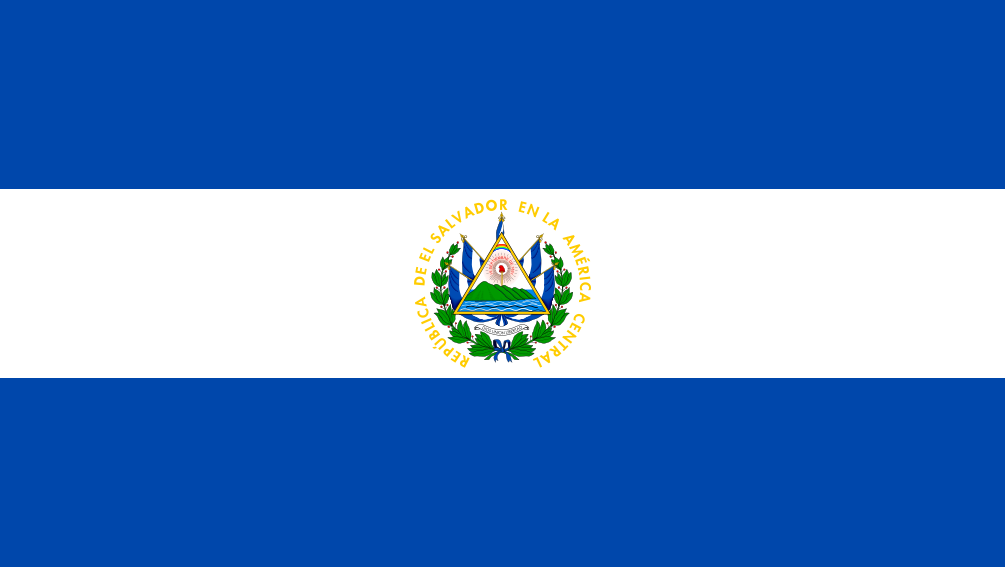
What the flag of El Salvador looks like
The flag of El Salvador has three horizontal bands of equal height. The top and bottom are blue and the middle is white. In the middle of the white band is the national coat of arms, a circular emblem contained entirely within the white stripe. The flag is wider than it is tall, with an official proportion of 189:335 (roughly 16:9).
The coat of arms shows a triangle which holds five volcanoes, a red Phrygian cap with rays of light, and a rainbow overhead. Five blue-and-white striped flags, in the colors of the old Central American federation, rise behind and beside the triangle, and a laurel wreath surrounds it. The ring around the edge has the words República de El Salvador en la América Central, and a scroll below carries the motto Dios, Unión, Libertad ("God, Union, Liberty"). The date 15 September 1821, when Central America declared independence from Spain, is written around the cap.
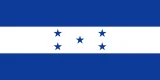
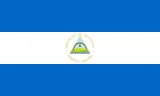
There are three official versions of the flag. The Bandera Magna, described above, is used for government sessions and national holidays. The version for public buildings and offices replaces the coat of arms with the motto "Dios, Unión, Libertad" in gold capital letters, and there is also a parade flag. The flag looks a lot like the flags of Honduras and Nicaragua. A simpler version is used for the El Salvador flag emoji.
El Salvador flag colors
Color codes measured from the official design. Use HEX for the web and CMYK for print.
HEX
#0047ABRGB
0, 71, 171CMYK
100, 58, 0, 33 HEX
#FFFFFFRGB
255, 255, 255CMYK
0, 0, 0, 0 El Salvador flag meaning and symbolism
The two blue bands symbolize the Pacific Ocean and the Atlantic Ocean. El Salvador has no coast on the Atlantic, but it is intended to represent Central America as a whole. The white band between them symbolizes peace.
In the coat of arms, the five volcanoes are the five states of the old federation: Guatemala, El Salvador, Honduras, Nicaragua and Costa Rica. The triangle is explained as the three branches of government, the Phrygian cap stands for liberty, and the rainbow is a sign of peace, which answers the question people ask about the rainbow on the flag. The five flags recall the federation, and the 14 sections of the laurel wreath stand for the country's 14 departments.
History of the El Salvador flag
El Salvador declared independence from Spain in 1821 together with the rest of Central America and joined the Federal Republic of Central America in 1823. On 20 February 1822, the Salvadoran general Manuel José Arce unveiled a blue-white-blue triband inspired by the flag of Argentina, during the war against efforts by the First Mexican Empire to annex Central America. The federation's flag was in turn inspired by it.
El Salvador used the blue-white-blue flag until 1865. A decree of that year adopted a flag of nine alternating blue and white stripes with a red canton of stars, one for each department, which resembled the flag of the United States. On 17 May 1912 the Legislative Assembly adopted the blue-white-blue triband again as the national flag, because the 1865 design resembled the U.S. flag too strongly at a time of anti-imperialist feeling in Latin America. The new flag was hoisted for the first time on 15 September 1912.
The present design of the flag is established by the Law of National Symbols of 1972.
El Salvador flag facts
| Country | El Salvador |
|---|---|
| Flag adopted | March 24, 1916 |
| Proportions | 13:23 |
| Colors | #0047AB, #FFFFFF |
| Symbols | coat of arms of El Salvador |
| Flag emoji | 🇸🇻 |
| Country code | SV, SLV (ISO 3166) |
| Capital | San Salvador |
| Continent | North America |
| Population | 6,029,976 |
| Area | 21,041 km² |
| Currency | United States dollar, Bitcoin |
| National anthem | National anthem of El Salvador |
El Salvador flag: frequently asked questions
What does the El Salvador flag symbol mean?
The coat of arms shows five volcanoes for the five states of the Central American federation, a Phrygian cap for liberty, and a rainbow for peace. The motto reads God, Union, Liberty.
When did El Salvador change its flag?
A blue-white-blue flag was unveiled in 1822 and used until 1865, when it was replaced by a striped flag with a red canton and stars. The blue-white-blue design was readopted on 17 May 1912, and the current design is set by the Law of National Symbols of 1972.
Why do El Salvador and Honduras have similar flags?
Both countries inherited the blue-white-blue design of the Federal Republic of Central America. El Salvador placed its coat of arms in the center, and Honduras chose five stars.
How many flags does El Salvador have?
There are three official versions: the Bandera Magna with the coat of arms, a version for public buildings and offices with the motto in place of the arms, and a parade flag. All use the same blue and white bands.
What flag is similar to El Salvador's?
Honduras and Nicaragua use similar bands. The flag of Argentina has similar blue and white bands as well, but with a sun in the center.
What was the original look of the flag of El Salvador?
The first flag, unveiled by General Manuel José Arce on 20 February 1822, was a blue-white-blue triband inspired by the flag of Argentina, made by his wife and sister. It was used until 1865, when an old El Salvador flag with striped bars and a red canton of stars replaced it. The triband returned in 1912.
What flag is 🇸🇻?
The 🇸🇻 emoji is the flag of El Salvador, a blue-white-blue horizontal triband, built from the regional-indicator letters S and V, the country's ISO code. Emoji use a simpler version of the flag. See the El Salvador flag emoji page.