Flag of the United States
The American flag has thirteen horizontal stripes, seven red and six white, and a blue canton with fifty white stars, one for each state. Known as the Stars and Stripes, it has had 27 official versions since 1777.
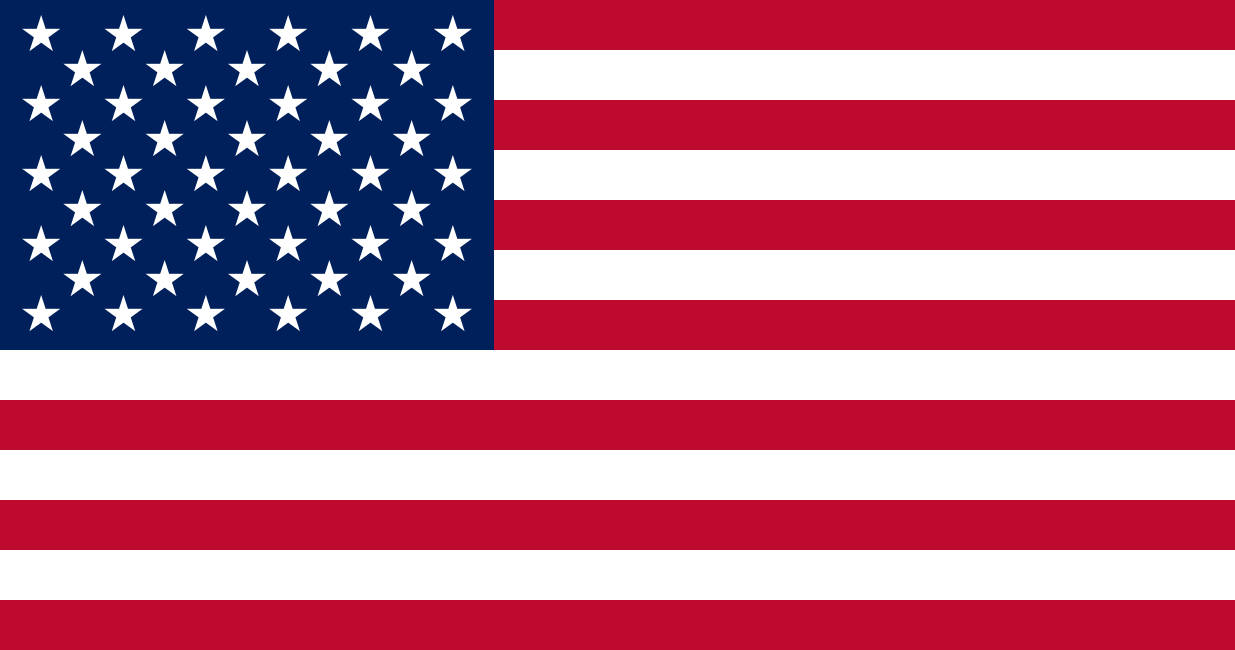
What the flag of the United States looks like
The US flag has thirteen horizontal stripes alternating red and white, starting and ending with red. In the upper left corner, the canton is a blue rectangle that extends down to the bottom of the seventh stripe. It holds fifty white five-pointed stars arranged in nine staggered rows, alternately six and five stars across. The flag is longer than most, with a height-to-length ratio of 10:19.
An executive order of 1959 sets the layout in detail, including the sizes of the canton, the stripes and the stars. The shades are fixed separately by government color standards, and the official colors are called Old Glory red and Old Glory blue. The flag is also known as the Stars and Stripes, the Star-Spangled Banner and Old Glory. For the emoji version, see the US flag emoji page.
United States flag colors
Color codes measured from the official design. Use HEX for the web and CMYK for print.
HEX
#BF0A30RGB
191, 10, 48CMYK
0, 95, 75, 25 HEX
#FFFFFFRGB
255, 255, 255CMYK
0, 0, 0, 0 HEX
#00205BRGB
0, 32, 91CMYK
100, 65, 0, 64 American flag meaning and symbolism
The thirteen stripes stand for the original thirteen colonies that declared independence from Britain, and each of the fifty stars represents a state. Thirteen stripes in total means that the top and bottom are red, which gives seven red and six white stripes.
The colors had no official meaning when the flag was created. In 1782 Charles Thomson, the secretary of Congress, described the colors of the Great Seal, not the flag: white for purity and innocence, red for hardiness and valor, and blue for vigilance, perseverance and justice. These are the meanings most often repeated for the flag today. The stars on a blue field were described in 1777 as representing a new constellation.
History of the American flag
On 14 June 1777 the Continental Congress resolved that the flag of the United States would have thirteen stripes, alternating red and white, and thirteen white stars on a blue field. This is the origin of Flag Day, observed on 14 June. Before this, the colonists used the Grand Union Flag, which combined thirteen stripes with the British Union Jack in the canton.
The identity of the designer is unclear. The story that Betsy Ross sewed the first flag at the request of George Washington is a family tradition and is not backed by firm records. Francis Hopkinson, a signer of the Declaration of Independence, is sometimes named as the designer.
As states joined the Union, the flag changed. In 1795 it was given fifteen stripes and fifteen stars, and this flag flew over Fort McHenry in 1814 and inspired the national anthem. In 1818 Congress decided to return to thirteen stripes and to add a star for each new state on the next 4 July. The current flag with fifty stars became official on 4 July 1960, after Hawaii joined in 1959. The new layout is often credited to Robert G. Heft, who made a 50-star design as a high school class project in 1958.
Rules for displaying the US flag
The US Flag Code is a set of guidelines, not a penal law. It says the flag should be displayed from sunrise to sunset unless lit at night, should not touch the ground, and should hang above other flags on the same staff. The main exception is the church pennant, which may fly above it during religious services held by naval chaplains at sea. An upside-down flag is a recognized signal of dire distress.
The flag of Puerto Rico and those of the states and territories are flown below the national flag or on separate poles. A new star is only added when a new state joins the Union, so the number of stars stays at fifty unless Congress admits another state. To see how it compares with other flags, go to flags of the world.
United States flag facts
| Country | the United States of America |
|---|---|
| Flag adopted | July 4, 1960 |
| Proportions | 10:19 |
| Colors | #BF0A30, #FFFFFF, #00205B |
| Symbols | five-pointed star, field, canton |
| Flag emoji | 🇺🇸 |
| Country code | US, USA (ISO 3166) |
| Capital | Washington, D.C. |
| Continent | North America |
| Population | 340,110,988 |
| Area | 9,826,675 km² |
| Currency | United States dollar |
| National anthem | The Star-Spangled Banner |
United States flag: frequently asked questions
How many stars are on the American flag?
There are 50 stars, one for each state. The number of stars has stayed at 50 since 1960, and it will change only if a new state joins the Union.
Why are there 7 red and 6 white stripes?
The 13 stripes stand for the original colonies. The flag begins and ends with a red stripe, so there are seven red stripes and six white ones.
What is the only flag that can fly above the US flag?
The Flag Code names the church pennant, which may be flown above the American flag during religious services conducted by naval chaplains at sea. It also allows the United Nations flag a position of prominence at UN headquarters.
What does an upside-down American flag mean?
According to the US Flag Code, an upside-down flag is a signal of dire distress in instances of extreme danger to life or property. It has also been used as a form of protest, which is a disputed practice.
Will there be a new American flag?
No change has been announced. The design is set by law and changes only when the number of states changes. The flag with 50 stars is the one in use.