Flag of Jamaica
The Jamaican flag is a gold diagonal cross (saltire) dividing the field into four triangles, green at the top and bottom and black at the hoist and fly. It is the only national flag in the world with none of red, white or blue.
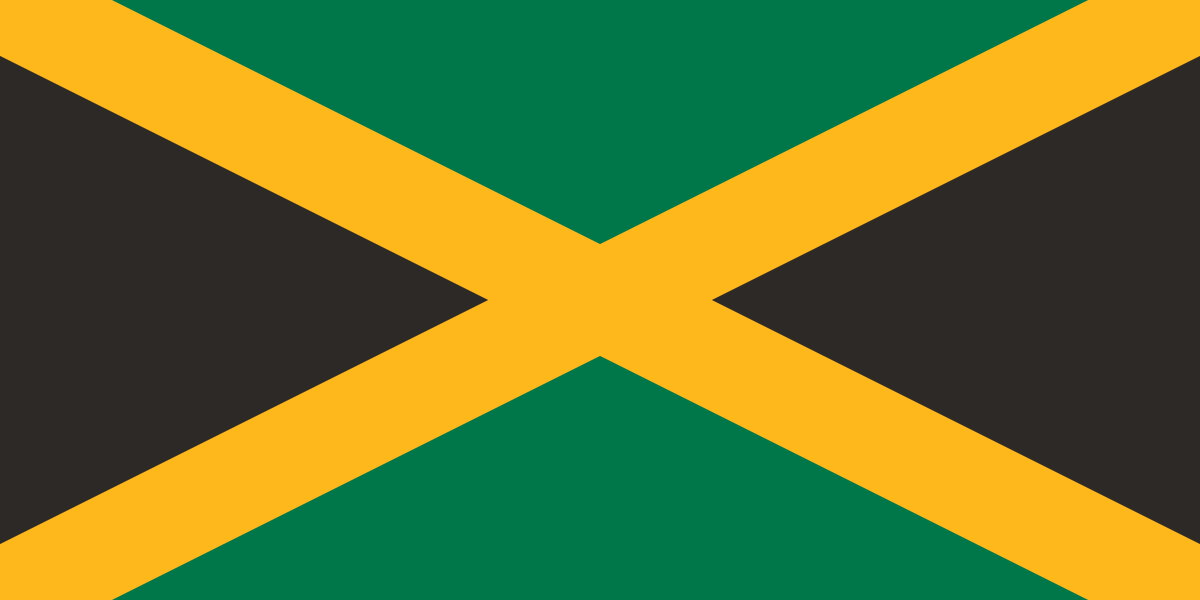
What the flag of Jamaica looks like
The flag of Jamaica is a rectangle with a width-to-height ratio of 2:1. A broad gold saltire, a diagonal cross that runs from corner to corner, divides it into four triangles. The triangles at the top and bottom are green, and the triangles at the hoist (next to the pole) and the fly (the free end) are black.
There is no coat of arms, star or other emblem on the flag. The whole design is made of the cross and four triangles, which makes it easy to recognize at a distance and to reproduce. Jamaica also has a separate coat of arms and a national motto, "Out of Many, One People", but they are not shown on the national flag.
The flag is one of the few national flags built on a diagonal cross. It is sometimes confused with the flag of Tanganyika, which had stripes in similar colors. You can also find it as the Jamaica flag emoji, or get a file from the download page.
Jamaica flag colors
Color codes measured from the official design. Use HEX for the web and CMYK for print.
HEX
#007749RGB
0, 119, 73CMYK
100, 0, 39, 53 HEX
#2D2926RGB
45, 41, 38CMYK
0, 9, 16, 82 HEX
#FFB81CRGB
255, 184, 28CMYK
0, 28, 89, 0 Jamaican flag colors and meaning
The symbolism was set out at independence in 1962. The best-known line is "Hardships there are, but the land is green, and the sun shineth." In that reading:
- Black stands for the hardships faced and overcome by the people. It is also described as the strength and creativity of the Jamaican people.
- Gold stands for the natural wealth of the island and for the sunshine.
- Green stands for hope and for the island's agricultural resources and green land.
The meanings have shifted a little since 1962. Today black is often linked to the strength and creativity of the people, gold to wealth and sunlight, and green to hope and agriculture. There is no official explanation for the saltire shape itself.
The colors should not be confused with the red, gold and green of Rastafari and reggae, which come from the Ethiopian flag. Jamaica's flag has no red, which surprises many people who expect it.
History of the Jamaican flag
Jamaica was a British colony from 1655, and before independence it flew the British Union Jack, along with a colonial flag: a blue ensign with the Jamaican badge on the right side. The badge came from the colonial coat of arms.
When independence from the United Kingdom approached in the early 1960s, the government set up a bipartisan committee of the House of Representatives to choose a national flag. A public contest drew many entries. The committee's choice was a design with horizontal stripes of green, gold and black, but it was rejected because it was too close to the flag of Tanganyika, which became Tanzania. The diagonal cross was a revision and gave a distinct flag.
The new flag was raised for the first time at midnight on 6 August 1962, when Jamaica became independent, and the Union Jack was lowered. Jamaica has used it without change ever since. A related day, Independence Day, is celebrated on 6 August, and the flag appears widely on that day and during sporting events such as the Olympics.
Facts about the Jamaican flag
- It is often said to be the only national flag without red, white or blue.
- Its saltire is one of the few diagonal crosses on a modern flag.
- Its pairing of green and gold is shared with Brazil, but the two flags look completely different.
- The flag was first raised at midnight as Jamaica became independent, and it has not changed since.
Jamaica flag facts
| Country | Jamaica |
|---|---|
| Flag adopted | August 6, 1962 |
| Proportions | 1:2 |
| Colors | #007749, #2D2926, #FFB81C |
| Symbols | saltire, field |
| Flag emoji | 🇯🇲 |
| Country code | JM, JAM (ISO 3166) |
| Capital | Kingston |
| Continent | North America |
| Population | 2,697,983 |
| Area | 10,992 km² |
| Currency | Jamaican dollar |
| National anthem | God Save the King |
Jamaica flag: frequently asked questions
What is the meaning of the Jamaican flag?
Black stands for the hardships and the strength of the people, gold for the sun and natural wealth, and green for hope and agriculture. The original wording was "Hardships there are, but the land is green, and the sun shineth."
Why does Jamaica not have red, white or blue on its flag?
The designers chose colors that represented the island's own land, sun and people rather than the British colors used on its colonial flags. Using black, green and gold made the flag clearly different from the Union Jack.
What was the old Jamaican flag?
Before 1962 Jamaica used the British Union Jack and a blue colonial ensign with a Jamaican badge. The current flag replaced them on independence day, 6 August 1962.
Are there two Jamaican flags?
No. There is one national flag. Some people confuse it with the red, gold and green Rastafari flag, which is unrelated to the official design.
Why did Jamaica change its flag?
Jamaica did not change its national flag. It adopted a new one for the first time in 1962, when it became independent from the United Kingdom and needed its own national symbol.