Flag of the Isle of Man
The Isle of Man flag is a red field with a triskelion in the center: three armored legs joined at the thigh and running in a circle. It is one of the oldest symbols still used by a government.
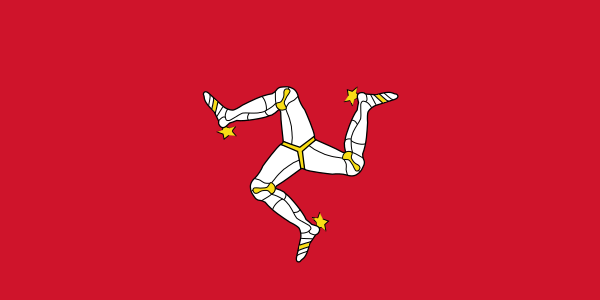
What the flag of the Isle of Man looks like
The flag of the Isle of Man is a plain red rectangle with a width-to-height ratio of 1:2. In the middle is a triskelion, the symbol of three legs. Each leg is shown in silver armor, bent at the knee, with a gold spur on the foot. The three legs are joined at the top of the thigh, and they run clockwise around the center, with the toes pointing in the same direction.
This symbol is known on the island as the Three Legs of Man, or simply the triskelion or the triskele. The same emblem is used on the island's coat of arms, on its coins and stamps, and on official documents. Since the Isle of Man is a self-governing Crown Dependency of the British Crown, it uses its own flag instead of the Union Jack for local purposes. You can see the small version on the Isle of Man flag emoji page.
Isle of Man flag colors
Color codes measured from the official design. Use HEX for the web and CMYK for print.
HEX
#CF142BRGB
207, 20, 43CMYK
0, 90, 79, 19 HEX
#FFFFFFRGB
255, 255, 255CMYK
0, 0, 0, 0 Isle of Man flag meaning and symbolism
The three legs are the central symbol of Manx identity. They are usually taken to mean that the island stands firm whichever way it is thrown, which fits the Latin motto on the coat of arms, Quocunque Jeceris Stabit: "Whichever way you throw it, it will stand". Because a triskelion has no fixed top, it looks the same whichever way it is turned.
The red background is not given an official meaning. The meanings of the legs and of the color are traditional rather than defined in law.
History of the Isle of Man flag
Triskelions are one of the oldest decorative symbols in Europe, and they appear in Celtic and Mediterranean art. The Isle of Man has a Celtic and Norse past, and from the 800s it was part of Norse kingdoms of the Irish Sea. In 1266 the island passed from Norway to Scotland, and the three legs appear in connection with Scottish rule from around the late 13th century. The arms of the island have shown the three legs ever since the Middle Ages.
Where the symbol came from is not certain. One theory ties it to Sicily, whose own emblem has three legs around the face of Medusa, and to the Norman and Angevin kings who ruled in the Mediterranean. Another suggests it came from the island itself and from older Celtic art. The flag of Italy's region of Sicily looks very similar, but it is not a national flag.
Over the centuries the island was held by Scotland, then by English nobles such as the Stanley and Atholl families, and in 1765 the British Crown bought back the rights to the island. The red flag with three legs became the island's official flag in the 1930s, and it has been flown on land since then. The Manx parliament, Tynwald, is among the oldest in the world, and the flag is raised on Tynwald Day, 5 July.
Isle of Man flag facts
| Country | Isle of Man |
|---|---|
| Flag adopted | December 4, 1971 |
| Proportions | 1:2 |
| Colors | #CF142B, #FFFFFF |
| Symbols | triskelion, field, spur, human leg |
| Flag emoji | 🇮🇲 |
| Country code | IM, IMN (ISO 3166) |
| Capital | Douglas |
| Continent | Europe |
| Population | 84,523 |
| Area | 572 km² |
| Currency | Manx pound |
| National anthem | Arrane Ashoonagh Vannin |
Isle of Man flag: frequently asked questions
Why are there three legs on the Isle of Man flag?
The three legs form a triskelion, an old symbol of movement and stability. On the Isle of Man it is said to mean that the island will stand firm however it is thrown, as in its Latin motto.
Is the Isle of Man its own country?
It is self-governing but not fully independent. The Isle of Man is a Crown Dependency of the British Crown and not part of the United Kingdom, which is responsible for its defense and foreign relations.
Why is the Isle of Man flag similar to Sicily's?
Both use a triskelion of three legs. The reason is debated. One theory links them through medieval rulers who held titles in both places, but the symbol is also found in older Celtic and Mediterranean art.
Is the Isle of Man more British or Irish?
The island sits in the Irish Sea between Great Britain and Ireland. It has its own Celtic language, Manx Gaelic, and Norse heritage, and is linked to the British Crown.
Why is the Isle of Man so famous?
It is best known for the Isle of Man TT motorcycle races, for Manx cats, and for its parliament, Tynwald, which is among the oldest in the world.