Flag of Gibraltar
The Gibraltar flag has two horizontal bands, a white one on top that is twice as wide as the red one below. A red castle with three towers stands in the center with a gold key hanging from its gate.
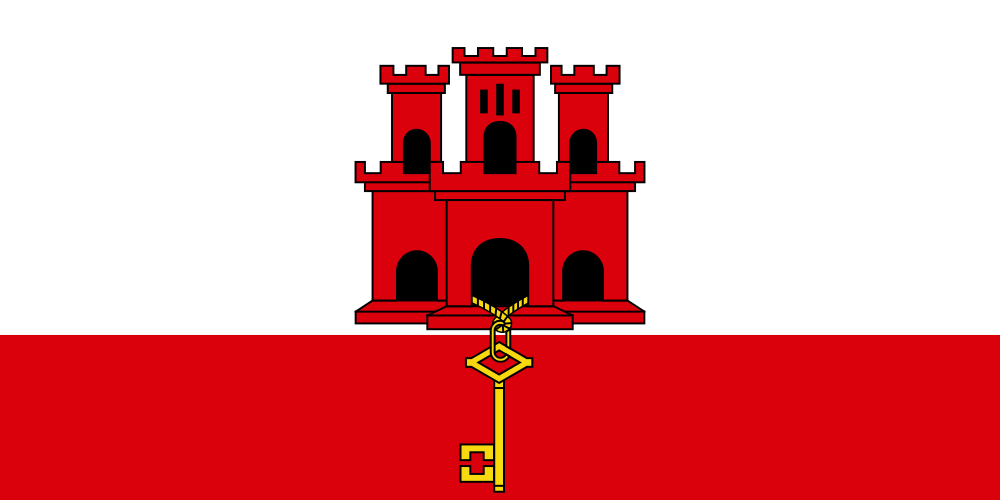
What the flag of Gibraltar looks like
The flag of Gibraltar has two horizontal bands: white on top, making up two-thirds of the height, and red below, making up one-third. The proportions are 1:2. In the middle of the flag, on the line where the bands meet, is a red castle with three towers. It has a closed gate with a gold key hanging from it.
The flag is a simplified version of the coat of arms of Gibraltar, which shows the same castle and key on a red shield. The castle is a fortress, and the key reflects the old idea of Gibraltar as the key to the Mediterranean. You can see a small version of the design in the Gibraltar flag emoji.
Gibraltar flag colors
Color codes measured from the official design. Use HEX for the web and CMYK for print.
HEX
#FFFFFFRGB
255, 255, 255CMYK
0, 0, 0, 0 HEX
#DA000CRGB
218, 0, 12CMYK
0, 100, 94, 15 HEX
#850007RGB
133, 0, 7CMYK
0, 100, 95, 48 Gibraltar flag meaning and symbolism
The flag has no official explanation for its colors, but the elements have clear sources. The castle stands for the fortress, which has been central to Gibraltar's history since the Middle Ages. The key is widely taken to show that the Rock was seen as the key to Spain and the entrance to the Mediterranean. Red and white are the colors of the arms granted in the 16th century, and are also found in many traditional heraldic designs.
The flag is usually flown with the national flag, the Union Jack, on public buildings. The Gibraltarians use it as a sign of local identity on National Day, which is held on 10 September.
History of the Gibraltar flag
The design goes back to 1502, when Isabella I of Castile granted Gibraltar a coat of arms in a royal warrant. The warrant gave the town a castle with a key, and the same arms are still used. Spain held Gibraltar until 1704, when it was captured by an Anglo-Dutch force during the War of the Spanish Succession. Spain ceded it to Great Britain in the Treaty of Utrecht in 1713.
For most of its history as a British territory, the main flags on the Rock were British flags. The castle and key flag was used locally for years, and it was officially adopted as the flag of Gibraltar on 8 November 1982. The government also uses a blue ensign with the arms, and the governor has a separate flag.
Gibraltar is a British overseas territory, and Spain maintains a claim to it. In referendums in 1967 and 2002, voters in Gibraltar chose by large majorities to stay under British sovereignty. See also the flag of Spain and the flag of the United Kingdom.
Gibraltar flag facts
| Country | Gibraltar |
|---|---|
| Flag adopted | 1982 |
| Proportions | 1:2 |
| Colors | #FFFFFF, #DA000C, #850007 |
| Flag emoji | 🇬🇮 |
| Country code | GI, GIB (ISO 3166) |
| Capital | Gibraltar |
| Continent | Europe |
| Population | 34,003 |
| Area | 7 km² |
| Currency | Gibraltar pound |
| National anthem | God Save the King |
Gibraltar flag: frequently asked questions
What is on the Gibraltar flag?
It has a white band over a red band, with a red three-towered castle and a gold key hanging from the gate. The castle and key come from the coat of arms of Gibraltar.
Does Gibraltar have its own flag?
Yes. Gibraltar has used the castle and key flag since its official adoption in 1982, and it is flown alongside the Union Jack.
Is Gibraltar part of the UK or Spain?
Gibraltar is a British overseas territory. It has been under British sovereignty since 1713, but Spain claims it. It is not part of the United Kingdom itself.
Are Gibraltarians Spanish or British?
Gibraltarians hold British nationality. They have their own identity and speak English, and many also speak Spanish.
What is 🇬🇮?
The emoji 🇬🇮 shows the flag of Gibraltar, with the white and red bands and the castle and key.