Flag of China
The China flag is a plain red field with five yellow stars in the upper hoist corner: one large star and an arc of four smaller ones. Known as the Five-starred Red Flag, it was adopted by the People's Republic of China in 1949.
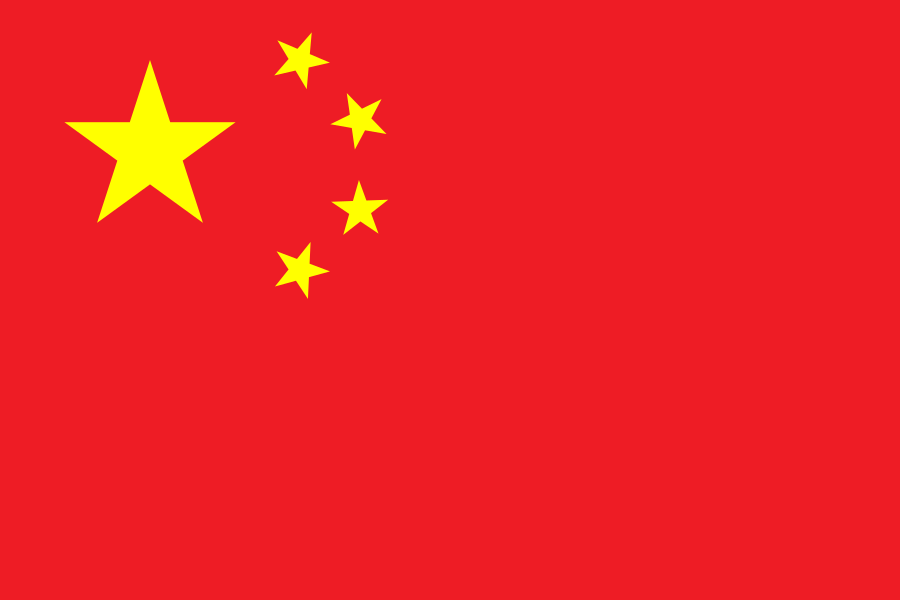
What the flag of China looks like
The flag of the People's Republic of China is a red rectangle with a proportion of 2:3. In the upper left corner, near the hoist, there is one large yellow five-pointed star and four smaller ones. The four small stars form an arc to the right of the large star, and each of them is turned so that one point faces the center of the large star.
The red covers almost all of the flag, and the yellow of the stars is the only contrast. In Chinese it is called Wǔxīng Hóngqí (五星红旗), the Five-starred Red Flag. See the China flag emoji page for the small version.
China flag colors
Color codes measured from the official design. Use HEX for the web and CMYK for print.
HEX
#EE1C25RGB
238, 28, 37CMYK
0, 88, 84, 7 HEX
#FFFF00RGB
255, 255, 0CMYK
0, 0, 100, 0 Chinese flag meaning and symbolism
The red field stands for the communist revolution. Yellow is used for the stars to stand out against the red, and it is also a traditional imperial color in China, though the official explanation concentrates on the brightness of the stars on a red background.
The official reading of the stars comes from the founding of the state in 1949. The large star represents the Communist Party of China and its leadership. The four small stars stand for the social classes of the people as described in Mao Zedong's writings: the workers, the peasants, the urban petty bourgeoisie and the national bourgeoisie. The arrangement, with the small stars turned toward the big one, is supposed to show the unity of the people under the party's leadership.
History of the Chinese flag
The last imperial dynasty, the Qing, used a yellow flag with a blue dragon chasing a red pearl. After the 1911 revolution the new Republic of China adopted the Five-Colored Flag in 1912, with horizontal stripes of red, yellow, blue, white and black, standing for the five main peoples of the nation (Han, Manchu, Mongol, Hui and Tibetan). In 1928 the Nationalist government replaced it with the flag of a white sun on a blue sky over a red field, which is still the flag of the Republic of China, governed from Taipei.
In 1949 the Chinese People's Political Consultative Conference invited the public to submit designs for the flag of the new state. More than 2,900 proposals were received. The winning design was by Zeng Liansong, an economist from Zhejiang province. His first version had a hammer and sickle inside the large star, but that was removed in the final version. The flag was formally adopted on 27 September 1949 and was first raised in Tiananmen Square on 1 October, when Mao Zedong proclaimed the People's Republic.
The flag has not been changed since. Hong Kong and Macau, as special administrative regions, have their own regional flags, which are flown alongside the national flag.
People's Republic of China vs Republic of China
People searching for the Chinese flag may find two different flags. The People's Republic of China (PRC), with its capital in Beijing, uses the red flag with five yellow stars described above. The Republic of China (ROC), governed from Taipei, uses a red flag with a blue canton and a white sun. The two governments have competing claims, and countries and international bodies treat the question differently. This page describes the flag of the PRC, which is the one used by the UN seat for China.
More flags from Asia can be found on the flags of the world page, and a similar red flag with a yellow star is used by Vietnam.
China flag facts
| Country | China |
|---|---|
| Flag adopted | September 27, 1949 |
| Proportions | 2:3 |
| Colors | #EE1C25, #FFFF00 |
| Symbols | five-pointed star, field |
| Flag emoji | 🇨🇳 |
| Country code | CN, CHN (ISO 3166) |
| Capital | Beijing |
| Continent | Asia |
| Population | 1,404,890,000 |
| Area | 9,596,961 km² |
| Currency | renminbi |
| National anthem | March of the Volunteers |
China flag: frequently asked questions
What does the Chinese flag mean?
The red represents the revolution. The large star stands for the Communist Party and the four smaller stars for the four social classes named in Mao's writings: workers, peasants, the petty bourgeoisie and the national bourgeoisie.
Who designed the Chinese flag?
Zeng Liansong, an economist from Zhejiang, designed it. His proposal was chosen in 1949 from several thousand submissions, and the hammer and sickle on the large star was removed.
Why did the Republic of China flag change?
The Qing dragon flag was replaced in 1912 by the Five-Colored Flag, and in 1928 the Nationalists adopted the blue sky, white sun design. The People's Republic then created a new flag in 1949 after the Communist victory.
What is the difference between China and the Republic of China?
China usually refers to the People's Republic of China, governed from Beijing. The Republic of China is the official name of the government in Taipei, which uses a different flag.
Are there other flags used in China?
Yes. Hong Kong and Macau, special administrative regions, have their own flags. Hong Kong's flag shows a white bauhinia flower on red, and Macau's shows a lotus flower on green.
Flags that look like the China flag
Flags of neighboring countries
 Afghanistan
  Bhutan
  India
India  Japan
Japan  Kyrgyzstan
  North Korea
  South Korea
  Kazakhstan
  Laos
Laos  Myanmar
  Mongolia
  Nepal
Nepal  Pakistan
  Russia
  Tajikistan
  Vietnam