Flag of Mongolia
The Mongolia flag is a vertical triband of red, blue and red, with the golden Soyombo symbol on the left red band. The blue stripe stands for the eternal sky, and the Soyombo, created in 1686, is a symbol of the Mongolian nation and its independence.
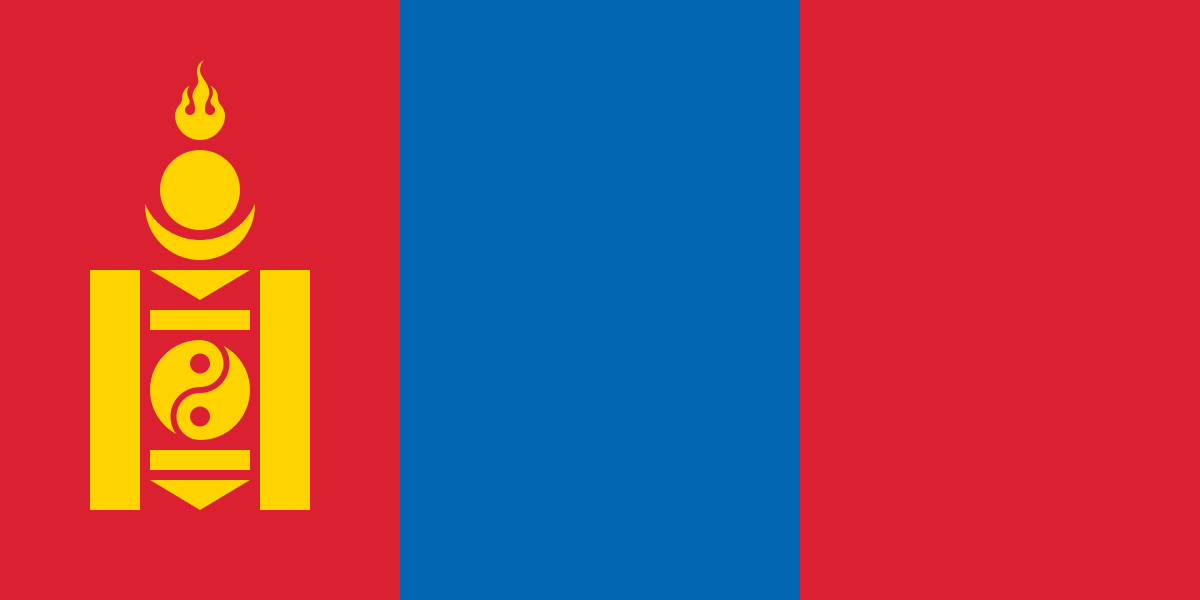
What the flag of Mongolia looks like
The Mongolian flag has three vertical stripes of equal width: red, blue and red. A golden-yellow symbol called the Soyombo is placed on the red stripe at the hoist. The flag's ratio is 1:2.
The Soyombo is made of several parts, stacked from top to bottom: a flame, the sun and a crescent moon, two triangles pointing down, a yin-yang circle, and two upright rectangles on either side of it, joined by horizontal bars at the top and the bottom. The symbol is drawn in the style of the Soyombo script, an alphabet which is said to have been created by the monk and scholar Zanabazar in 1686. The Mongolia flag emoji shows the flag in a simplified form.
Mongolia flag colors
Color codes measured from the official design. Use HEX for the web and CMYK for print.
HEX
#DA2031RGB
218, 32, 49CMYK
0, 85, 78, 15 HEX
#0066B2RGB
0, 102, 178CMYK
100, 43, 0, 30 HEX
#FFD300RGB
255, 211, 0CMYK
0, 17, 100, 0 Mongolia flag meaning and symbolism
Blue is the color of the sky, which has a sacred place in Mongolian tradition: the Mongols are often described as the people of the "eternal blue sky" (Mönkh Kök Tengri). Red is commonly said to stand for progress and prosperity.
The parts of the Soyombo have several traditional readings:
- Flame: rebirth, growth and the continuing life of the family and the nation, with three tongues for past, present and future
- Sun and moon: the origin of all life, and the eternity of the Mongol people
- Two triangles: arrows or spears pointing down, a symbol of the defeat of enemies
- Yin-yang: the harmony of opposites, such as day and night, or male and female
- Two rectangles: honesty and justice, and also the strength of a fortress wall
As with many flags, these meanings are traditional, and sources differ on some of the details.
History of the Mongolian flag
The Mongol Empire of the 13th century used banners made of horse hair, known as tug. A white one is said to have been used in peacetime and a black one in war. These were standards of the khans, not national flags in the modern sense.
The Soyombo became a national emblem after Mongolia declared independence from the Qing dynasty in 1911, when the theocratic Bogd Khanate used it on its banners. After a revolution in 1921, a communist-led government was formed, and the Mongolian People's Republic was proclaimed in 1924. Its flags were red and carried the Soyombo, and from 1940 the flag was a red-blue-red triband with a golden Soyombo and a yellow star above it. Mongolia was a close ally of the Soviet Union, and the star was a sign of communism.
After the democratic revolution of 1990 the star was removed. The present flag was adopted on 12 February 1992, together with the new constitution, and the Soyombo kept its place as the main national emblem.
Mongolia and Inner Mongolia
Mongolia is an independent country between Russia and China. Inner Mongolia is a different place: an autonomous region of China, with its own regional flag. The two should not be mixed up, and the flag on this page belongs to the state of Mongolia only. See also the flags of Asia.
Mongolia flag facts
| Country | Mongolia |
|---|---|
| Flag adopted | February 12, 1992 |
| Proportions | 1:2 |
| Colors | #DA2031, #0066B2, #FFD300 |
| Symbols | field, Soyombo symbol, pale |
| Flag emoji | 🇲🇳 |
| Country code | MN, MNG (ISO 3166) |
| Capital | Ulaanbaatar |
| Continent | Asia |
| Population | 3,409,939 |
| Area | 1,564,116 km² |
| Currency | Mongolian tögrög |
| National anthem | National anthem of Mongolia |
Mongolia flag: frequently asked questions
What does the symbol on the Mongolian flag mean?
The golden symbol is the Soyombo. It combines a flame, the sun and moon, two triangles, a yin-yang circle and two rectangles, standing for the continuity of the nation, the defeat of enemies, harmony, honesty and justice.
Why did Mongolia change its flag?
After the end of communist rule in 1990, the Soviet-style star above the Soyombo was removed. The present flag was adopted on 12 February 1992.
What colors are in the Mongolian flag?
Red, blue and gold. Red stands for progress and prosperity, blue for the eternal sky, and gold for the Soyombo.
Is Mongolia part of China or Russia?
Neither. Mongolia is an independent country located between them. Inner Mongolia, by contrast, is a region of China.
What did the Mongols call their empire?
The Mongol Empire was called the Yeke Mongghol Ulus, or "Great Mongol State". It was founded by Genghis Khan in 1206.