Flag of South Korea
The South Korean flag, called the Taegukgi, is white with a red and blue yin-yang circle (the taegeuk) in the center and a black trigram in each corner. It expresses ideas of balance and harmony in the universe.
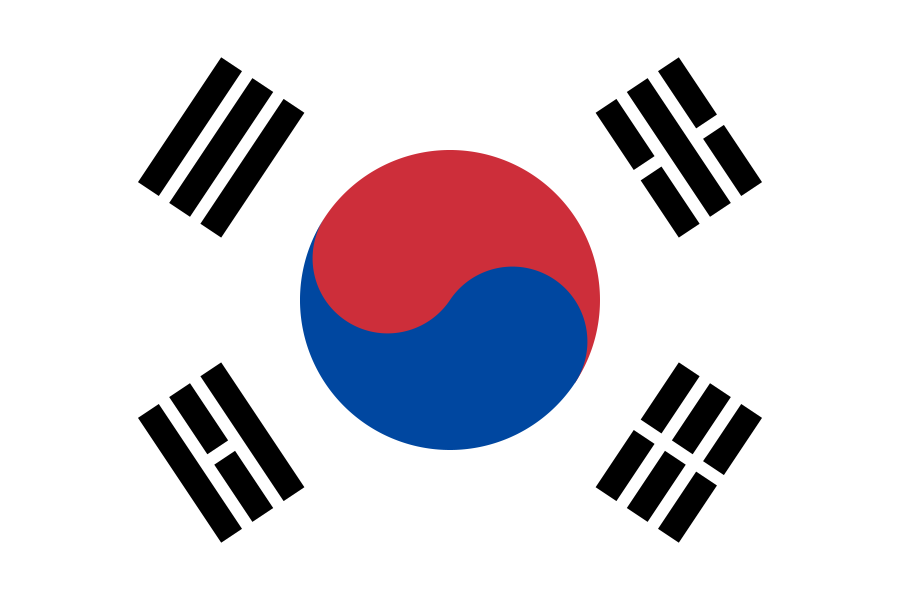
What the flag of South Korea looks like
The flag of South Korea has a white rectangle with a ratio of 2:3. In the center is a circle, the taegeuk, divided by an S-shaped curve into a red half on top and a blue half at the bottom. Around it, one in each corner, are four black trigrams, each made of three bars that are either solid or broken in the middle.
The four trigrams are placed as follows:
- Top left: three solid bars, geon (heaven).
- Bottom right: three broken bars, gon (earth).
- Top right: broken, solid, broken bars, gam (water).
- Bottom left: solid, broken, solid bars, ri (fire).
The trigrams come from the older set of eight trigrams used in the Chinese I Ching (Book of Changes), and the flag uses four of them. The flag's design is described in detail by Korean law, including the exact size of the circle and the placement of the trigrams. The design also appears in the South Korea flag emoji.
South Korea flag colors
Color codes measured from the official design. Use HEX for the web and CMYK for print.
HEX
#FFFFFFRGB
255, 255, 255CMYK
0, 0, 0, 0 HEX
#000000RGB
0, 0, 0CMYK
0, 0, 0, 100 HEX
#CD2E3ARGB
205, 46, 58CMYK
0, 78, 72, 20 HEX
#0047A0RGB
0, 71, 160CMYK
100, 56, 0, 37 South Korean flag meaning and symbolism
The flag is based on East Asian philosophy. The white background stands for peace and purity, and the long tradition of white clothing in Korea. The taegeuk in the center represents the balance of opposing forces in the universe: red is the positive, active force (yang), and blue is the negative, passive force (yin). Together they show that harmony comes from the interaction of opposites, and that everything in nature is in constant motion.
The four trigrams are often said to represent heaven, earth, fire and water. They are also linked in popular teaching with the virtues of justice, wisdom, fertility and intelligence, and with the seasons and the four cardinal directions. These readings are traditional, and various explanations exist.
The overall idea of the flag is that the nation is part of the cosmos and follows its principles of balance and change. This is why people often say the Korean flag is a flag of philosophy, not of heraldry.
History of the South Korean flag
The earliest versions of the taegeuk flag were designed in the early 1880s, when Korea (then ruled by the Joseon dynasty) needed a national flag for diplomatic missions. A version with the taegeuk and trigrams was used in 1882, and King Gojong proclaimed a version as the national flag in January 1883. The flag was used until Japan annexed Korea in 1910, after which it was banned.
During Japanese rule the flag became a symbol of resistance. It was carried in the March 1st Movement of 1919, and it was used by the Provisional Government of the Republic of Korea, which operated in exile in China. Different versions of the flag appeared, with varying shapes of the circle and trigram positions.
After the end of Japanese rule in 1945 and the division of Korea, the flag was adopted by the Republic of Korea, established in 1948. The government officially standardized the design in 1949, and the specifications for sizes and colors were updated later, most recently in the late 20th century. North Korea chose a different design.
North and South Korea flags
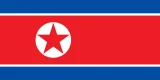
Do North and South Korea have different flags? Yes. North Korea uses a red flag with a white-edged blue stripe at the top and bottom and a red star in a white disk. South Korea kept the older Taegukgi. For events where both teams take part together, such as some sports competitions, a separate unification flag has been used: white, with a blue silhouette of the whole Korean peninsula.
Since the Korean War ended with an armistice in 1953 and not a peace treaty, the two states remain technically at war, which is why the question of which flag represents Korea is more than a design question.
South Korea flag facts
| Country | Republic of Korea |
|---|---|
| Flag adopted | October 15, 1949 |
| Proportions | 2:3 |
| Colors | #FFFFFF, #000000, #CD2E3A, #0047A0 |
| Symbols | eight trigrams, field, Taegeuk |
| Flag emoji | 🇰🇷 |
| Country code | KR, KOR (ISO 3166) |
| Capital | Seoul |
| Continent | Asia |
| Population | 51,466,201 |
| Area | 100,295 km² |
| Currency | Korean mun, won |
| National anthem | Aegukga |
South Korea flag: frequently asked questions
Why is Korea's flag red and blue?
The red and blue halves of the circle represent yang and yin, the positive and negative forces of the universe. They show balance and harmony.
What are the symbols on the South Korean flag?
The center circle is the taegeuk, and the four black trigrams in the corners stand for heaven, earth, fire and water. The white background represents peace.
What was Korea's original flag?
The first official version of the Taegukgi was proclaimed by King Gojong in 1883, following designs from 1882. It had a similar circle and trigrams, but with different positions and proportions.
Do North and South Korea have different flags?
Yes. South Korea uses the white Taegukgi, while North Korea uses a red flag with blue and white stripes and a red star in a white disk. A unification flag showing the peninsula is used at joint events.
What is the correct South Korean flag?
The correct flag has the red half of the circle on top, the blue half below, and the trigrams arranged with heaven at top left and earth at bottom right. Reversed or rotated versions are common mistakes.