Flag of North Korea
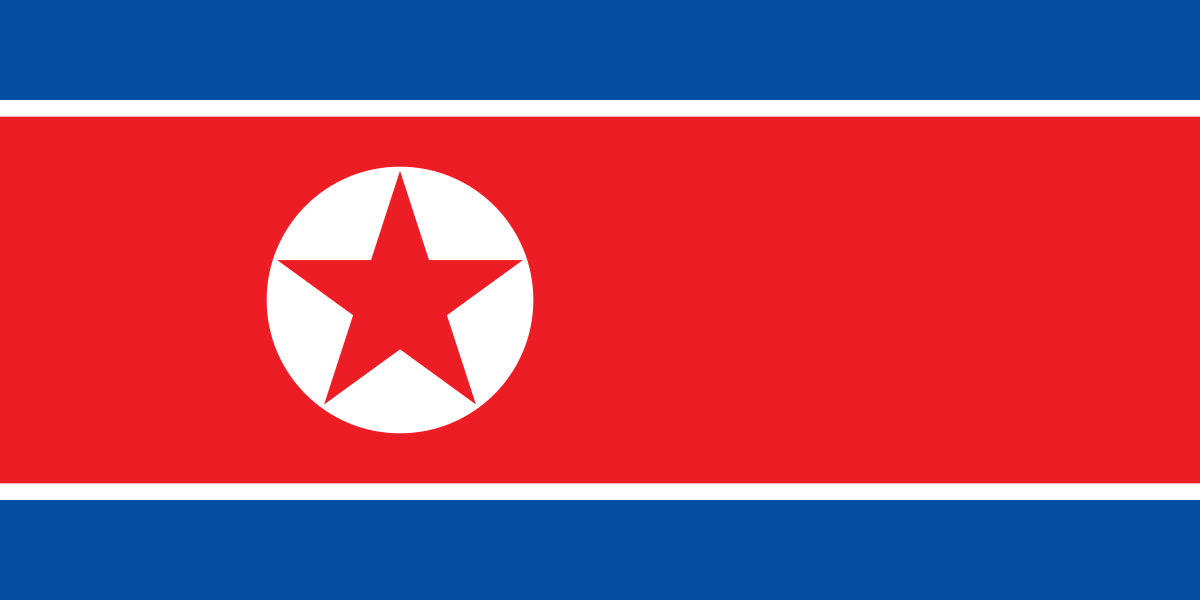
The North Korea flag has a wide red central band with a red five-pointed star inside a white disc near the hoist. Thin white lines separate the red band from blue stripes at the top and bottom. It has been in use since 1948.
What the flag of North Korea looks like
The flag of North Korea, officially the flag of the Democratic People's Republic of Korea (DPRK), is a horizontal design with a width-to-height ratio of 1:2. It is built from five stripes. A wide red band fills the middle. Above and below it sit narrow white stripes, and outside those are two blue stripes along the top and bottom edges.
On the red band, a bit closer to the hoist (the side nearest the flagpole) than to the center, is a white circle. Inside the circle is a red five-pointed star with one point facing up. The red band takes up about half of the flag's height, which is why red is the dominant color in any picture of it.
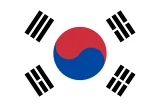
The design is clearly different from the flag of its southern neighbor. The South Korean flag is white with a red and blue taegeuk in the center and four black trigrams in the corners. If you are looking for the small icon version, see the North Korea flag emoji, which shows the same blue, white and red bands and the star in the circle.
North Korea flag colors
Color codes measured from the official design. Use HEX for the web and CMYK for print.
HEX
#EC1D25RGB
236, 29, 37CMYK
0, 88, 84, 7 HEX
#034DA2RGB
3, 77, 162CMYK
98, 52, 0, 36 HEX
#FFFFFFRGB
255, 255, 255CMYK
0, 0, 0, 0 North Korea flag meaning and symbolism
The meanings given for the flag come from North Korean official sources and are repeated by most reference works. They are not written into a single legal definition of the colors, so treat them as the usual explanations.
- Red stands for patriotism, and for the blood shed by Koreans in the revolutionary struggle against Japanese rule.
- Blue is said to represent sovereignty, peace and friendship, and the aspiration of the Korean people to unite with others in the cause of peace.
- White stands for purity, strength and dignity, and for the idea of a single Korean nation with a long history.
- The red star is the symbol of socialism and of the revolutionary tradition. It is often described as the guiding light of the state.
- The white circle around the star is sometimes explained as a symbol of the nation's unity and purity.
Red, white and blue are also common colors in other flags, but here the choice reflects the political message of the state after 1945 rather than a link to older Korean symbols. Traditional Korean banners used white and the taegeuk (yin-yang) symbol, which the North dropped in its national flag.
History of the North Korean flag
Korea was ruled by Japan from 1910 to 1945. Before that, the kingdom and later empire flew the white Taegukgi with the taegeuk and trigrams, which is the ancestor of the South Korean flag today. After Japan's defeat in 1945, the peninsula was split at the 38th parallel into a Soviet zone in the north and a US zone in the south. At first the Taegukgi was used in the north as well.
As the northern administration moved toward its own state, it wanted a flag with a clear socialist message and without the traditional symbols. The new flag was approved in 1948 and officially adopted on 8 September 1948, when the Democratic People's Republic of Korea was proclaimed. Official accounts credit Kim Il Sung, the first leader, with the final design, although some historians point to Soviet influence on the choice of red, white and blue and the red star.
The flag has kept the same basic design since then. North Korea marks 9 September as its Foundation Day. The flag is hung in public buildings, schools and at most official events, and it is treated with strict ceremony.
North Korea and South Korea flags
The two Koreas do not share a flag, and their national flags look nothing alike. The northern flag is red, white and blue with a star, and the southern one is white with a taegeuk. Both governments claim to represent the whole of Korea, and the war that began in 1950 ended with an armistice in 1953 rather than a peace treaty, so the conflict has never been formally ended.
When teams from both countries have marched together, for example at the Sydney Olympics in 2000 and the Pyeongchang Winter Olympics in 2018, they carried a special Korean unification flag. It shows a pale blue outline of the whole Korean Peninsula on a white field. It is used in sport and at some joint events and is not the flag of either state. You can find a gallery of other national flags at flags of the world.
North Korea flag facts
| Country | North Korea |
|---|---|
| Flag adopted | September 8, 1948 |
| Proportions | 1:2 |
| Colors | #EC1D25, #034DA2, #FFFFFF |
| Symbols | field, five-pointed star, roundel, fess, fimbriation |
| Flag emoji | 🇰🇵 |
| Country code | KP, PRK (ISO 3166) |
| Capital | Pyongyang |
| Continent | Asia |
| Population | 26,418,204 |
| Area | 120,540 km² |
| Currency | North Korean won |
| National anthem | Aegukka |
North Korea flag: frequently asked questions
What does the North Korean flag symbolize?
Red is said to stand for patriotism and the blood of revolutionary fighters, white for purity and strength, and blue for sovereignty, peace and friendship. The red star in the white circle represents socialism and the revolutionary tradition.
Do North and South Korea share a flag?
No. North Korea uses a red, white and blue flag with a red star, and South Korea uses the white Taegukgi with a red and blue circle and four black trigrams. A separate unification flag showing the peninsula has been used only at joint sports events.
What does the North Korean flag look like?
It has a wide red band in the center, edged with thin white lines, between blue stripes at the top and bottom. A white disc with a red five-pointed star sits on the red band, nearer to the hoist. The ratio is 1:2.
When was the North Korean flag adopted?
The current flag was adopted on 8 September 1948, when the Democratic People's Republic of Korea was established. Its basic design has not changed since.
What will the North Korean flag look like in 2026?
There is no sign of a redesign. The flag remains the same red, white and blue design with the red star that has been used since 1948.
What war never officially ended?
The Korean War (1950-53) ended with an armistice, not a peace treaty. That is why North and South Korea are technically still at war.