Flag of Japan
The Japan flag is a white rectangle with a large red disc in the center. Known as the Nisshoki or Hinomaru ("circle of the sun"), it stands for the sun, which is central to Japan's name, "land of the rising sun".
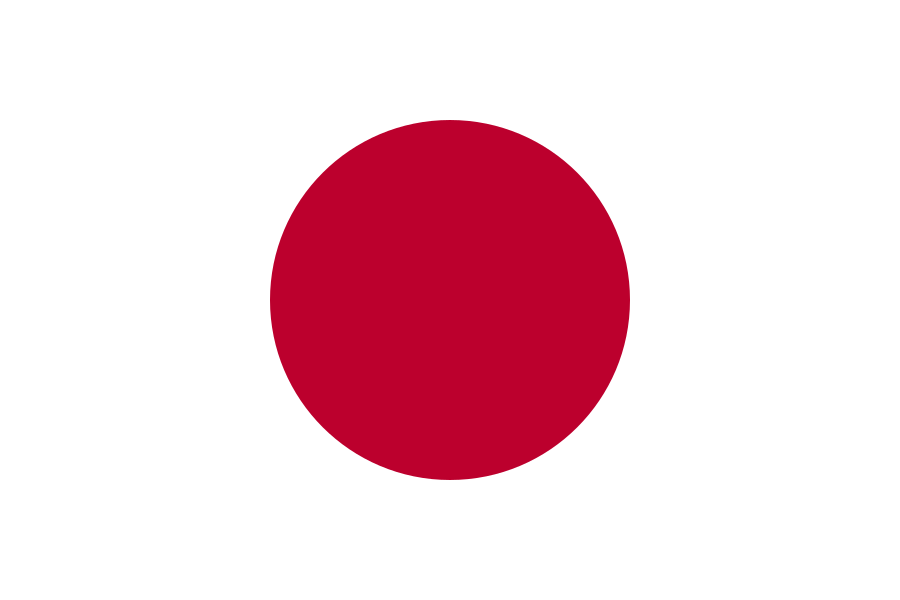
What the flag of Japan looks like
The flag of Japan has a plain white field with a single crimson-red disc. The proportions are 2:3, and the diameter of the disc is three-fifths of the height of the flag. The disc is placed exactly in the center. The 1870 rules placed the disc slightly toward the hoist, and the 1999 law moved it to the exact center.
It is one of the simplest national flags, with no text, emblems or stripes. In Japan the flag is called Nisshoki ("sun-mark flag") in its formal name and Hinomaru in everyday speech. Many people learn to draw it as a child. The Japan flag emoji follows the same design, and you can find print-ready files on the Japan flag download page.
Japan flag colors
Color codes measured from the official design. Use HEX for the web and CMYK for print.
HEX
#FFFFFFRGB
255, 255, 255CMYK
0, 0, 0, 0 HEX
#BC002DRGB
188, 0, 45CMYK
0, 100, 76, 26 Japan flag meaning and symbolism
The red disc is the sun. The sun has long held a central place in Japanese culture and religion. The imperial family is traditionally linked with the sun goddess Amaterasu in Shinto mythology, and the name Nippon (or Nihon) is written with characters that mean "origin of the sun". Seen from China, Japan lay to the east, where the sun rises, which is where the phrase "land of the rising sun" comes from.
The colors are often explained in simple terms: white for honesty and purity, and red for sincerity, passion and warmth. These are common readings in Japan, but the law that describes the flag does not assign a formal meaning to the colors.
History of the Japanese flag
A red sun on a plain background has been used in Japan for hundreds of years. Feudal lords and warriors carried it on war fans and banners, and it was a sign of power in the Edo period. In 1854 the Tokugawa shogunate chose a white flag with a red disc to mark Japanese ships so they would be recognized by foreign vessels. After the fall of the shogunate, the new Meiji government confirmed it as the flag for merchant ships in a proclamation of 1870, and the same design was used on land for state ceremonies.
For about 130 years the Hinomaru was used as the national flag without a specific law. It became tied to the military expansion of Imperial Japan, and after 1945 it was a controversial symbol for many people, including in Japan, where some teachers and unions opposed its use in schools. The issue was settled in 1999, when the Act on National Flag and Anthem made the Hinomaru the official flag and Kimigayo the anthem. The law sets the proportions and specifies that the disc is crimson. The flag was raised at the Olympic Games held in Tokyo in 1964 and again in 2021.
Japan flag vs the Rising Sun Flag
There are two flags that are often called Japan's flag, and they should not be confused. The national flag is the Hinomaru. The Rising Sun Flag (Kyokujitsu-ki) shows a red sun disc, shifted slightly toward the hoist, with 16 red rays spreading out across a white field. It was adopted as the war flag of the Imperial Japanese Army in 1870 and as the naval ensign in 1889. Both were abolished in 1945. The Japan Maritime Self-Defense Force has used a version of the flag since 1954, and a version is used by the Ground Self-Defense Force.
In Japan, the design with rays is also common in folk culture, on fishing boats, on product labels and at sports events, where it is a celebratory symbol. In South Korea, China and other countries that were occupied by Imperial Japan, it is associated with that period, and its display at sporting events and during military visits has drawn protests. Japan's government says that the flag has a long history in Japanese culture and that it is not political.
Each of Japan's 47 prefectures also has its own flag, usually a simple symbol on a plain background. See other flags of Asia.
Japan flag facts
| Country | Japan |
|---|---|
| Flag adopted | August 13, 1999 |
| Proportions | 2:3 |
| Colors | #FFFFFF, #BC002D |
| Symbols | Sun, field, roundel |
| Flag emoji | 🇯🇵 |
| Country code | JP, JPN (ISO 3166) |
| Capital | Tokyo |
| Continent | Asia |
| Population | 123,802,000 |
| Area | 377,974 km² |
| Currency | yen |
| National anthem | Kimigayo |
Japan flag: frequently asked questions
Why is Japan's flag white with a red circle?
The red circle is the sun, a central symbol in Japanese tradition and in the name of the country. The white background is usually linked with purity and honesty.
What are the two flags of Japan?
The first is the national flag, the Hinomaru, a red disc on white. The second is the Rising Sun Flag, with 16 red rays, which was the military ensign of Imperial Japan and is still used by Japan's Self-Defense Forces.
What is the current Japanese flag?
The current flag is the Hinomaru, a white flag with a red disc in the center, made official by the 1999 Act on National Flag and Anthem. It was first used to mark Japanese ships in the 1850s and was proclaimed the merchant flag in 1870.
Why is the Japanese Rising Sun Flag controversial?
The Rising Sun Flag was flown by Japanese forces during the war years, and for many people in Korea, China and elsewhere it is a reminder of that period of occupation. In Japan it is also used as an ordinary decorative design.
Do Japanese prefectures have their own flags?
Yes. All 47 prefectures have their own flags, and so do many cities and towns. Most of them show a simplified emblem on a solid color background.
What will the flag of Japan look like in 2026?
It will look the same as it does now. The design is fixed by the 1999 law, and no change has been proposed.