Flag of Trinidad and Tobago
The Trinidad and Tobago flag is red with a black diagonal band, edged in white, that runs from the upper hoist to the lower fly. It was adopted at independence on 31 August 1962 and designed by the artist Carlisle Chang.
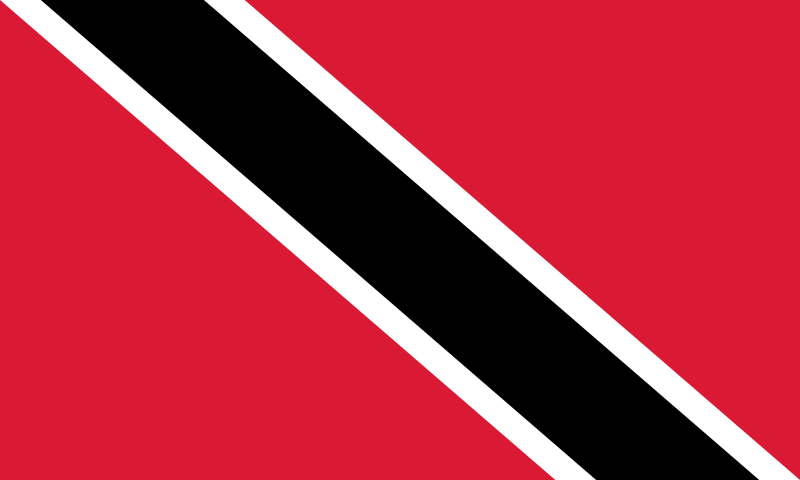
What the flag of Trinidad and Tobago looks like
The flag of Trinidad and Tobago has a red field crossed by a diagonal band from the upper corner next to the pole to the opposite lower corner. The band is black and is bordered on each side by a narrow white stripe. The proportions are 3:5. There are no other symbols.
The same design is used for Trinidad and for Tobago: the two islands are one country with one flag. The black band is a diagonal that goes from the top left to the bottom right. You can also find it as the Trinidad and Tobago flag emoji.
Trinidad & Tobago flag colors
Color codes measured from the official design. Use HEX for the web and CMYK for print.
HEX
#DA1A35RGB
218, 26, 53CMYK
0, 88, 76, 15 HEX
#000000RGB
0, 0, 0CMYK
0, 0, 0, 100 HEX
#FFFFFFRGB
255, 255, 255CMYK
0, 0, 0, 0 Trinidad and Tobago flag meaning and symbolism
The colors are linked in the official explanation to the elements and to the national spirit:
- Red stands for the vitality of the land and its people, for courage and for the warmth and energy of the sun.
- White stands for the sea that surrounds the islands, and for the equality of all citizens and the purity of the national aspirations.
- Black stands for the strength, unity and dedication of the people, and in a second reading for the earth and its riches.
A common summary is that the three colors stand for earth, water and fire, with the sun linked to the red.
History of the Trinidad and Tobago flag
Trinidad and Tobago were British colonies for most of the 19th and 20th centuries, and flew the British Blue Ensign with a colonial badge. In 1958 to 1962 they were part of the West Indies Federation. When the federation broke up, the two islands became independent together on 31 August 1962.
The flag was designed ahead of independence by Carlisle Chang, a Trinidadian artist, and chosen by a committee that looked at several proposals. It was first raised at independence and has been used unchanged since then, including after the country became a republic in 1976. The flag is celebrated on Independence Day and on Republic Day, 24 September.
Trinidad & Tobago flag facts
| Country | Trinidad and Tobago |
|---|---|
| Flag adopted | August 31, 1962 |
| Proportions | 3:5 |
| Colors | #DA1A35, #000000, #FFFFFF |
| Symbols | field, bend, fimbriation |
| Flag emoji | 🇹🇹 |
| Country code | TT, TTO (ISO 3166) |
| Capital | Port of Spain |
| Continent | North America |
| Population | 1,369,125 |
| Area | 5,128 km² |
| Currency | Trinidad and Tobago dollar |
| National anthem | Forged from the Love of Liberty |
Trinidad & Tobago flag: frequently asked questions
What does the Trinidad flag symbolize?
Red stands for the vitality of the land and the energy of the people, white for the sea and equality, and black for strength, unity and the earth. The colors are often described as fire, water and earth.
Who designed the flag of Trinidad and Tobago?
The flag was designed by Carlisle Chang, a Trinidadian artist, and adopted at independence on 31 August 1962.
Do Trinidad and Tobago have the same flag?
Yes. The two islands form one country, and the national flag is the same for both. Tobago also has its own local flag for its House of Assembly.
Is Trinidad and Tobago the same thing?
They are two main islands forming one country, the Republic of Trinidad and Tobago. Trinidad is the larger island, and the capital Port of Spain is on Trinidad.
What language do they speak in Trinidad and Tobago?
The official language is English. Many people also speak Trinidadian English Creole, and smaller communities speak Hindi, Spanish and French Creole.