Flag of Saint Lucia
The Saint Lucia flag is a cerulean blue field with three overlapping triangles in the center: a gold one in front, a black one behind it, and a white border around the black. The triangles stand for the island's twin Pitons.
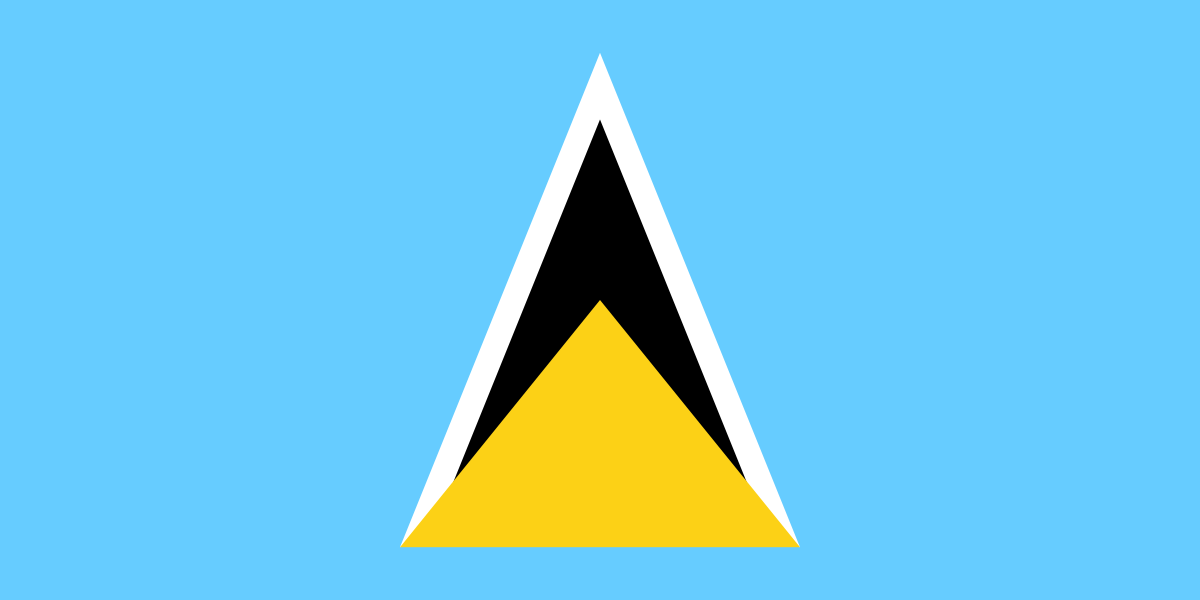
What the flag of Saint Lucia looks like
The national flag of Saint Lucia has a width-to-height ratio of 2:1. The background is a light, sky-like blue called cerulean. In the center are overlapping isosceles triangles, all pointing upward. The largest is black and has a thin white border. In front of it, along the same base line, sits a smaller gold (yellow) triangle. Together the shapes look like a single peak with a layered face.
The flag has no stars, crescents, coat of arms or stripes. It is a clean geometric design. You can see it in small size on the Saint Lucia flag emoji page.
St. Lucia flag colors
Color codes measured from the official design. Use HEX for the web and CMYK for print.
HEX
#66CCFFRGB
102, 204, 255CMYK
60, 20, 0, 0 HEX
#FCD116RGB
252, 209, 22CMYK
0, 17, 91, 1 HEX
#000000RGB
0, 0, 0CMYK
0, 0, 0, 100 HEX
#FFFFFFRGB
255, 255, 255CMYK
0, 0, 0, 0 Saint Lucia flag meaning and symbolism
The blue field represents the Atlantic Ocean and the Caribbean Sea, which meet around the island. It also stands for the sky. The triangles represent the two Pitons, Gros Piton and Petit Piton, twin volcanic cones on the southwest part of the island that are a national symbol of Saint Lucia, and they also stand for unity.
Gold stands for sunshine and prosperity. Black and white allude to the harmonious relationship between the Black and white communities of the island.
History of the Saint Lucia flag
France colonised Saint Lucia in 1635, and the island frequently changed hands between France and Britain until the Treaty of Paris in 1814 gave it permanently to the British. The island had no unique colonial flag at first; after it received its own coat of arms in August 1939, the British Blue Ensign defaced with that emblem served as its flag.
The present flag was designed by the Saint Lucian artist Dunstan St. Omer. It was adopted on 1 March 1967, when Saint Lucia became an Associated State of the United Kingdom, and it replaced the colonial Blue Ensign. When the country became independent on 22 February 1979, the design stayed the same, but the shade of blue and the sizes of the triangles were modified slightly. 22 February is celebrated as Independence Day.
Saint Lucia flag facts
- Saint Lucia is also written St. Lucia. Both spellings are used for the country, and the flag is the same.
- The capital is Castries, the official language is English, and most people also speak Saint Lucian Creole, a French-based language.
- The Pitons, which inspired the triangles, stand on the southwest coast near the town of Soufrière.
- For other Caribbean banners, see the flags of North America.
St. Lucia flag facts
| Country | Saint Lucia |
|---|---|
| Flag adopted | March 1, 1967 |
| Proportions | 1:2 |
| Colors | #66CCFF, #FCD116, #000000, #FFFFFF |
| Symbols | Atlantic Ocean, triangle, Pitons |
| Flag emoji | 🇱🇨 |
| Country code | LC, LCA (ISO 3166) |
| Capital | Castries |
| Continent | North America |
| Population | 167,591 |
| Area | 617 km² |
| Currency | Eastern Caribbean dollar |
| National anthem | Sons and Daughters of Saint Lucia |
St. Lucia flag: frequently asked questions
What does the St. Lucia flag represent?
The blue field stands for the sea and sky, and the triangles stand for the twin Pitons. Gold is said to mean sunshine and prosperity, while black and white represent the island's different communities living in harmony.
Who designed the flag of Saint Lucia?
The flag was designed by Dunstan St. Omer, a Saint Lucian artist and painter. It was adopted in 1967 and has remained the national flag since independence in 1979.
What country did St. Lucia belong to?
Saint Lucia was a British colony after 1814, having earlier changed hands between France and Britain many times. It became an Associated State in 1967 and fully independent on 22 February 1979, and it is now a Commonwealth realm.
What language do they speak in St. Lucia?
English is the official language. Many Saint Lucians also speak Saint Lucian Creole (Kwéyòl), which is based on French and reflects the island's French history.
What is the 🇱🇨 emoji?
The 🇱🇨 emoji shows the flag of Saint Lucia. The letters L and C are the country code of Saint Lucia.