Flag of the Maldives
The Maldives flag has a red field with a large green rectangle in the middle, and inside it a white crescent moon opening toward the fly. It has been the national flag since independence from Britain in 1965.
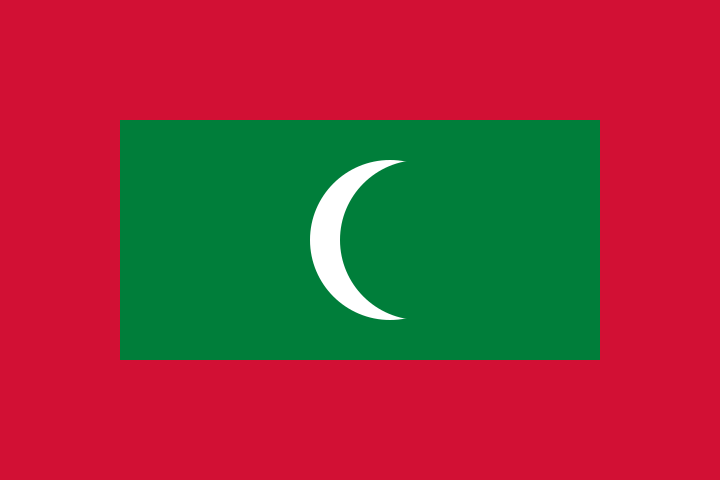
What the flag of the Maldives looks like
The flag of the Maldives is a red rectangle with a green rectangle at its center, bordered on all sides by a red band. In the middle of the green panel is a white crescent, with its points facing the fly (the side away from the flagpole). The ratio is 2:3.
The design is plain: three colors and one symbol, with no stars, text or coat of arms. You can find image files on the Maldives flag download page, and the emoji version is shown at /maldives/emoji/.
Maldives flag colors
Color codes measured from the official design. Use HEX for the web and CMYK for print.
HEX
#D21034RGB
210, 16, 52CMYK
0, 92, 75, 18 HEX
#007E3ARGB
0, 126, 58CMYK
100, 0, 54, 51 Maldives flag meaning and symbolism
The red border stands for the blood of the national heroes who sacrificed their lives defending their country. Red also links to the historic flags of the Maldivian sultanate, which were red for centuries.
The green rectangle is said to represent peace and prosperity, and it recalls the palms and vegetation of the atolls. The white crescent symbolizes Islam, the faith of the Maldivian people, since Islam has been the state religion since the 12th century. The crescent opens toward the right, in the fly direction.
History of the Maldives flag
For a long time the sultans of the Maldives used a plain red flag. At some point a black and white band was added at the hoist, forming a combined banner that was used on ships and public buildings. In the 20th century the green rectangle with a white crescent was inserted in the middle. Sources differ on exactly when and by whom this change was made.
The Maldives was a British protectorate from 1887. When it became independent on 26 July 1965, the flag was formally adopted in the form seen today, and the black and white band was removed. The Maldives has kept the same flag through the change from sultanate to republic in 1968 and since.
Interesting facts about the flag
- The country covers around 1,190 islands grouped into atolls, spread over a large area of the Indian Ocean.
- The flag is raised every year on Independence Day, 26 July.
For other Asian flags see the Asia flags page.
Maldives flag facts
| Country | Maldives |
|---|---|
| Flag adopted | July 26, 1965 |
| Proportions | 2:3 |
| Colors | #D21034, #007E3A |
| Symbols | field, bordure, crescent |
| Flag emoji | 🇲🇻 |
| Country code | MV, MDV (ISO 3166) |
| Capital | Malé |
| Continent | Asia |
| Population | 436,330 |
| Area | 298 km² |
| Currency | Maldivian rufiyaa |
| National anthem | Gaumiii salaaam |
Maldives flag: frequently asked questions
What does the Maldives flag mean?
Red stands for the blood of national heroes, green for peace and prosperity, and the white crescent for Islam. The three colors together are the colors of the country's identity.
What was the original look of the Maldives flag?
The earliest flags used by the Maldivian sultans were plain red. Later a black and white strip was added next to the hoist, and the green rectangle with a crescent came afterward. The black and white strip was dropped in 1965.
When was the Maldives flag adopted?
The current design was confirmed when the Maldives became independent from the United Kingdom in July 1965. The year is often given as 1965, with 25 or 26 July depending on the source.
Is the Maldives part of Asia or Africa?
The Maldives is in Asia. It lies in the Indian Ocean southwest of India and Sri Lanka, and its capital is Malé.
What language do they speak in the Maldives?
The official language is Dhivehi (Maldivian). English is widely used in tourism, government and higher education.