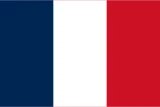
Flag of Guadeloupe
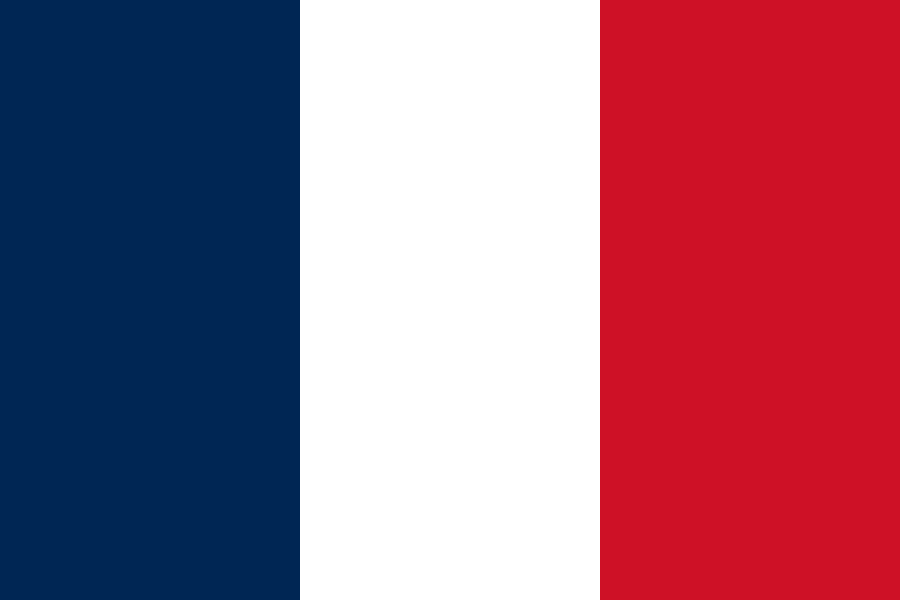
The official Guadeloupe flag is the French tricolor of blue, white and red, because Guadeloupe is an overseas department and region of France. Several local flags are also used, including one with a sun and sugar cane.
What the flag of Guadeloupe looks like
Guadeloupe does not have a separate legal flag. The flag used for official purposes is the flag of France, a vertical tricolor with blue at the hoist, white in the middle and red at the fly, in a ratio of 2:3. It is the official national flag used in Guadeloupe.
Locally, a few other designs are in use. One is an unofficial flag that features a yellow sun and green sugar cane. It is based on the coat of arms of the capital, Basse-Terre, and has a black or red field with a 30-rayed yellow sun and a green sugar cane, plus a blue stripe with three yellow fleurs-de-lis at the top. A regional logo on a white field is also often used as a regional flag, but it is not a national flag.
Guadeloupe flag colors
Color codes measured from the official design. Use HEX for the web and CMYK for print.
HEX
#FFFFFFRGB
255, 255, 255CMYK
0, 0, 0, 0 HEX
#002654RGB
0, 38, 84CMYK
100, 55, 0, 67 HEX
#CE1126RGB
206, 17, 38CMYK
0, 92, 82, 19 Guadeloupe flag meaning and symbolism
As the French tricolor, the flag expresses Guadeloupe's place in the French Republic. Its colors are linked to the French Revolution and to the ideals of liberty, equality and fraternity. The white is also said to come from the old royal banner.
The local sun and sugar cane flag has no official status. The independentist People's Union for the Liberation of Guadeloupe has also proposed a national flag, which closely resembles the flag of Suriname, with a wider red stripe and the star shifted toward the hoist.
History of the Guadeloupe flag
Columbus reached Guadeloupe in 1493, and France colonized the island in 1635. For most of its history under French rule, it flew the white banner of the French monarchy, and then the tricolor after the Revolution. The island was held for periods by Britain, in 1759-63 and again in the early 19th century, before it came back to France for good in 1816.
Slavery was abolished in 1794, restored by Napoleon in 1802 and finally ended in 1848. In 1946, Guadeloupe became an overseas department of France. The tricolor has been the only official flag since then, and there has never been a separately adopted national flag. Guadeloupe is not a country, which is why it has no flag of its own like other sovereign states. It is, instead, a part of France and of the European Union.
Guadeloupe flag facts
| Country | Guadeloupe |
|---|---|
| Proportions | 2:3 |
| Colors | #FFFFFF, #002654, #CE1126 |
| Flag emoji | 🇬🇵 |
| Country code | GP, GLP (ISO 3166) |
| Capital | Basse-Terre |
| Continent | North America |
| Population | 384,160 |
| Area | 1,628 km² |
Guadeloupe flag: frequently asked questions
Does Guadeloupe have its own flag?
Not an official one. The legal flag is the French tricolor. Local, unofficial flags such as a design with a sun and sugar cane are used for cultural purposes.
Why is Guadeloupe not a country?
Guadeloupe is an overseas department and region of France, and its residents are French citizens. It has had this status since 1946, and it is part of the European Union.
What is the Guadeloupe flag emoji?
The emoji shows the French tricolor, the same as the official flag. See the Guadeloupe flag emoji page.
What country does Guadeloupe belong to?
It belongs to France. The islands lie in the Caribbean, in the Lesser Antilles, and their capital is Basse-Terre.