Flag of the British Indian Ocean Territory
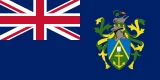
The British Indian Ocean Territory flag is a blue ensign with the Union Jack in the corner and wavy blue and white stripes in the fly, with a palm tree and a crown above them. It stands for the Chagos Archipelago and its military base on Diego Garcia.
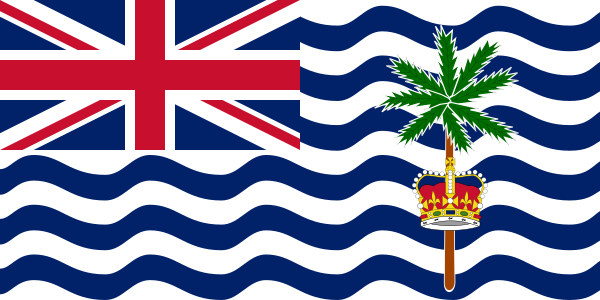
What the flag of the British Indian Ocean Territory looks like
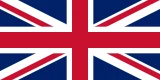
The flag is a British blue ensign: a dark blue field with the Union Jack in the upper hoist corner. The rest of the flag shows alternating wavy bands of white and blue that run across the fly. Above the waves stand a palm tree and a crown. The proportions are 1:2.
Its design is shared with the territory's coat of arms, which uses the same waves, palm and crown. The British Indian Ocean Territory flag emoji keeps the Union Jack and the waves, but the palm and crown become very small at emoji size.
British Indian Ocean Territory flag colors
Color codes measured from the official design. Use HEX for the web and CMYK for print.
HEX
#012169RGB
1, 33, 105CMYK
99, 69, 0, 59 HEX
#FFFFFFRGB
255, 255, 255CMYK
0, 0, 0, 0 HEX
#C8102ERGB
200, 16, 46CMYK
0, 92, 77, 22 British Indian Ocean Territory flag meaning
The wavy stripes represent the Indian Ocean around the Chagos Archipelago. The palm tree stands for the coconut palms that cover the islands and that once supported a plantation economy. The crown is a symbol of the British Crown and of the territory's status as a British Overseas Territory. The Union Jack in the corner marks the link with the United Kingdom, as on other blue ensigns. These readings are the commonly given ones.
History of the British Indian Ocean Territory flag
The territory was created in 1965, when the UK separated the Chagos Archipelago from the colony of Mauritius, and added a few islands from the Seychelles that were returned in 1976. The purpose was to make land available for a joint UK and US defense facility on Diego Garcia, and the Chagossians who lived on the islands were removed in the following years.
The flag in its present form was adopted in 1990. Before that, the territory flew the Union Jack. A commissioner represents the Crown there.
Sovereignty and the Chagos Islands
Mauritius has long claimed the archipelago. In 2019 the International Court of Justice gave an advisory opinion that the separation was not lawful, and the UN General Assembly called on the UK to end its administration. In 2024 and 2025 the UK and Mauritius agreed a treaty under which sovereignty would pass to Mauritius while the UK keeps use of Diego Garcia on a long lease. The treaty's ratification and the future of this flag depend on how that process proceeds. Today the islands have no permanent civilian population, only military and contractor staff.
British Indian Ocean Territory flag facts
| Country | British Indian Ocean Territory |
|---|---|
| Flag adopted | 1990 |
| Proportions | 1:2 |
| Colors | #012169, #FFFFFF, #C8102E |
| Symbols | crown, field, Union Jack |
| Flag emoji | 🇮🇴 |
| Country code | IO, IOT (ISO 3166) |
| Capital | Diego Garcia |
| Continent | Asia |
| Population | 3,000 |
| Area | 60 km² |
| Currency | pound sterling, United States dollar |
| National anthem | God Save the King |
British Indian Ocean Territory flag: frequently asked questions
Does the UK still own the British Indian Ocean Territory?
The UK administers it as an overseas territory, but sovereignty is disputed. In 2024-25 the UK and Mauritius agreed a treaty to transfer sovereignty to Mauritius, with Diego Garcia leased back to the UK.
Who is the rightful owner of the Chagos Islands?
Mauritius says it is, and the International Court of Justice found in 2019 that the UK's separation of the islands from Mauritius was unlawful. The UK held them until the transfer arrangements.
What is on the British Indian Ocean Territory flag?
A blue ensign with the Union Jack, wavy blue and white stripes for the ocean, a palm tree and a crown.
Is the British Indian Ocean Territory a nationality?
No. It has no permanent residents of its own. Chagossians have a separate claim to British citizenship under a 2022 change in UK law.