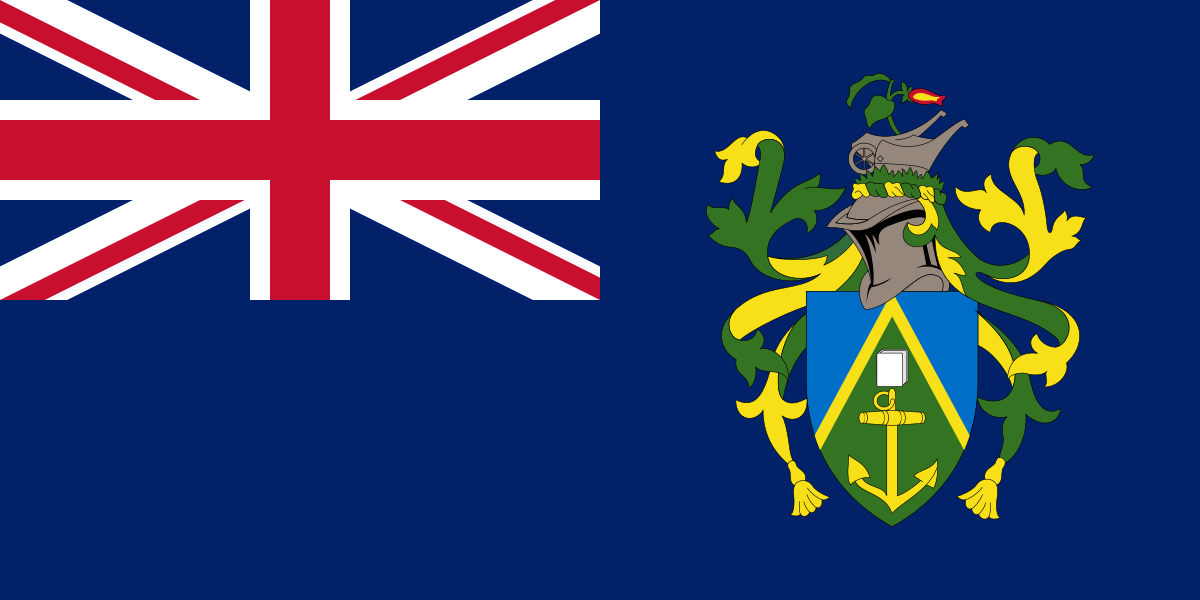
Flag of the Pitcairn Islands
The Pitcairn Islands flag is a British blue ensign carrying the territory's coat of arms in the fly. It is the flag of one of the world's smallest communities, descended from the Bounty mutineers and their Tahitian companions, on a remote island in the South Pacific.
What the Pitcairn Islands flag looks like
The flag is a blue ensign: a dark blue field with the Union Jack in the upper hoist corner. In the fly is the coat of arms of Pitcairn, drawn on a shield with a decorated crest above it. The proportions are 1:2.
The shield shows the island's cliffs and sea, with a green wedge running to its base. In the wedge are an open Bible and the anchor from the Bounty. Above the shield, the crest is a wheelbarrow with a branch of miro, a local tree. The Pitcairn Islands flag emoji reduces this to the Union Jack and a small colored badge.
Pitcairn Islands flag colors
Color codes measured from the official design. Use HEX for the web and CMYK for print.
HEX
#012169RGB
1, 33, 105CMYK
99, 69, 0, 59 HEX
#C8102ERGB
200, 16, 46CMYK
0, 92, 77, 22 HEX
#FFFFFFRGB
255, 255, 255CMYK
0, 0, 0, 0 HEX
#337321RGB
51, 115, 33CMYK
56, 0, 71, 55 HEX
#F7E017RGB
247, 224, 23CMYK
0, 9, 91, 3 Pitcairn Islands flag meaning and symbolism
The Union Jack shows the link with the United Kingdom, to which Pitcairn is a British Overseas Territory. The Bible and the anchor refer to the islanders' Christian faith and to HMS Bounty, whose crew settled the island in 1790. The wheelbarrow is a humble working tool of the island, and the miro is a native wood used for carving, a craft islanders sell to visitors. The green stands for the land, and the blue for the Pacific Ocean around it.
History of the Pitcairn Islands flag
In 1789 part of the crew of HMS Bounty, led by Fletcher Christian, mutinied against Captain William Bligh. A group of the mutineers, with several Tahitian men and women, settled on uninhabited Pitcairn in 1790 and burned the ship. Their descendants still make up most of the islanders. Britain annexed the island in 1838, and most of its history since has been as a small colony with a few dozen to a couple of hundred people.
The present flag was adopted in 1984 together with the coat of arms. Pitcairn Islands is a group of four islands, but only Pitcairn is inhabited. The others, Henderson, Ducie and Oeno, are uninhabited, and Henderson is a World Heritage site.
Pitcairn Islands flag facts
| Country | Pitcairn |
|---|---|
| Flag adopted | 1984 |
| Proportions | 1:2 |
| Colors | #012169, #C8102E, #FFFFFF, #337321, #F7E017 |
| Symbols | field, coat of arms of the Pitcairn Islands, Union Jack |
| Flag emoji | 🇵🇳 |
| Country code | PN, PCN (ISO 3166) |
| Capital | Adamstown |
| Continent | Oceania |
| Population | 50 |
| Area | 47 km² |
| Currency | New Zealand dollar, Pitcairn Islands dollar |
| National anthem | We From Pitcairn Island |
Pitcairn Islands flag: frequently asked questions
What country does Pitcairn Island belong to?
It belongs to the United Kingdom. Pitcairn, Henderson, Ducie and Oeno form a British Overseas Territory governed through the British High Commissioner in New Zealand.
Does anybody still live on Pitcairn Island?
Yes. Around 50 people live on Pitcairn, mostly in the settlement of Adamstown, making it one of the least populated territories in the world.
What language is spoken on Pitcairn Island?
Islanders speak English and Pitkern, a mixture of 18th-century English and Tahitian.
Are Pitcairn Islanders British citizens?
Islanders are British citizens. Since the British Overseas Territories Act 2002, people connected with the territory hold full British citizenship.
What is the dark history of Pitcairn Island?
Besides the violence among the early settlers, the island is known for the sexual abuse trials of 2004, in which several men were convicted, prompting changes to its governance and policing.