Flag of Tonga
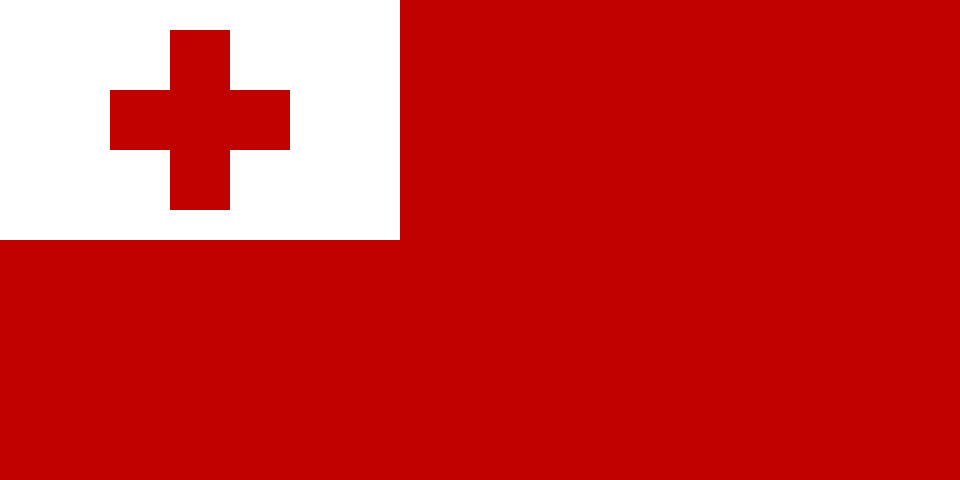
The Tonga flag is red with a white canton in the upper hoist corner, and inside the canton a red cross. It was adopted in 1875, and the constitution says it may not be altered.
What the flag of Tonga looks like
The flag of Tonga has a plain red field with a white rectangle, the canton, in the top left corner next to the flagpole. In the canton is a red cross with arms of equal length, known in heraldry as a couped cross because its arms do not reach the edges. The flag is twice as wide as it is tall, with a ratio of 1:2.
The red and white scheme is bold and easy to tell apart from other Pacific flags. For image files see the Tonga flag download page, and the emoji is at /tonga/emoji/.
Tonga flag colors
Color codes measured from the official design. Use HEX for the web and CMYK for print.
HEX
#C10000RGB
193, 0, 0CMYK
0, 100, 100, 24 HEX
#FFFFFFRGB
255, 255, 255CMYK
0, 0, 0, 0 Tonga flag meaning and symbolism
The flag expresses the Christian faith of the Kingdom of Tonga. The red cross refers to the blood of Christ and to his sacrifice, and the white stands for purity. The red of the field is linked to the same blood.
Christianity arrived in the islands in the early 19th century, and Methodist missionaries had a strong influence on the royal court. Today most Tongans are Christian, and Sunday is observed as a day of rest by law.
History of the Tonga flag
Tonga unified under King George Tupou I (Taufaʻāhau), who ruled from 1845. He was a Wesleyan Methodist convert who united the islands and gave them a written code of laws. An earlier national flag dating from the 1860s, with a red cross on a white field, is mentioned by some sources, but the current design is the one set out in the 1875 constitution.
The flag was shaped by the king together with his adviser, the Methodist missionary Shirley Baker, who served as prime minister. It was formally adopted on 4 November 1875 with the new constitution. A clause of the constitution forbids any change to the flag, which makes it one of the few flags whose design is protected by the country's founding law.
Tonga was never fully colonized. It became a British protected state in 1900 under a treaty of friendship, which gave Britain control of foreign affairs, and became fully independent again within the Commonwealth on 4 June 1970. The flag stayed the same through that period.
Tonga flag and the Swiss flag
The Tongan flag is sometimes mistaken for a reversed Swiss flag, because both combine a red field with a cross. The Swiss flag is square, with a white cross centered on red, while Tonga's is rectangular and the red cross sits inside a white canton. For more Pacific designs see the Oceania flags page.
Tonga flag facts
| Country | Tonga |
|---|---|
| Flag adopted | November 4, 1875 |
| Proportions | 1:2 |
| Colors | #C10000, #FFFFFF |
| Symbols | field, Greek cross, canton |
| Flag emoji | 🇹🇴 |
| Country code | TO, TON (ISO 3166) |
| Capital | Nukuʻalofa |
| Continent | Oceania |
| Population | 108,020 |
| Area | 749 km² |
| Currency | Tongan paʻanga |
| National anthem | Ko e fasi 'o e tu'i 'o e 'Otu Tonga |
Tonga flag: frequently asked questions
Why is the Tongan flag like that?
The red cross and white canton express the Christian faith of the kingdom, which King George Tupou I adopted. The flag was designed in the 1870s with the help of missionary Shirley Baker and fixed by the 1875 constitution.
Is Tonga a country or not?
Yes. The Kingdom of Tonga is an independent country in the South Pacific with its own monarchy, and it has been a member of the United Nations since 1999.
What does "Tonga" mean in English?
In several Polynesian languages the word tonga means south. The name of the country is commonly connected to that meaning.
Was Tonga a Swiss colony?
No. Tonga was never a Swiss colony, and Switzerland has never had colonies. The confusion comes from the similar red-and-white colors and the cross.
What country owns Tonga?
Tonga is not owned by any other country. It is a constitutional monarchy that was a British protected state from 1900 to 1970 and is now an independent member of the Commonwealth.