Flag of Palau
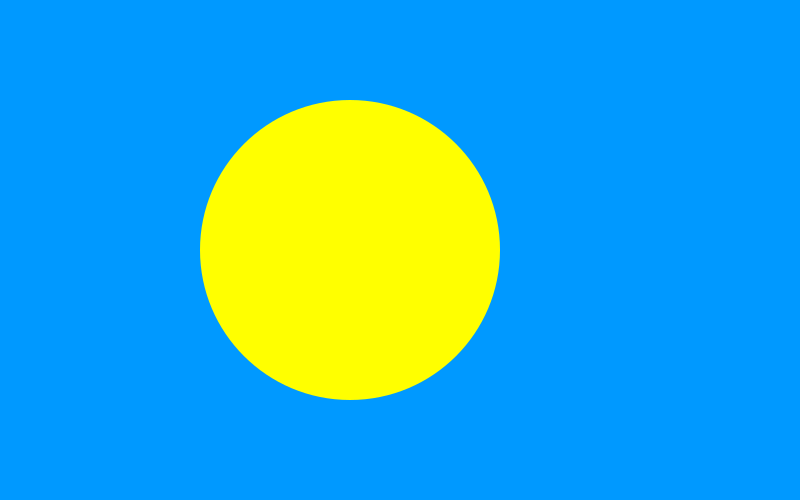
The Palau flag is a light blue field with a golden-yellow disc, the full moon, placed slightly toward the hoist. It was adopted on 1 January 1981, when the islands gained self-government before becoming independent in 1994.
What the flag of Palau looks like
The flag of Palau has a sky blue field with a ratio of 5:8. A large golden-yellow circle sits on it. The circle is off center: it is moved toward the hoist, so that more blue shows on the fly side than on the pole side.
The flag has no other detail. It looks a little like the flag of Japan at first glance, but the colors are different and the disc is not in the middle. For an emoji version, see the Palau flag emoji.
Palau flag colors
Color codes measured from the official design. Use HEX for the web and CMYK for print.
HEX
#0099FFRGB
0, 153, 255CMYK
100, 40, 0, 0 HEX
#FFFF00RGB
255, 255, 0CMYK
0, 0, 100, 0 Palau flag meaning and symbolism
The disc is a full moon. The moon is important in Palauan culture, where it is traditionally linked to the right time for fishing, planting and other activities. Many accounts say that the full moon is the time of peace, love and tranquility, and that it is the symbol of the nation's well-being.
The blue field stands for the Pacific Ocean, and is also said to represent the change from foreign rule to self-government. The sea has always been central to Palau's economy and food supply.
The off-center position of the moon is often explained as an intentional choice so that the flag would not be confused with the flag of Japan, which the islands had been under in the past. It is also said to show that the moon is rising or setting, rather than hanging fixed in the sky.
History of the Palau flag
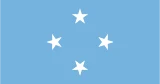
Palau was controlled by Spain until 1899, then by Germany, and from 1914 by Japan. After the Second World War it became part of the United Nations Trust Territory of the Pacific Islands, which was administered by the United States. The trust territory flag was light blue with a ring of white stars.
A flag with the moon design was chosen for the new government and raised on 1 January 1981, when Palau became a self-governing republic with its own constitution. In 1994, under a Compact of Free Association with the United States, Palau became fully independent on 1 October, keeping the same flag. Each of the sixteen states of Palau also has its own flag.
Palau flag facts
| Country | Palau |
|---|---|
| Flag adopted | January 1, 1981 |
| Proportions | 5:8 |
| Colors | #0099FF, #FFFF00 |
| Symbols | full moon, field, roundel |
| Flag emoji | 🇵🇼 |
| Country code | PW, PLW (ISO 3166) |
| Capital | Ngerulmud |
| Continent | Oceania |
| Population | 21,729 |
| Area | 466 km² |
| Currency | United States dollar |
| National anthem | Belau rekid |
Palau flag: frequently asked questions
Why is the Palau flag off center?
The moon is shifted toward the hoist. It is commonly said that this keeps the flag from looking like Japan's, and that the placement also suggests a moon in the sky.
Why does the Palau flag look like Japan's?
Both have a circle on a plain field. The Japanese disc is red, on white and in the center, while Palau's is yellow, on blue and off center, so the flags have different meanings and are not related.
Is Palau a part of America?
No. Palau is an independent country in the western Pacific Ocean. It has a Compact of Free Association with the United States, which handles its defense.
When was the Palau flag adopted?
It was adopted on 1 January 1981.
What is the capital of Palau?
The capital is Ngerulmud, on the island of Babeldaob. It replaced Koror as the capital in 2006.