Flag of Tuvalu
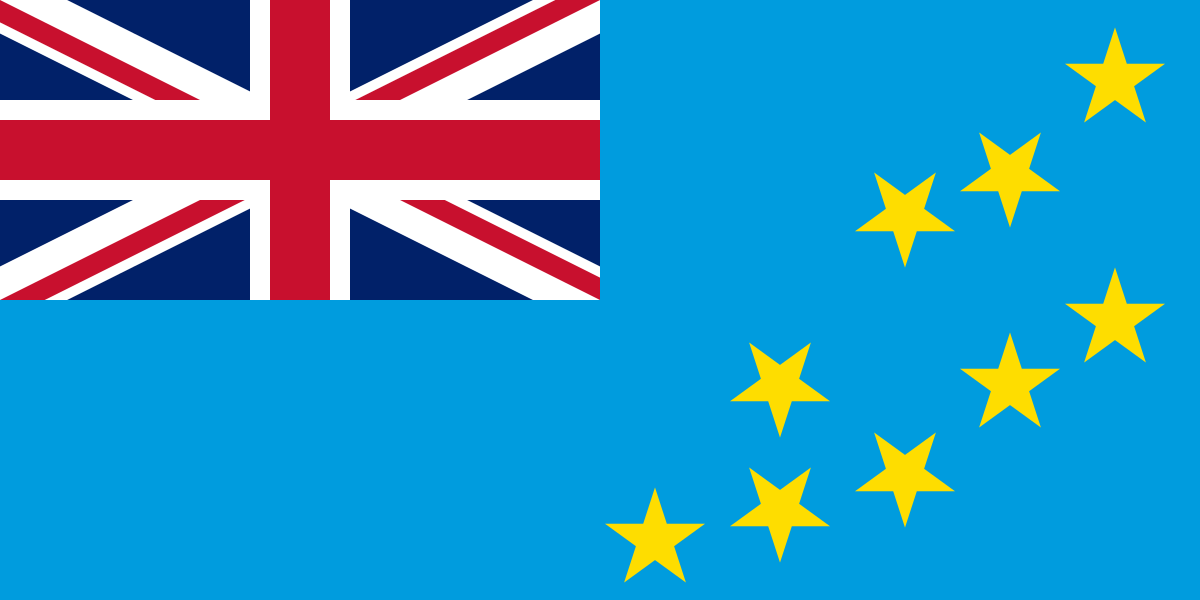
The Tuvalu flag is a light blue field with the Union Jack in the upper hoist corner and nine yellow stars on the fly side. The stars are placed like the nine islands of the country on a map.
What the flag of Tuvalu looks like
The national flag of Tuvalu has a sky-blue background with a 1:2 shape. In the top-left corner (the canton) is the flag of the United Kingdom, the Union Jack, with its red and white crosses on a dark blue field. The Union Jack takes up roughly a quarter of the flag.
The rest of the flag, the fly, carries nine five-pointed yellow stars. They are not set in a regular row. Their positions copy the layout of the islands that make up the country in the central Pacific, so the stars are spread diagonally across the fly half, with north pointing toward the hoist. In total the flag uses five colors: light blue, yellow, red, white and dark blue.
Tuvalu flag colors
Color codes measured from the official design. Use HEX for the web and CMYK for print.
HEX
#009CDERGB
0, 156, 222CMYK
100, 30, 0, 13 HEX
#C8102ERGB
200, 16, 46CMYK
0, 92, 77, 22 HEX
#FFFFFFRGB
255, 255, 255CMYK
0, 0, 0, 0 HEX
#012169RGB
1, 33, 105CMYK
99, 69, 0, 59 HEX
#FEDD00RGB
254, 221, 0CMYK
0, 13, 100, 0 Tuvalu flag meaning and symbolism
The light blue background stands for the Pacific Ocean, which surrounds and defines Tuvalu. The country is made up of nine small coral islands and atolls with a total land area of about 25 square kilometres, so the sea is the setting of everyday life.
Each yellow star represents one island: Nanumea, Niutao, Nanumanga, Nui, Vaitupu, Nukufetau, Funafuti, Nukulaelae and Niulakita. The name Tuvalu means "eight standing together" in Tuvaluan, because only eight of the islands were originally inhabited. The ninth star stands for Niulakita, the ninth island. This is the usual answer to why Tuvalu has nine stars.
The Union Jack reflects the long link with Britain. Tuvalu was long under British administration, and it is still a Commonwealth realm, which means the British monarch is also the head of state. The yellow and blue together reflect the color of the islands in the ocean.
History of the Tuvalu flag
Before independence, the islands were known as the Ellice Islands and were administered with the Gilbert Islands as a British colony. On 1 October 1975 the Ellice Islands separated from the Gilbert Islands and became the Colony of Tuvalu. Independence followed on 1 October 1978, the same day the national flag was adopted, a design by Vione Natano chosen from 40 proposals.
The 1978 design had the light blue field, the Union Jack and the nine stars that are still on the flag. In 1995 the government of Prime Minister Kamuta Latasi adopted a new design without the Union Jack, as a step toward becoming a republic. It had a light blue band between two red bands, separated by thin white bands, with eight white stars and the coat of arms on a white triangle. The change was unpopular. Many Tuvaluans felt that the British link was a part of their history, and the original flag was restored on 11 April 1997 and has been used since.
Kiribati, the neighboring country that was once joined with Tuvalu, chose a very different flag. See also the full list of flags of Oceania.
Flags that look like the Tuvalu flag
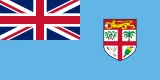
The Tuvalu flag is easy to confuse with Fiji's flag, which also has a light blue field with the Union Jack in the canton. The difference is on the fly: Fiji's flag shows a shield with a lion and a cocoa pod, while Tuvalu's shows stars. Several other former British territories in the Pacific, such as the Cook Islands, also use blue backgrounds with stars.
Tuvalu flag facts
| Country | Tuvalu |
|---|---|
| Flag adopted | October 1, 1978 |
| Proportions | 1:2 |
| Colors | #009CDE, #C8102E, #FFFFFF, #012169, #FEDD00 |
| Symbols | map, five-pointed star, Union Jack |
| Flag emoji | 🇹🇻 |
| Country code | TV, TUV (ISO 3166) |
| Capital | Funafuti |
| Continent | Oceania |
| Population | 10,643 |
| Area | 25 km² |
| Currency | Tuvaluan dollar, Australian dollar |
| National anthem | Tuvalu mo te Atua |
Tuvalu flag: frequently asked questions
Why does Tuvalu have 9 stars on its flag?
Each of the nine stars stands for one of the country's nine islands. They are placed on the flag in a way that follows the islands' positions on a map.
Why does Tuvalu have a British flag in its flag?
The Union Jack recalls Tuvalu's past as a British colony and its membership in the Commonwealth. The country gained independence in 1978 and still has the British monarch as head of state.
Is Tuvalu a British territory?
No. Tuvalu has been an independent state since 1 October 1978. It is a Commonwealth realm, which means it shares a monarch with the United Kingdom but governs itself.
What country is 🇹🇻?
The flag emoji 🇹🇻 is the flag of Tuvalu, a Polynesian island nation in the Pacific Ocean between Hawaii and Australia. Its capital is Funafuti.
Did Tuvalu ever change its flag?
Yes. In 1995 it replaced the 1978 flag with a red-and-blue design without the Union Jack, but the new flag was unpopular and the original design was restored on 11 April 1997.