Flag of Uzbekistan
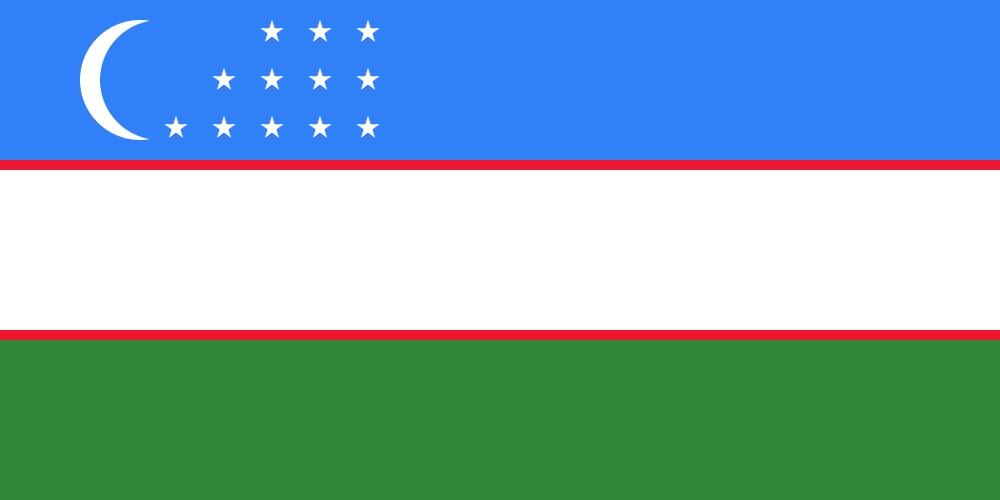
The Uzbekistan flag has three horizontal bands of blue, white and green, separated by thin red lines. A white crescent and twelve white stars sit in the upper hoist corner. It was adopted on 18 November 1991, shortly after independence from the Soviet Union.
What the flag of Uzbekistan looks like
The national flag of Uzbekistan is a horizontal tricolor with a width-to-height ratio of 1:2. The top band is blue, the middle band is white and the bottom band is green. Narrow red lines, known as fimbriations, run between the three bands, so the white stripe is edged in red on both sides.
In the blue band, near the hoist, is a white crescent that opens toward the fly. Next to it are twelve small white five-pointed stars arranged in three rows: three stars in the first row, four in the second and five in the third. The stars point to the right of the crescent, so the whole group reads as a single emblem on the blue field.
The red lines are much thinner than the main bands, which is why the red covers only a few percent of the flag. You can see the design in small size in the Uzbekistan flag emoji, and you can get print-ready versions on the download page.
Uzbekistan flag colors
Color codes measured from the official design. Use HEX for the web and CMYK for print.
HEX
#FFFFFFRGB
255, 255, 255CMYK
0, 0, 0, 0 HEX
#308738RGB
48, 135, 56CMYK
64, 0, 59, 47 HEX
#3081F7RGB
48, 129, 247CMYK
81, 48, 0, 3 HEX
#EE162ERGB
238, 22, 46CMYK
0, 91, 81, 7 Uzbekistan flag meaning and symbolism
The official explanation of the symbols is set out in the state description of the flag. Blue is said to stand for the sky and water, and it is also linked with the Turkic heritage and the memory of the medieval ruler Timur (Tamerlane), whose empire used the color. White represents peace and the purity of thoughts and aspirations. Green stands for nature and new life, and it is often connected with the Islamic tradition. The thin red lines represent the life force that flows through every living thing.
The crescent is described as a symbol of the rebirth of an independent Uzbek state, and it is also associated with Islam. The twelve stars are most often explained as the twelve months of the year, or as the signs of the zodiac, and they stand for the idea of renewal and the passing of time. Some commentators also relate the number to the twelve ancient regions or states that once existed on the territory of Uzbekistan, but this reading is less common.
Because the meanings come from interpretation rather than a single legal text, you may see slightly different explanations in school books and on official websites.
History of the Uzbekistan flag
Before the 20th century, the lands of present-day Uzbekistan were ruled by several khanates and emirates, including Bukhara, Khiva and Kokand, each with its own banners. In the Soviet era, the Uzbek Soviet Socialist Republic first used a plain red flag with a hammer and sickle, and from the early 1950s a red flag with a hammer and sickle, a star and a light blue horizontal stripe, which was the flag the republic carried until the end of the Soviet Union.
Uzbekistan declared independence on 31 August 1991. The new national flag was approved on 18 November 1991 by the Supreme Soviet of the republic, and it has remained in use ever since, with no change to its basic design. The date is now marked as Flag Day. The coat of arms and the national anthem followed in 1992.
The Uzbek flag was one of several new flags that appeared in Central Asia in the early 1990s. If you want to compare it with those of its neighbors, see Kazakhstan, Turkmenistan and Tajikistan.
Uzbekistan flag facts
| Country | Uzbekistan |
|---|---|
| Flag adopted | November 18, 1991 |
| Proportions | 1:2 |
| Colors | #FFFFFF, #308738, #3081F7, #EE162E |
| Symbols | field, five-pointed star, crescent, fimbriation |
| Flag emoji | 🇺🇿 |
| Country code | UZ, UZB (ISO 3166) |
| Capital | Tashkent |
| Continent | Asia |
| Population | 34,915,100 |
| Area | 448,978 km² |
| Currency | Uzbek som |
| National anthem | National Anthem of Uzbekistan |
Uzbekistan flag: frequently asked questions
Why does the Uzbekistan flag have 12 stars?
The twelve stars are usually said to represent the twelve months of the year or the twelve signs of the zodiac. Together with the crescent, they symbolize renewal and a new beginning for the independent state.
What do the colors of the Uzbekistan flag mean?
Blue stands for the sky and water, white for peace and purity, and green for nature and new life. The thin red lines are said to represent the life force in every living being.
Did Uzbekistan change their flag?
Yes, once, when it left the Soviet Union. The Soviet-era flag of the Uzbek SSR was replaced by the current blue, white and green flag on 18 November 1991, and that design has not changed since.
Which country's flag is the Uzbekistan flag emoji?
The emoji shows the flag of Uzbekistan. It is displayed on most devices as the blue, white and green stripes with the crescent and stars in the upper left.
What is on the flag of Uzbekistan?
The flag has blue, white and green horizontal stripes separated by narrow red lines. In the top-left corner are a white crescent and twelve white stars in three rows of 3, 4 and 5.