Flag of Namibia
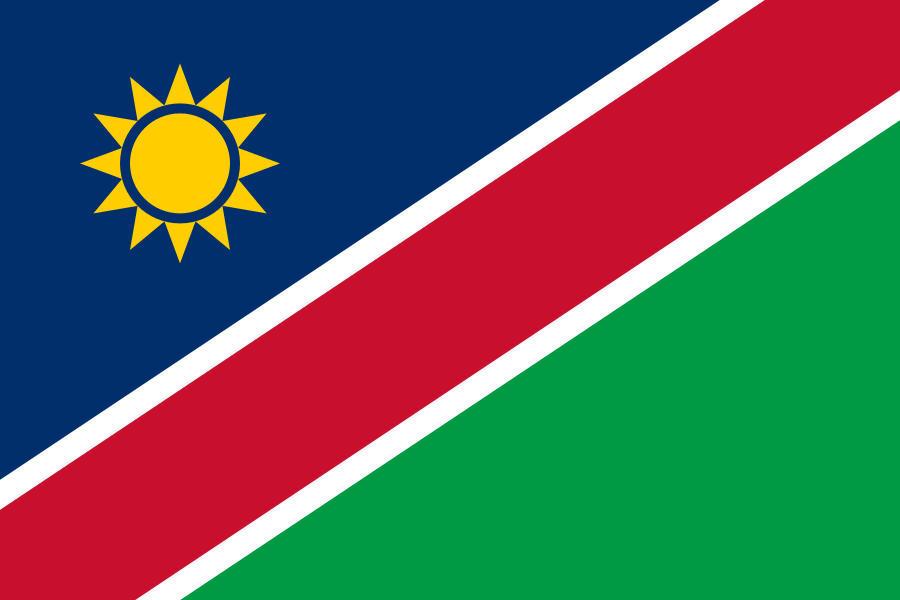
The Namibian flag is divided by a red diagonal band with white edges. Above it is a blue triangle with a golden sun of twelve rays, and below it is a green triangle. It was first raised on independence day, 21 March 1990.
What the flag of Namibia looks like
The flag of Namibia has a ratio of 2:3. A red diagonal band, known in heraldry as a bend sinister, runs from the lower hoist corner to the upper fly corner. It is edged with thin white stripes on both sides. The upper-left triangle is blue, and it contains a golden-yellow sun with twelve triangular rays. The lower-right triangle is green.
The flag is one of the few in Africa with a diagonal band. The sun is placed in the canton, so it shows clearly even when the flag is hanging in the wind. Five colors appear: blue, red, white, green and gold.
Namibia flag colors
Color codes measured from the official design. Use HEX for the web and CMYK for print.
HEX
#009A44RGB
0, 154, 68CMYK
100, 0, 56, 40 HEX
#002F6CRGB
0, 47, 108CMYK
100, 56, 0, 58 HEX
#C8102ERGB
200, 16, 46CMYK
0, 92, 77, 22 HEX
#FFFEFFRGB
255, 254, 255CMYK
0, 0, 0, 0 HEX
#FFCD00RGB
255, 205, 0CMYK
0, 20, 100, 0 Namibia flag meaning and symbolism
The meanings were given officially when the flag was introduced. Blue stands for the sky and for the Atlantic Ocean, and it also refers to the country's water resources and rain. Red stands for the people and for their heroism and determination to build a future with equal opportunities. Green represents vegetation and agricultural resources. White stands for peace and unity. The sun symbolizes life and energy, and its gold color recalls the country's dry landscapes.
The twelve rays of the sun are often said to stand for the country's main ethnic groups, although the official explanation does not stress this.
History of the Namibian flag
The area was a German colony, German South West Africa, from 1884 until 1915, when South African forces took over. South Africa later administered the land as South West Africa, and its own flag flew there until independence. Several homelands inside the territory also used their own flags in the 1970s and 1980s.
When the independence process began, the Constituent Assembly held a national competition for the new flag. The winning design was a combination of the best parts of several proposals and was largely developed by Theo Jankowski, a Namibian graphic artist. The flag was raised for the first time on 21 March 1990, as South Africa's rule ended and Namibia became independent. The design has not changed since.
See also the flag of South Africa, Namibia's neighbor, and other flags of Africa.
Namibia flag facts
| Country | Namibia |
|---|---|
| Flag adopted | March 21, 1990 |
| Proportions | 2:3 |
| Colors | #009A44, #002F6C, #C8102E, #FFFEFF, #FFCD00 |
| Symbols | Sun, field, bend sinister, fimbriation |
| Flag emoji | 🇳🇦 |
| Country code | NA, NAM (ISO 3166) |
| Capital | Windhoek |
| Continent | Africa |
| Population | 2,533,794 |
| Area | 825,615 km² |
| Currency | rand, Namibian dollar |
| National anthem | Namibia, Land of the Brave |
Namibia flag: frequently asked questions
What is the meaning of the Namibian flag?
Blue is the sky and the Atlantic, red is the people and their determination, green is vegetation, white is peace and unity, and the gold sun is life and energy.
Is Namibia German or Dutch?
Neither today, but it has links to both. It was a German colony from 1884 to 1915, and then governed by South Africa until independence in 1990. German and Afrikaans are still spoken by minorities, while English is the official language.
What languages are spoken in Namibia?
English is the official language. Many people speak Oshiwambo, Afrikaans, Nama or Damara, Herero, German and other local languages.
Is Namibia in Europe or Africa?
Namibia is in Africa. It lies on the Atlantic coast of southern Africa and borders Angola, Zambia, Botswana and South Africa. Its capital is Windhoek.
When was the Namibian flag adopted?
It was adopted on 21 March 1990, the day of Namibia's independence from South Africa.