Flag of East Timor
The East Timor flag (the flag of Timor-Leste) is red with two overlapping triangles, a black one on a yellow one, pointing from the hoist, and a white star in the black triangle. It was first raised in 1975 and restored at independence in 2002.
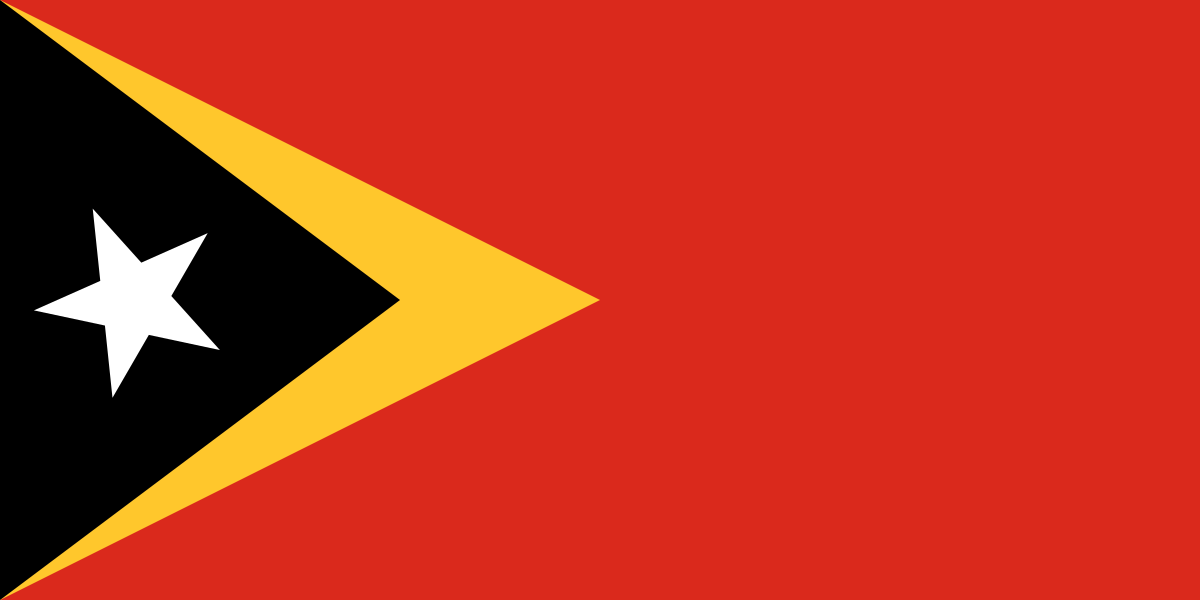
What the flag of East Timor looks like
The flag of East Timor has a red field with two isosceles triangles whose bases lie along the hoist, the side nearest the pole. The larger triangle is yellow and reaches about halfway across the flag. The smaller triangle is black and lies on top of the yellow one, extending about a third of the way across. In the black triangle is a white five-pointed star, with one point aimed toward the hoist. The flag has a ratio of 1:2.
The star is sometimes called the guiding light of the nation, and its tilted position is part of the design. The flag has a bold, modern appearance and is among the few national flags that use triangles from the hoist in this way. For a simple version of the design, see the East Timor flag emoji.
East Timor flag colors
Color codes measured from the official design. Use HEX for the web and CMYK for print.
HEX
#DA291CRGB
218, 41, 28CMYK
0, 81, 87, 15 HEX
#000000RGB
0, 0, 0CMYK
0, 0, 0, 100 HEX
#FFC72CRGB
255, 199, 44CMYK
0, 22, 83, 0 East Timor flag meaning and symbolism
The constitution and official explanations give each element a meaning:
- Red stands for the struggle for national liberation.
- Yellow represents the traces of colonialism in the country's past.
- Black stands for the obscurantism that needs to be overcome, meaning ignorance and darkness.
- The white star symbolizes peace and is described as the light that guides the people.
The triangles are meant to look like a wedge pushing forward, with the black piece of the flag pointing toward the future. People often say the layers move from the colonial past (yellow) through difficulty (black) to peace (the star).
History of the East Timor flag
Timor was a Portuguese colony for centuries, and the flag of Portugal was flown there until the 1970s. After the Carnation Revolution in Portugal in 1974, Portugal moved toward leaving its colonies. On 28 November 1975, the Fretilin independence movement declared the Democratic Republic of East Timor and raised the new red, yellow and black flag.
The independence was short-lived. Indonesia invaded on 7 December 1975 and annexed the territory the following year, and the flag was banned and became a symbol of the resistance movement. After a UN-organized referendum in 1999, in which East Timorese voted to leave Indonesia, the territory was run by a United Nations administration, and the UN flag was used in official settings.
When the country became fully independent on 20 May 2002, it restored the 1975 flag as the national flag. The state is officially called Timor-Leste, which means East Timor in Portuguese and is the name used in the constitution. Both names appear in English, and the flag is the same.
East Timor flag facts
| Country | East Timor |
|---|---|
| Flag adopted | May 20, 2002 |
| Proportions | 1:2 |
| Colors | #DA291C, #000000, #FFC72C |
| Symbols | five-pointed star, triangle, field |
| Flag emoji | 🇹🇱 |
| Country code | TL, TLS (ISO 3166) |
| Capital | Dili |
| Continent | Asia |
| Population | 1,400,638 |
| Area | 14,919 km² |
| Currency | United States dollar, East Timor centavo coins |
| National anthem | Pátria |
East Timor flag: frequently asked questions
What was East Timor called before?
It was known as Portuguese Timor while it was a Portuguese colony, then as Timor Timur when Indonesia annexed it from 1976 to 1999. It is now officially Timor-Leste, though East Timor is still widely used.
Is East Timor a country?
Yes. East Timor, officially Timor-Leste, is a sovereign state that became independent on 20 May 2002 and is a member of the United Nations and of ASEAN.
Why is Timor-Leste a separate country?
It was a Portuguese colony while the western half of the island was part of the Dutch East Indies and later Indonesia. After the Indonesian occupation ended in 1999, its people voted for independence.
What do the colors of the East Timor flag mean?
Red stands for the fight for liberation, yellow for the traces of colonialism, black for the darkness that must be overcome and the white star for peace and guidance.
What language is spoken in Timor-Leste?
The official languages are Tetum and Portuguese. Indonesian and English are working languages, and a number of local languages are also spoken.