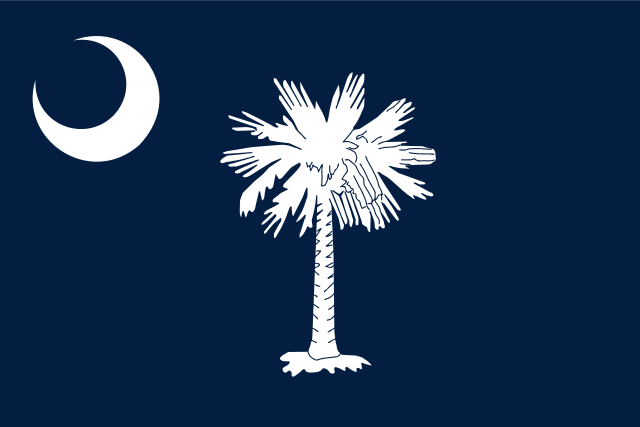
Flag of South Carolina
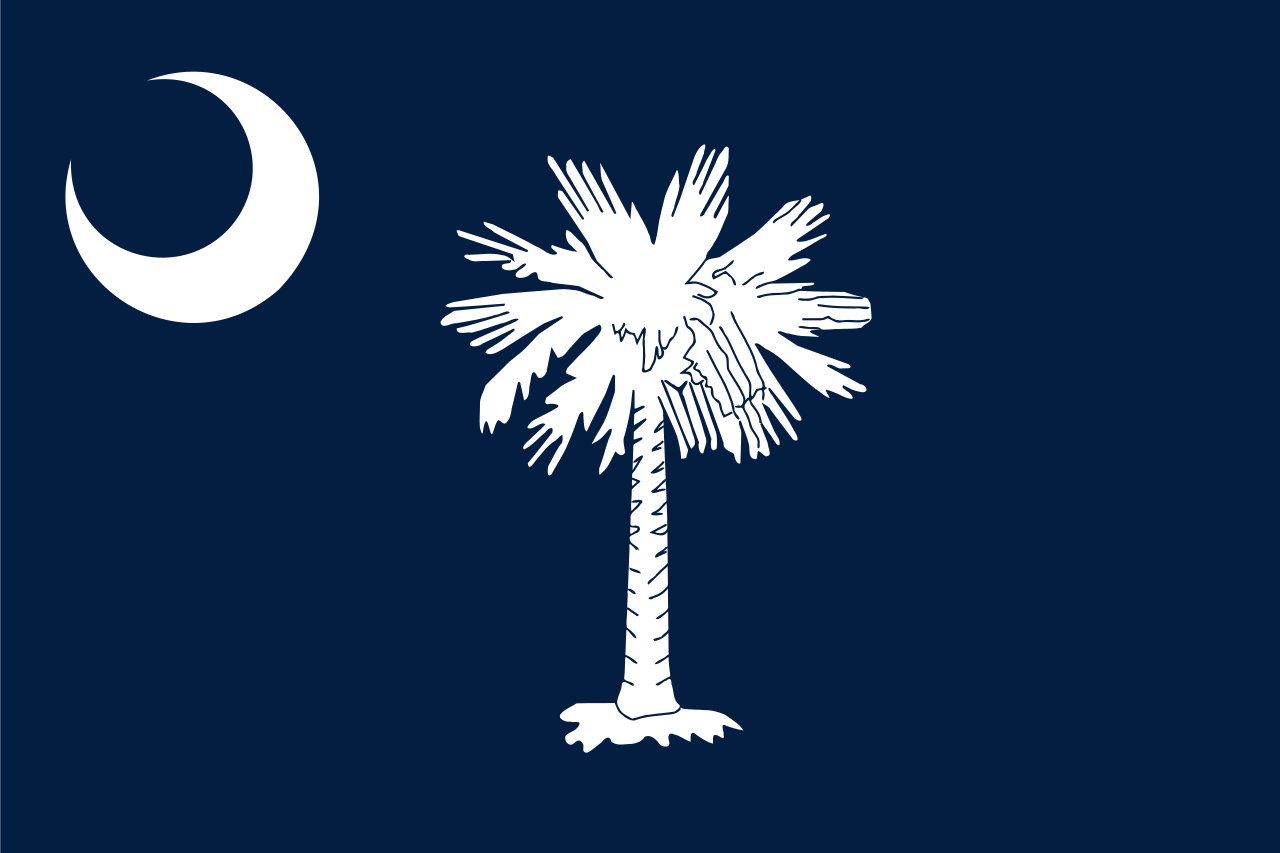
The South Carolina flag shows a white palmetto tree and a white crescent on an indigo blue field. The crescent recalls the badge of Revolutionary War soldiers, and the palmetto recalls the defense of a fort made of palmetto logs in 1776.
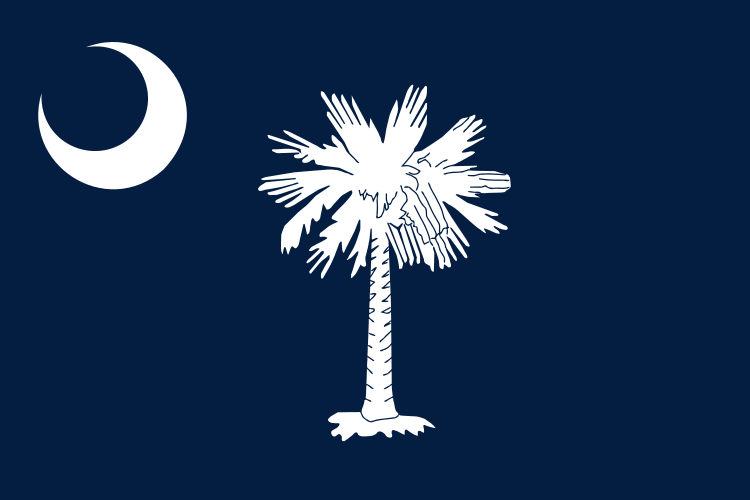
What the South Carolina state flag looks like
The flag of South Carolina is easy to describe. It has an indigo blue field, a deep blue with a slight violet tone. In the center stands a white palmetto tree, a palm with a straight trunk and a crown of fronds. In the upper left corner, near the hoist, is a white crescent with its points facing up. The flag's ratio is 2:3, and there is no text on it.
The design uses only two colors, which makes it one of the simplest and most recognizable U.S. state flags.
South Carolina flag meaning and symbolism
The palmetto honors the Battle of Sullivan's Island on June 28, 1776. Colonel William Moultrie's South Carolina troops defended a fort built of soft palmetto logs, and the logs absorbed the shot from British warships instead of splintering. The fort was later named Fort Moultrie, and the palmetto became the state's emblem, which is why South Carolina is called the Palmetto State.
The crescent goes back to 1775, when Moultrie designed a blue flag for his troops. It is based on the silver badge that soldiers wore on their caps, which was shaped like a crescent. The blue of the field is said to match the color of the uniforms of the state's militia. The state motto, Dum spiro spero ("while I breathe, I hope"), appears on the state seal and not on the flag.
History of the South Carolina flag
The first flag of the state's troops in 1775 was a blue field with a white crescent in the corner. In January 1861 a new flag was adopted that added the palmetto tree to the blue field and crescent. This is the basic design in use today.
The legislature formally confirmed the flag in 1910. Early versions of the palmetto and the crescent varied a little in shape, and the exact colors and the drawing of the tree were fixed more precisely later on. The flag has not been replaced.
Answering a question people often ask: the "old" South Carolina flag is the 1775 version without the palmetto, and the flag has otherwise stayed close to its 1861 form. Compare it with North Carolina and Georgia on the U.S. state flags page.
Flying the South Carolina flag
The flag of the United States takes the position of honor, and the state flag is flown beneath or beside it. The flag is displayed at state buildings and at events across the state.
South Carolina flag colors
#041E42RGB
4, 30, 66CMYK
94, 55, 0, 74#FFFFFFRGB
255, 255, 255CMYK
0, 0, 0, 0South Carolina flag facts
| Adopted | January 28, 1861 |
|---|---|
| Proportions | 2:3 |
| Symbols | Sabal palmetto, field |
| State capital | Columbia |
| State motto | Dum spiro spero |
| Population | 5,118,425 |
South Carolina state flag FAQ
Why is the crescent moon on the South Carolina flag?
It comes from the silver crescent badge worn on the caps of South Carolina soldiers in 1775. Colonel William Moultrie placed it on the blue flag he made for his troops.
What does the palmetto tree on the South Carolina flag mean?
It honors the 1776 defense of a palmetto-log fort on Sullivan's Island, where the soft logs absorbed British cannon fire. South Carolina is called the Palmetto State for this reason.
What was the old South Carolina flag?
The earlier flag, from 1775, was a plain blue field with a white crescent in the corner. The palmetto tree was added in 1861.
When did South Carolina change its flag?
The palmetto was added in January 1861, and the legislature formally confirmed the flag in 1910. The design has remained the same since then.
What is the South Carolina state motto?
The motto is Dum spiro spero, Latin for "while I breathe, I hope". It appears on the state seal.