Flag of North Carolina
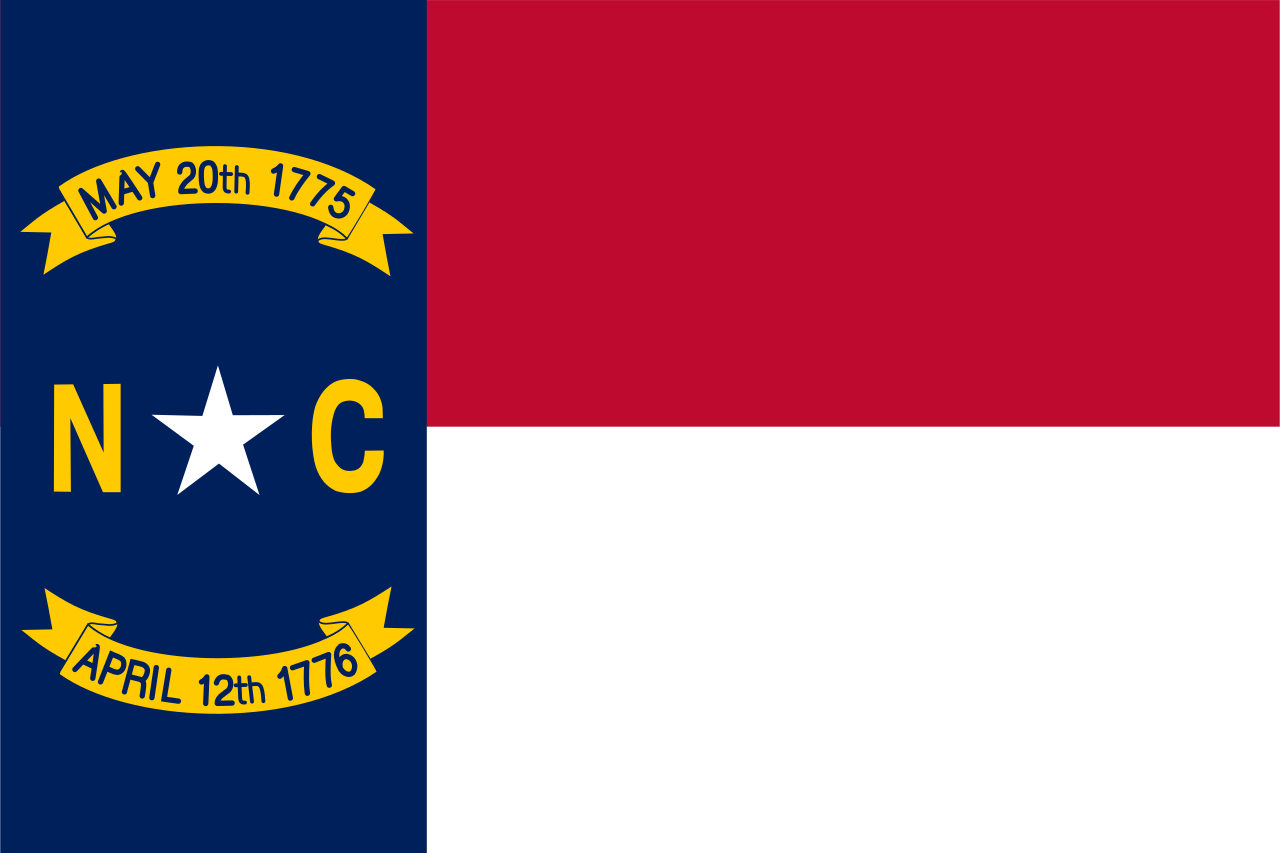
The North Carolina flag combines a blue vertical bar at the hoist with a white star, the letters N and C and two dates, beside horizontal red and white bars. It was adopted in 1885 and is one of the few state flags that carry dates.
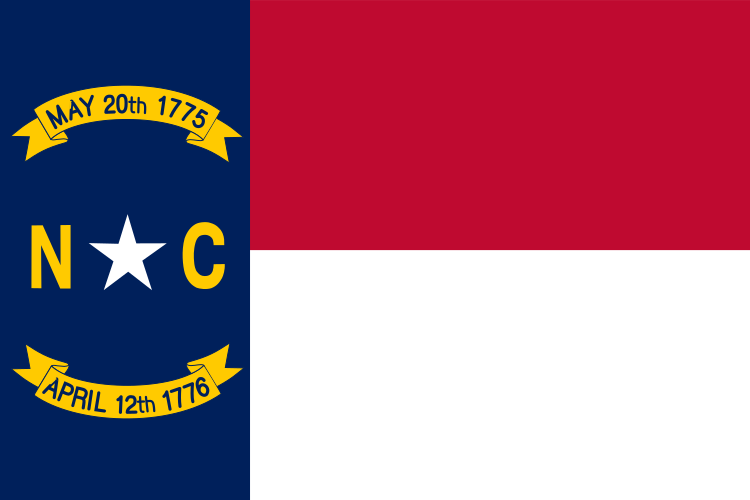
What the North Carolina state flag looks like
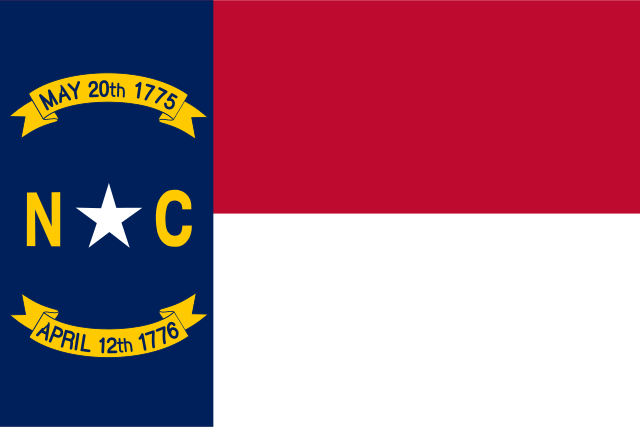
The flag is divided into two parts. At the hoist, a blue vertical bar, called the union, takes up about a third of the flag. In its center is a white star, with a gold letter N on the left of the star and a gold letter C on the right. Above the star runs a gold scroll with the date May 20th 1775, and below it a second gold scroll with April 12th 1776.
The remaining part of the flag, the fly, is made of two equal horizontal bars: red on top and white beneath. The flag has a ratio of 2:3. The blue, red and white are the colors of the United States flag.
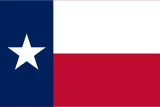
People often notice that the layout resembles the Texas flag, which also has a blue vertical bar with a star and red and white bars. The two differ in the order of the bars and in the details of the blue section.
North Carolina flag meaning and symbolism
The two dates are the main feature of the design, and both mark early steps toward independence. May 20, 1775 is the date of the Mecklenburg Declaration of Independence, which North Carolinians have long cited as an early break with British rule, although historians debate the document. April 12, 1776 is the date of the Halifax Resolves, when North Carolina's provincial congress authorized its delegates to vote for independence. This was the first formal state action of its kind in the colonies.
The letters N and C stand for North Carolina. The colors follow the national palette of red, white and blue. The star is a simple emblem of the state. The state motto, Esse quam videri ("to be rather than to seem"), appears on the state seal and not on the flag.
History of the North Carolina flag
North Carolina's flag history has two major steps. An earlier flag, adopted in 1861, used a different lower date.
The present flag was adopted by the General Assembly in 1885. It kept the layout but replaced the earlier lower date with April 12, 1776, so the flag celebrates early independence actions. It has flown with few changes since.
This answers a frequent question: the flag has two dates because it commemorates two separate events from the Revolutionary era. As for rivalry with Texas, the Lone Star flag was adopted in 1839, decades before North Carolina's 1885 design.
Flying the North Carolina flag
As with any state flag, the national flag is flown in the position of honor. The North Carolina flag is displayed at state buildings and schools and is easy to find at events across the state. You can see how it compares to others on the U.S. state flags page, including neighbors such as South Carolina, or read about the flag of the United States.
North Carolina flag colors
#FFFFFFRGB
255, 255, 255CMYK
0, 0, 0, 0#BF0A30RGB
191, 10, 48CMYK
0, 95, 75, 25#00205BRGB
0, 32, 91CMYK
100, 65, 0, 64#FFCA00RGB
255, 202, 0CMYK
0, 21, 100, 0North Carolina flag facts
| Adopted | March 9, 1885 |
|---|---|
| Proportions | 2:3 |
| State capital | Raleigh |
| State motto | Esse quam videri |
| Population | 10,439,388 |
North Carolina state flag FAQ
Why does the North Carolina flag have two dates?
May 20, 1775 recalls the Mecklenburg Declaration, and April 12, 1776 marks the Halifax Resolves, which authorized a vote for independence. Together they celebrate the state's early role in the American Revolution.
Has the North Carolina flag changed?
Yes. An earlier flag adopted in 1861 used a different lower date. The current design replaced it in 1885 and has stayed nearly unchanged since.
Which flag was first, NC or Texas?
The Texas flag came first, adopted in 1839. North Carolina adopted its present flag in 1885, with a similar blue, white and red layout.
What is special about the NC state flag?
It is one of the few state flags that display dates. It also carries the initials N and C and a white star beside red and white bars.
What is the only flag that can fly above the U.S. flag?
Under the U.S. Flag Code, the only flag allowed above the national flag is the church pennant, and only during Navy chaplain services held at sea.