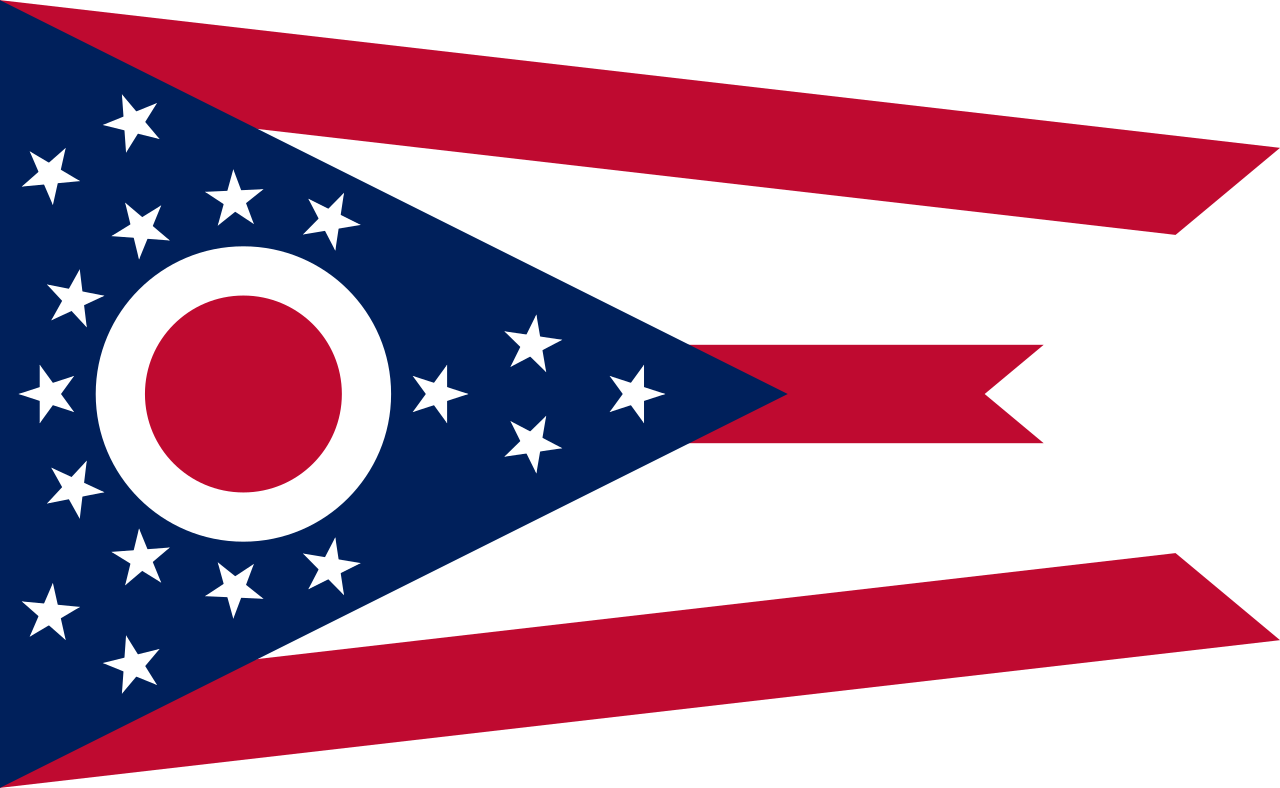
Flag of Ohio
The Ohio flag is the only U.S. state flag that is not a rectangle. It is a swallowtail "burgee" with red and white stripes, a blue triangle and 17 white stars around a red-centered circle. John Eisenmann designed it in 1901.
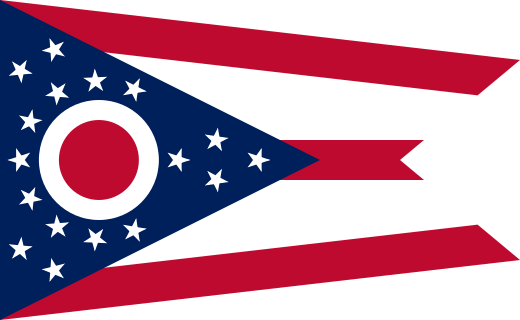
What the Ohio state flag looks like
The Ohio state flag is a pennant-shaped flag called a burgee, with two points at the fly end where a notch is cut out. It is the only state flag in the country that is not rectangular. The proportions are 8:13.
Five horizontal stripes run across the flag: three red and two white, with red at the top and bottom. At the hoist is a blue triangle that reaches into the stripes and ends in a point. Inside the triangle sit 17 white stars. Thirteen of them form a group around a white circle with a red center, and the other four are arranged in a point along the triangle's edge.
The white circle with a red center resembles the letter "O", the initial of Ohio, and also suggests a buckeye, the state tree and a nickname for the state. The flag uses red, white and blue, the colors of the U.S. flag.
Ohio flag meaning and symbolism
The design carries several commonly cited meanings. The blue triangle is said to stand for Ohio's hills and valleys, and the red and white stripes for its roads and waterways. The 17 stars show that Ohio was the 17th state to join the Union: the 13 original colonies plus four more admitted before it. The stars' grouping, with the circle at the center, is read as the letter O.
The motto "With God, all things are possible" is the state motto, adopted in 1959. It is on the state seal and does not appear on the flag.
History of the Ohio flag
Ohio entered the Union in 1803, and the state did not have an official flag for nearly a century. The present design came from John Eisenmann, an architect from Cleveland, who created it in 1901 for the Ohio display at the Pan-American Exposition in Buffalo, New York. It was meant as a banner for the state's exhibit.
The design was well received, and the General Assembly formally adopted it as the state flag in 1902. It has remained the same since. The swallowtail shape follows a tradition from military and naval pennants, which is why the flag looks like one used on a ship.
Because of its unusual form, the Ohio flag appears in discussions of flag design as an example of a state breaking from the standard rectangle. See the U.S. state flags page for others, including neighbors Pennsylvania and Michigan.
Flag rules and etiquette in Ohio
Ohio follows the national rule that the flag of the United States is flown in the place of honor. The Ohio flag has no emoji of its own.
Ohio flag colors
#FFFFFFRGB
255, 255, 255CMYK
0, 0, 0, 0#BF0A30RGB
191, 10, 48CMYK
0, 95, 75, 25#00205BRGB
0, 32, 91CMYK
100, 65, 0, 64Ohio flag facts
| Adopted | May 9, 1902 |
|---|---|
| Proportions | 8:13 |
| Designer | John Eisenmann |
| State capital | Columbus |
| State motto | With God, all things are possible |
| Population | 11,799,448 |
Ohio state flag FAQ
Why is the Ohio flag not rectangular?
Its designer, John Eisenmann, chose a swallowtail pennant, or burgee, shape for the 1901 design. The notched shape follows military and naval pennants and makes Ohio's flag unique among state flags.
Why are there 17 stars on the Ohio flag?
Ohio was the 17th state admitted to the Union. Thirteen stars represent the original colonies and four more represent the states admitted before Ohio.
What is the Ohio motto?
The state motto is "With God, all things are possible". It was adopted in 1959 and is on the state seal, not the flag.
Is there an Ohio flag emoji?
No. There are no emoji for U.S. state flags in the Unicode standard, so the Ohio flag has no emoji of its own.
What do the stripes and triangle on the Ohio flag mean?
The red and white stripes are commonly said to represent roads and waterways, and the blue triangle represents hills and valleys.