Flag of Pennsylvania
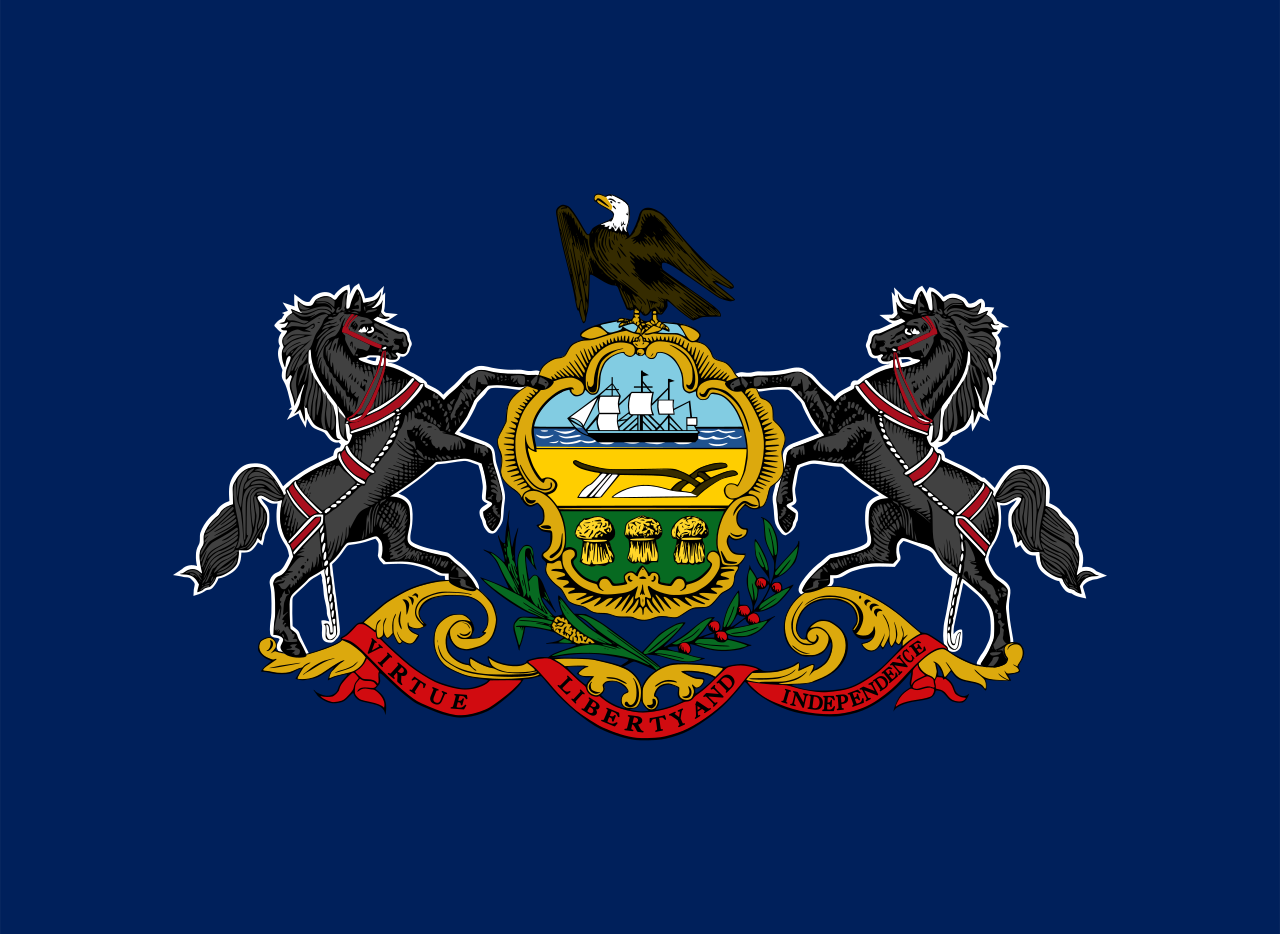
The Pennsylvania flag displays the state coat of arms on a deep blue field, with two black horses holding up a shield topped by a bald eagle. The design was made the official state flag in 1907.
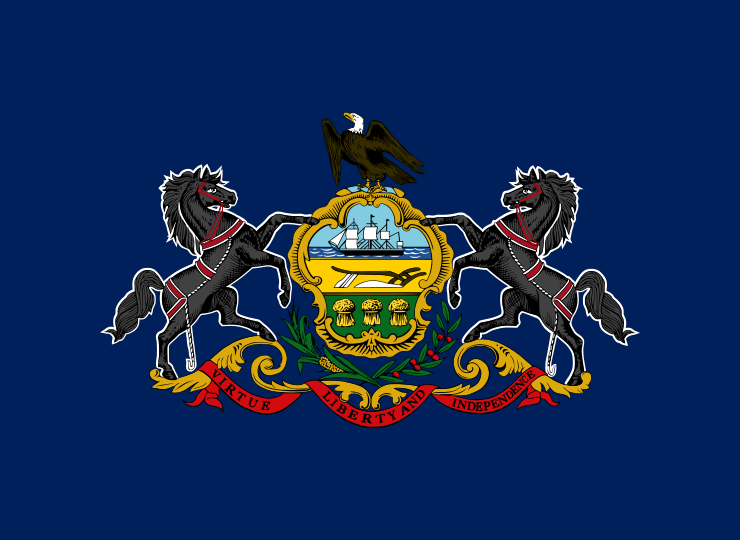
What the Pennsylvania state flag looks like
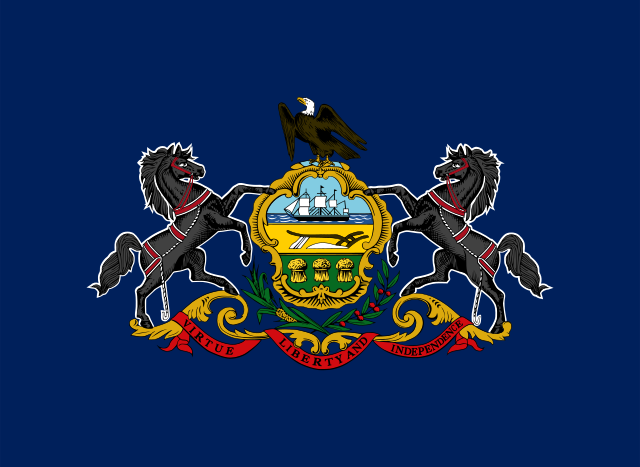
The state flag of Pennsylvania has a deep blue field with the full coat of arms in the center. The arms are built around a shield held up by two black horses, one on each side, rearing on their hind legs. The shield is divided into three parts. At the top is a ship under full sail on a sea, below it a plow, and at the bottom three golden sheaves of wheat.
Above the shield sits a bald eagle with spread wings. Beneath the shield, a corn stalk and an olive branch cross each other. A white ribbon below them carries the motto Virtue, Liberty and Independence.
Pennsylvania flag meaning and symbolism
The parts of the coat of arms refer to the economy and values of the state. The ship stands for trade and commerce through the Delaware River and the ports of the state. The plow stands for agriculture, and the three sheaves of wheat for fertility and prosperity. The olive branch and corn stalk are symbols of peace and abundance. The bald eagle is the national bird.
The black horses are the feature people ask about most. The horses are commonly said to be a symbol of strength and power, and they have been part of the state arms since the 18th century. The motto, Virtue, Liberty and Independence, reflects the ideals of the American Revolution, when the state was a center of the movement. Pennsylvania is also known as the Keystone State, though the keystone is not on the flag.
History of the Pennsylvania flag
Pennsylvania's coat of arms dates to the Revolutionary era, and a blue flag with the arms was used by the state's militia and regiments for generations. For a long time, however, there were different versions of the arms and the flag, and no one standard.
The state legislature fixed the design in 1907, requiring a blue field of a defined shade with the coat of arms in the center. The arms themselves had been settled in 1875. The flag has remained the same since then.
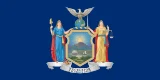
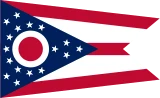
As a flag built around a seal, Pennsylvania belongs to a large group of states with a coat of arms or seal on blue. Compare it with New York and Ohio on the U.S. state flags page.
Flag rules and etiquette in Pennsylvania
Pennsylvania follows the national rule that the flag of the United States is flown at the position of honor, above the state flag. The only flag allowed above it under the U.S. Flag Code is the church pennant, during Navy services held at sea.
Pennsylvania flag colors
#00205BRGB
0, 32, 91CMYK
100, 65, 0, 64#2B2B2BRGB
43, 43, 43CMYK
0, 0, 0, 83#0C0C0CRGB
12, 12, 12CMYK
0, 0, 0, 95Pennsylvania flag facts
| Adopted | June 13, 1907 |
|---|---|
| Proportions | 19:26 |
| State capital | Harrisburg |
| State motto | Virtue, Liberty, and Independence |
| Population | 13,002,700 |
Pennsylvania state flag FAQ
What do the horses on the Pennsylvania flag mean?
The two black horses are the supporters of the shield in the state coat of arms. They are commonly seen as symbols of strength and power.
What does the Pennsylvania flag symbolize?
The ship, plow and wheat sheaves stand for commerce, farming and prosperity. The motto, Virtue, Liberty and Independence, reflects the ideals of the American Revolution.
What is Pennsylvania's state flag?
It is a dark blue flag with the state coat of arms in the center, officially adopted in 1907.
Is Pennsylvania changing its flag?
The flag has been the same since 1907, and the state has not adopted a new design. Several other states have recently redesigned their flags, which prompts the question.
What is the only flag that can fly above the U.S. flag?
Under the U.S. Flag Code, only the church pennant may fly above the national flag, and only during Navy chaplain services at sea.