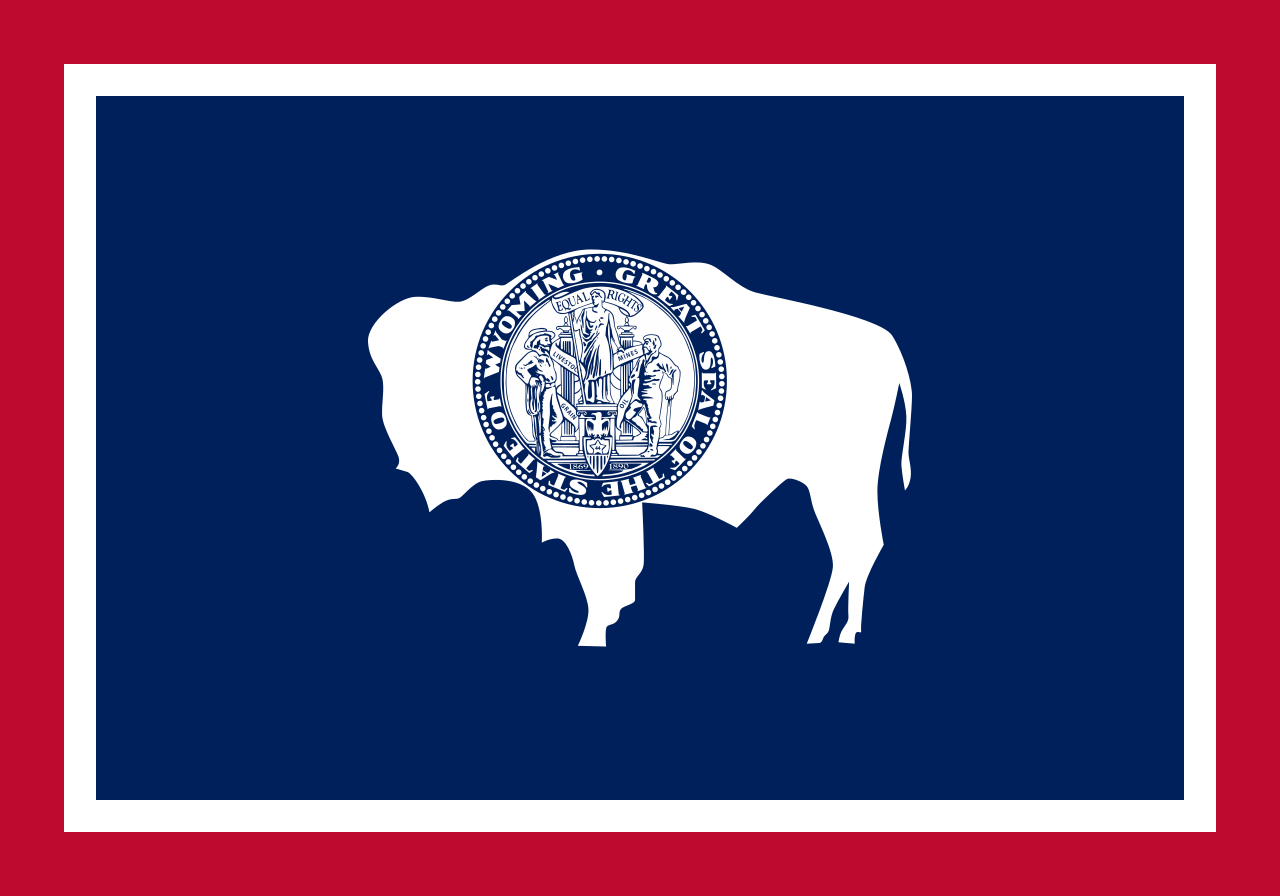
Flag of Wyoming
The Wyoming flag shows a white bison on a deep blue field, framed by a white and a red border. The bison carries the state seal as a brand on its side. It was designed in 1916 by Verna Keays.
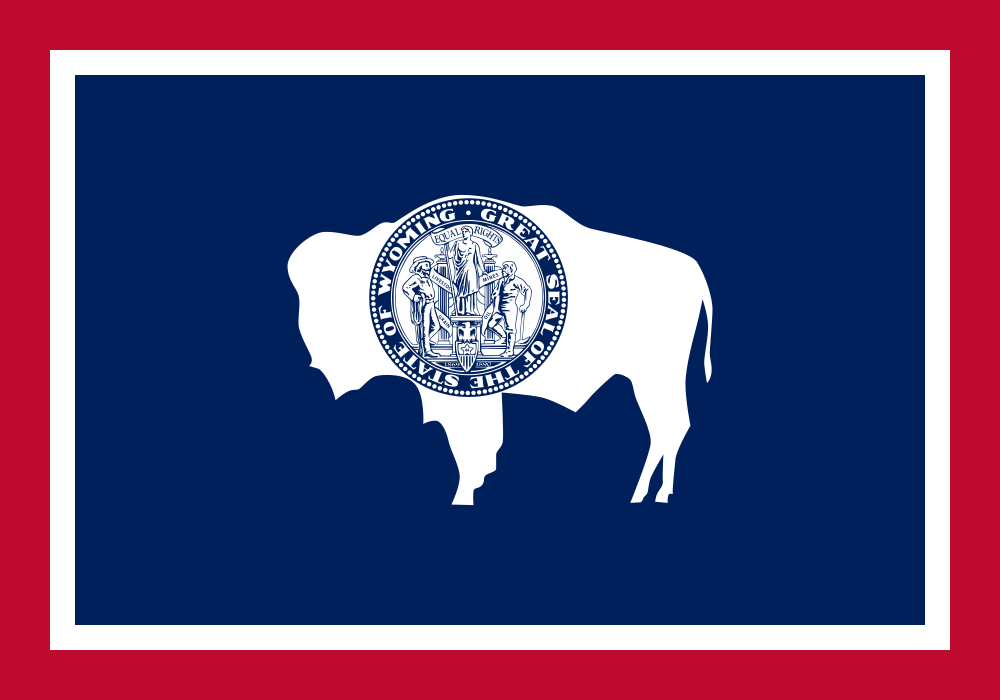
What the Wyoming flag looks like
The state flag of Wyoming has a deep blue field with a white silhouette of an American bison in the center. The animal faces the hoist. On its side is a round brand showing the state seal, which marks the bison in the way ranchers brand their cattle. Around the blue field there is a thin white border and a wider red border on the outside.
The flag has proportions of 7:10, so it is a little closer to a square than most state flags. There is no text on the flag itself, although the seal shown inside the brand includes the words Equal Rights on a banner and the dates 1869 and 1890, which mark the organization of Wyoming Territory and its admission as a state.
Wyoming flag meaning and symbolism
The bison, also called buffalo, recalls the animals that once roamed the plains and is a well-known symbol of the West. The brand, the mark of livestock ownership, refers to the importance of ranching. Together they show a link between wild nature and the work of settlers.
The colors have official meanings. Red stands for the Native Americans and the blood of pioneers who gave their lives to settle the region. White stands for purity and uprightness. Blue, the color of the sky and the mountains, stands for fidelity, justice and virility. The seal's figure of a woman embodies the rights of women, a theme tied to Wyoming's nickname, the Equality State.
History of the Wyoming flag
Wyoming became the 44th state in 1890, but it had no official flag for more than twenty years. In 1916 the Wyoming Daughters of the American Revolution held a design contest, and the winner was Verna Keays, a recent graduate of the Art Institute of Chicago. Governor Robert D. Carey signed the bill adopting her design on January 31, 1917.
Keays's original flag was changed in only a small way: her bison faced the fly, but the bison was later made to face the hoist, and that is now the practice. There has been no major redesign since. Its colors are the same red, white and blue as the flag of the United States, and it can be compared with other U.S. state flags.
Wyoming flag colors
#00205BRGB
0, 32, 91CMYK
100, 65, 0, 64#BF0A30RGB
191, 10, 48CMYK
0, 95, 75, 25#FFFFFFRGB
255, 255, 255CMYK
0, 0, 0, 0Wyoming flag facts
| Adopted | January 31, 1917 |
|---|---|
| Proportions | 7:10 |
| Designer | Verna Keays |
| State capital | Cheyenne |
| State motto | Equal Rights |
| Population | 576,851 |
Wyoming state flag FAQ
What does the Wyoming flag symbolize?
The bison was once called the "monarch of the plains", and the brand stands for the western custom of branding. Red, white and blue represent pioneers and Native Americans, purity, and fidelity and justice.
Why is the Wyoming flag a bison?
The bison is a well-known symbol of the Great Plains and the West, and the design makes it the center of the flag. It was part of the winning design from a 1916 contest, and the state kept it after adopting the flag in 1917.
Who designed the Wyoming flag?
Verna Keays, a recent graduate of the Art Institute of Chicago, designed it. It was adopted on January 31, 1917.
What is the Wyoming state motto?
The motto is Equal Rights, the words on the banner held by the female figure on the state seal, which embodies the rights of women.
Did Wyoming redesign its flag?
No. The 1917 design is still the state flag, with only a small change: the bison now faces the hoist.