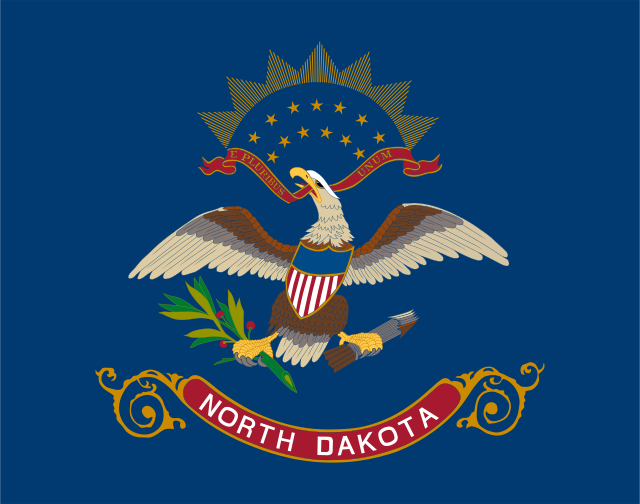
Flag of North Dakota
The North Dakota flag shows a bald eagle with spread wings on a dark blue field, holding arrows and an olive branch. Adopted in 1911, it is based on the banner carried by North Dakota troops in the Spanish-American War and the Philippines.
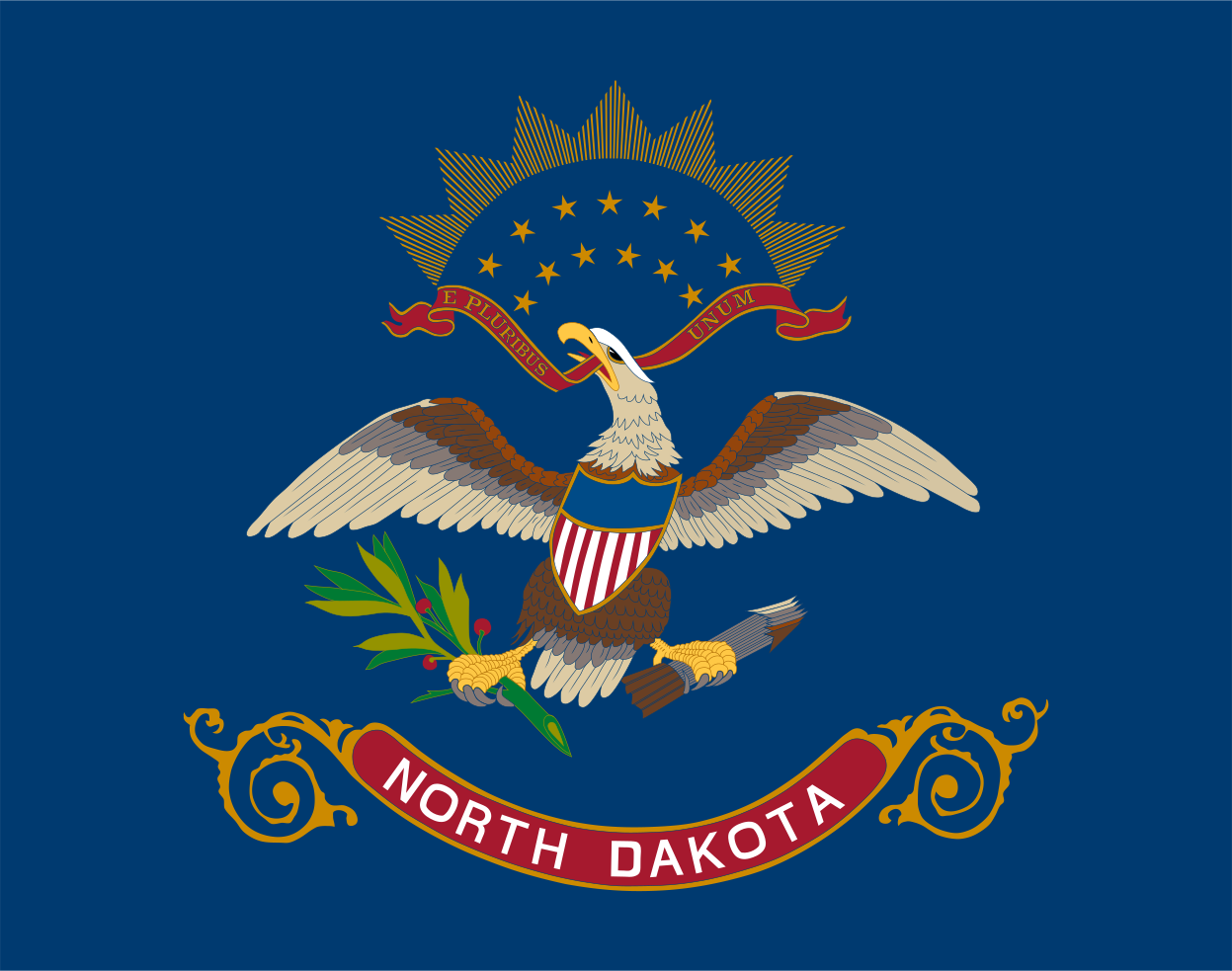
What the North Dakota state flag looks like
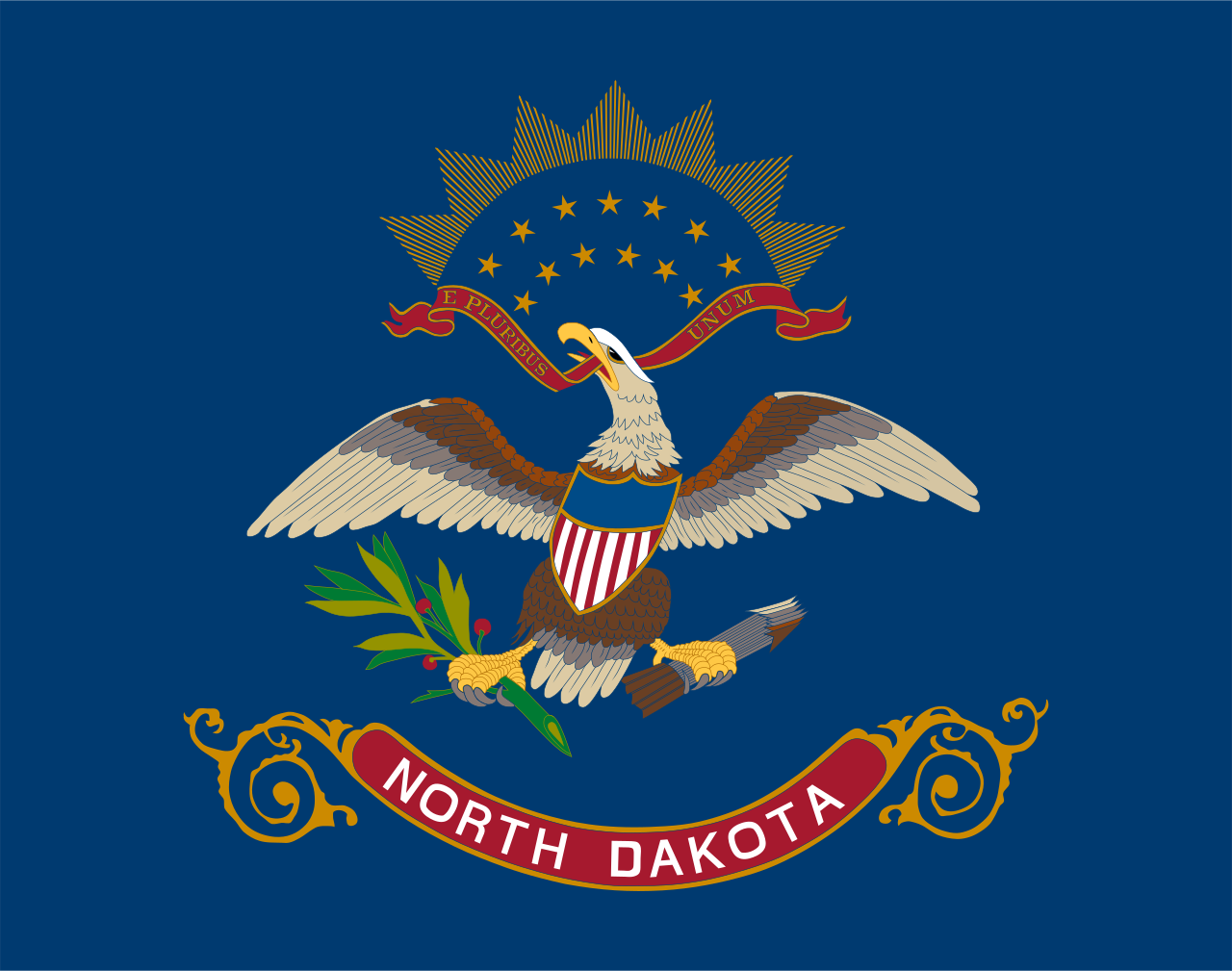
The state flag has a dark blue field with a large bald eagle in the center. The eagle's wings are spread. On its breast is a shield with red and white stripes, in the style of the U.S. flag. In one talon it holds an olive branch and in the other a bundle of arrows. In its beak the eagle holds a scroll with the Latin words E Pluribus Unum, meaning "out of many, one".
Above the eagle is a curved row of stars, and below it a red scroll carries the words North Dakota. The flag's proportions are unusual: it is about 1.27 times as wide as it is tall, which makes it look squarer than most state flags. A yellow fringe often runs along the edge of flags made for display.
North Dakota flag meaning and symbolism
The design borrows from American national symbols rather than local ones. The bald eagle is the national bird, and the shield echoes the stars and stripes. The olive branch is a classic symbol of peace and the arrows stand for readiness to defend it. The motto E Pluribus Unum appears on the Great Seal of the United States.
The row of stars is usually explained as a reference to the states and the state's place within the Union. The blue and red follow the national colors. The state motto, "Liberty and Union, Now and Forever, One and Inseparable", is on the state seal and not on the flag.
History of the North Dakota flag
North Dakota became a state in 1889 and had no official flag for more than twenty years. When the First North Dakota Volunteer Infantry went to the Philippines in 1898 during the Spanish-American War and the Philippine-American War, it carried a regimental banner with an eagle on a blue field. After the veterans returned, the banner became the model for the state flag.
The legislature adopted the flag in 1911. The law called for a flag that follows the regimental banner, and in the following decades the legislature clarified details of the design so that it would match the original more closely. The state's colors and the eagle have stayed the same.
Like many state flags, it is a seal-style emblem on a plain background, which makes the details hard to read at a distance. You can compare it with South Dakota and others on the U.S. state flags page.
Interesting facts about the North Dakota flag
- It is modeled on a flag that served in a war, not on a design created in a contest.
- Its proportions are among the least rectangular of any U.S. state flag.
- It is a one-sided flag. The only U.S. state with two different sides is Oregon.
For the national flag, see the flag of the United States.
North Dakota flag colors
#003A70RGB
0, 58, 112CMYK
100, 48, 0, 56#A6192ERGB
166, 25, 46CMYK
0, 85, 72, 35#D4C4A2RGB
212, 196, 162CMYK
0, 8, 24, 17#44544BRGB
68, 84, 75CMYK
19, 0, 11, 67North Dakota flag facts
| Adopted | 1911 |
|---|---|
| Proportions | 11:14 |
| State capital | Bismarck |
| Population | 779,094 |
North Dakota state flag FAQ
What does the North Dakota flag symbolize?
The eagle, shield, olive branch and arrows are drawn from the national symbols of the United States. They stand for the Union, peace and readiness to defend it.
Where does the North Dakota flag design come from?
It is modeled on the regimental banner carried by North Dakota volunteers in the Philippines during the Spanish-American War period. The state adopted it in 1911.
What is North Dakota's state motto?
The motto is "Liberty and Union, Now and Forever, One and Inseparable". It appears on the state seal and not on the flag.
What is the only state flag that is two-sided?
Oregon is the state with different designs on its two sides. North Dakota's flag is single-sided.
Who is the only president on a state flag?
George Washington appears on the flag of Washington state. The North Dakota flag shows no person.