Flag of Togo
The Togo flag has five horizontal stripes, alternating green and yellow, with a red square in the upper hoist corner holding a white five-pointed star. It was designed by the Togolese artist Paul Ahyi and adopted in 1960.
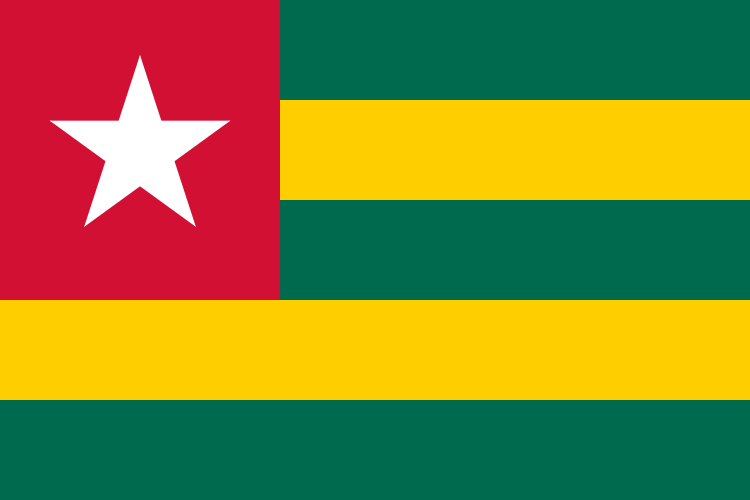
What the flag of Togo looks like
The flag of Togo has five equal horizontal stripes: green, yellow, green, yellow and green. In the upper left corner, next to the pole, is a red square canton that covers the top three stripes. Inside the canton is a white five-pointed star placed in the center.
The green and yellow stripes combine with red to make the Pan-African colors, which many African countries took after Ethiopia's flag. A copy of the flag for download is on the Togo flag download page, and you can also see the Togo flag emoji.
Togo flag colors
Color codes measured from the official design. Use HEX for the web and CMYK for print.
HEX
#006A4ERGB
0, 106, 78CMYK
100, 0, 26, 58 HEX
#FFCE00RGB
255, 206, 0CMYK
0, 19, 100, 0 HEX
#D21034RGB
210, 16, 52CMYK
0, 92, 75, 18 HEX
#FFFFFFRGB
255, 255, 255CMYK
0, 0, 0, 0 Togo flag meaning and symbolism
The meanings usually given are:
- Green for hope and agriculture.
- Yellow for faith, labor and the country's mineral wealth.
- Red for the blood shed in the struggle for independence, and for charity and loyalty.
- The white star for peace and for the light that guides the country. Its white color is read as purity.
The five stripes are also said to represent the five regions of Togo: Maritime, Plateaux, Centrale, Kara and Savanes. The meanings are traditional, not set out in great detail by law.
History of the Togo flag
In 1884 Germany declared a protectorate over the coast that became Togoland. After the First World War the territory was split into a British mandate in the west and a French mandate in the east, and the French part flew the tricolor of France. The French area became an autonomous republic in 1956 and an independent country on 27 April 1960.
The present flag came with independence. It was designed by Paul Ahyi (1930-2010), a well-known Togolese sculptor and painter who also made monuments in Lomé, including the Independence Monument. He combined the Pan-African colors in alternating stripes with a red canton and a white star.
The flag has been used in this form ever since independence. Official dates usually give 27 or 28 April 1960; the flag was raised on the day of independence.
Flags similar to Togo's flag
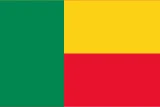
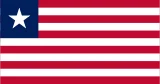
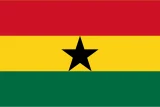
Togo's flag shares its colors with Benin and Ghana, its neighbors, and the star in a canton recalls Liberia, which has red and white stripes with a blue canton. See the full list on the Africa flags page.
Togo flag facts
| Country | Togo |
|---|---|
| Flag adopted | April 27, 1960 |
| Proportions | 2:3 |
| Colors | #006A4E, #FFCE00, #D21034, #FFFFFF |
| Symbols | field, five-pointed star, canton |
| Flag emoji | 🇹🇬 |
| Country code | TG, TGO (ISO 3166) |
| Capital | Lomé |
| Continent | Africa |
| Population | 7,797,694 |
| Area | 56,785 km² |
| Currency | West African CFA franc |
| National anthem | Terre de nos aïeux |
Togo flag: frequently asked questions
What does the Togo flag symbolize?
Green stands for hope and agriculture, yellow for faith and mineral wealth, red for the blood of those who fought for independence, and the white star for peace and purity. The five stripes are said to stand for the five regions.
Who designed the flag of Togo?
The flag was designed by Paul Ahyi, a Togolese artist and sculptor. It was adopted at independence in April 1960.
What was Togo originally called?
The territory was called Togoland during the German colonial period starting in 1884. After 1919 it was divided into British Togoland and French Togoland, and the French part became the Togolese Republic.
Which language does Togo speak?
French is the official language. Ewe and Kabiyè are national languages, and many other local languages are spoken across the country.
Where is Togo?
Togo is a narrow country in West Africa on the Gulf of Guinea. It borders Ghana to the west, Benin to the east and Burkina Faso to the north, and its capital is Lomé.