Flag of Benin
The Benin flag has a green vertical band at the hoist and two horizontal bands, yellow above red, at the fly. It uses the Pan-African colors and was first raised in 1959, changed for 15 years under a Marxist government, and restored in 1990.
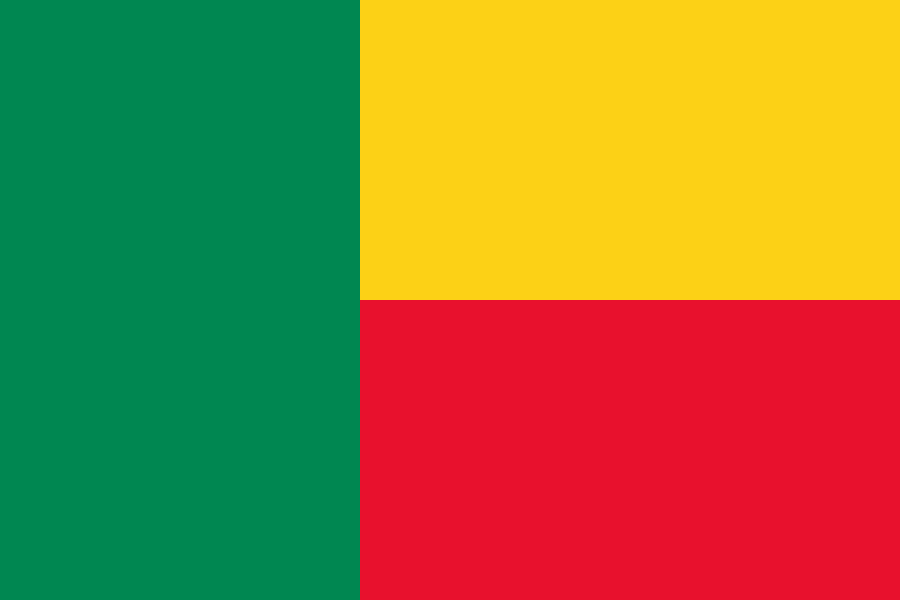
What the flag of Benin looks like
The flag of Benin is divided into two parts. A green vertical band takes up the left side, next to the pole, and covers about two-fifths of the flag's length. The remaining area is split into two equal horizontal bands, with yellow on top and red below. The width-to-height ratio is 2:3.
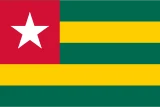
There is no emblem or coat of arms on the national flag. The design is plain and is recognized by this layout alone. It resembles the flag of Togo, which also uses green, yellow and red, but Togo's flag has horizontal stripes and a white star on a red canton.
Benin flag colors
Color codes measured from the official design. Use HEX for the web and CMYK for print.
HEX
#008751RGB
0, 135, 81CMYK
100, 0, 40, 47 HEX
#FCD116RGB
252, 209, 22CMYK
0, 17, 91, 1 HEX
#E8112DRGB
232, 17, 45CMYK
0, 93, 81, 9 Benin flag meaning and symbolism
Green, yellow and red are the Pan-African colors, used by many African states after independence. In Benin, the colors are traditionally explained as follows:
- Green stands for hope and revival.
- Yellow stands for the wealth of the country, and is also linked to the savanna in the north.
- Red stands for courage and the blood of the ancestors who defended the land.
These readings are widely repeated in Benin, but the law that describes the flag sets out its design rather than a formal meaning for each color, so they are traditional rather than official. The same colors also reappear in many neighboring countries, such as Togo.
History of the Benin flag
Benin was a French colony and, until 1975, was known as Dahomey. The flag was adopted on 16 November 1959, when the country was a self-governing republic within the French Community. It stayed in use when Dahomey became fully independent on 1 August 1960.
In 1972 Mathieu Kérékou took power in a military coup and soon declared the state to be Marxist-Leninist. On 30 November 1975 the country was renamed the People's Republic of Benin, and a new flag replaced the old one. It was a plain green field with a red star in the upper left corner. Green had been used in the original flag, and the red star was a typical symbol of socialist states.
The Marxist system ended after a national conference in 1990, and the green, yellow and red flag was brought back on 1 August 1990, as the country moved to multiparty democracy. It has remained the flag of the Republic of Benin ever since.
Benin flag and the Kingdom of Benin
People searching for a Benin flag are sometimes looking for the Kingdom or Empire of Benin, which is a different place. That kingdom was centered on the city of Benin in what is now southern Nigeria, and the modern country took the name Benin only in 1975, after the Bight of Benin on its coast. No reliable flag of the historical kingdom is known. Images labeled as such are modern creations or flags from other countries.
Benin flag facts
| Country | Republic of Benin |
|---|---|
| Flag adopted | August 1, 1990 |
| Proportions | 2:3 |
| Colors | #008751, #FCD116, #E8112D |
| Symbols | field, flanche |
| Flag emoji | 🇧🇯 |
| Country code | BJ, BEN (ISO 3166) |
| Capital | Porto-Novo |
| Continent | Africa |
| Population | 14,111,034 |
| Area | 114,763 km² |
| Currency | West African CFA franc |
| National anthem | L'Aube Nouvelle |
Benin flag: frequently asked questions
What does the Benin flag symbolize?
Green is read as hope and revival, yellow as the country's wealth, and red as courage and the blood of ancestors. They are the Pan-African colors, which many African states adopted around independence.
When did Benin change its flag?
The current flag dates from 1959. It was replaced on 30 November 1975, when a Marxist government introduced a green flag with a red star, and it was reinstated on 1 August 1990.
What was the original flag of Benin?
The first flag of independent Benin, then called Dahomey, is the same green, yellow and red design that is used today. It was adopted in 1959.
What country is Benin today, and what was it called before?
Benin is a republic in West Africa, between Togo and Nigeria. It was named Dahomey until 1975.
Is the flag of the Kingdom of Benin the same as the national flag?
No. The historical Kingdom of Benin was in present-day Nigeria and is not connected to the modern state of Benin. The national flag of the Republic of Benin does not refer to it.