Flag of Norfolk Island
The Norfolk Island flag is a vertical triband of green, white and green with a green Norfolk Island pine in the center of the white band. The pine, which grows nowhere else in such numbers, is the island's best-known symbol. The flag was adopted around 1980.
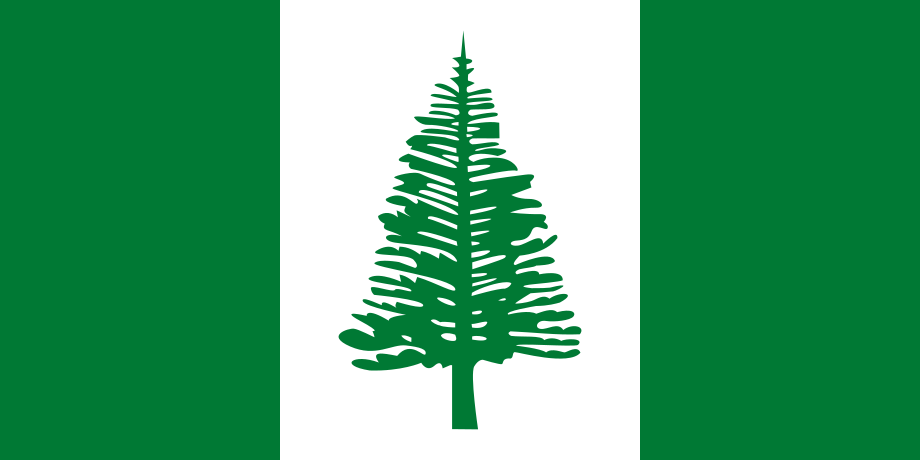
What the flag of Norfolk Island looks like
The flag has three vertical stripes: green, white and green. The white stripe in the middle holds a green Norfolk Island pine (Araucaria heterophylla), drawn with its layered, symmetrical branches. The flag is twice as wide as it is tall, with a ratio of 1:2.
It is one of the few national or territorial flags that show a single tree as the main emblem, and the green and white color scheme makes it easy to recognize. The image on the Norfolk Island flag emoji keeps the three stripes and the tree.
Norfolk Island flag colors
Color codes measured from the official design. Use HEX for the web and CMYK for print.
HEX
#007934RGB
0, 121, 52CMYK
100, 0, 57, 53 HEX
#FFFFFFRGB
255, 255, 255CMYK
0, 0, 0, 0 Norfolk Island flag meaning and symbolism
The Norfolk Island pine is the island's emblem. The tree is tall and grows in a regular, almost geometric shape, and it covers much of the island. It was noted by Captain James Cook, who sighted the island in 1774 and found timber that he thought suitable for ships' masts.
The green bands stand for the vegetation and farmland of the island, while the white is often read as peace. As with most flags of this type, the meanings are traditional rather than defined by law.
History of the Norfolk Island flag
Norfolk Island, 1,400 kilometers off the east coast of Australia, was settled by Britain in 1788 as a dependent colony of New South Wales and then used as a convict settlement. It was abandoned in 1814, reopened as a harsher penal station in 1825, and closed again in 1855. In 1856 the descendants of the Bounty mutineers and their Tahitian companions moved from Pitcairn Island to Norfolk, and many islanders today trace their descent from them.
The island became an external territory of Australia in 1914. The Norfolk Island flag was adopted around 1980, at the time the island gained a measure of self-government, and it has been in use since. Self-government was ended by Australia in 2015, and a regional council now runs the island. The flag remains a symbol of the islanders' separate identity.
Which flag is official on Norfolk Island?
Norfolk Island is an external territory of Australia, so the flag of Australia is the official national flag. The island flag is used locally, flown alongside the Australian flag, and is shown on this page because it is the flag specific to the territory.
Norfolk Island flag facts
| Country | Territory of Norfolk Island |
|---|---|
| Flag adopted | 1980 |
| Proportions | 1:2 |
| Colors | #007934, #FFFFFF |
| Symbols | Araucaria heterophylla, field, pale |
| Flag emoji | 🇳🇫 |
| Country code | NF, NFK (ISO 3166) |
| Capital | Kingston |
| Continent | Oceania |
| Population | 2,188 |
| Area | 35 km² |
| Currency | Australian dollar |
| National anthem | God Save the King |
Norfolk Island flag: frequently asked questions
Why does Norfolk Island have its own flag?
Norfolk Island has a distinct history and identity, and the flag was adopted around 1980, when the island gained its own limited self-government. It is used alongside the Australian flag.
Is Norfolk Island part of Australia?
Yes, as an external territory. Australia is responsible for its defense and foreign affairs. The island has a regional council, and its residents are Australian citizens.
What country owns Norfolk Island?
Australia. It has been an Australian external territory since 1914, after earlier periods as a British penal colony and as a settlement of the Pitcairn islanders.
What is the tree on the Norfolk Island flag?
It is a Norfolk Island pine, a conifer native to the island. It grows in an upright shape with whorled branches and is one of the symbols of the island.
What is the most common surname on Norfolk Island?
Names such as Christian, Quintal, Adams, Nobbs and Buffett are common, because many islanders descend from the Pitcairn settlers who came from the Bounty mutineers.