Flag of Equatorial Guinea
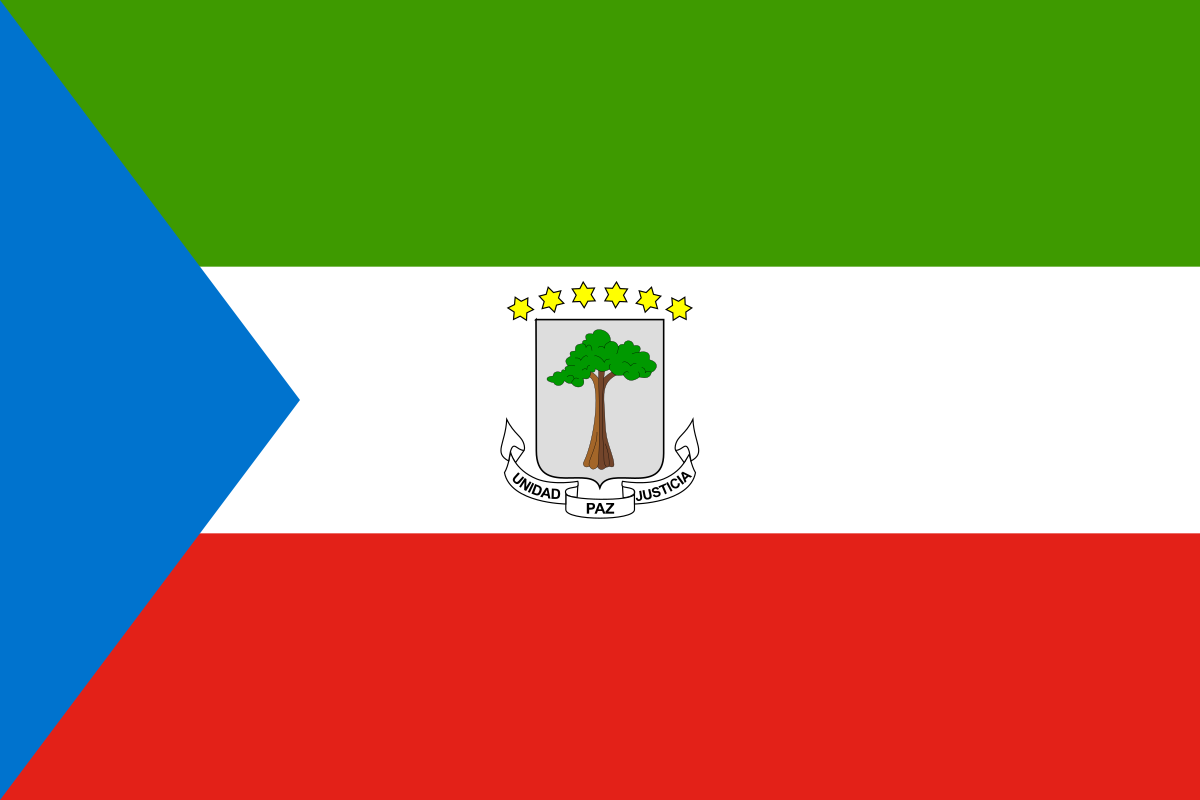
The Equatorial Guinea flag is a horizontal tricolor of green, white and red with a blue triangle at the hoist. The national coat of arms, a silk-cotton tree with six stars, sits in the center of the white band.
What the flag of Equatorial Guinea looks like
The flag has three horizontal bands of equal height: green on top, white in the middle and red at the bottom. A blue isosceles triangle is placed at the hoist, the side nearest the flagpole, and its point reaches toward the center of the flag. The proportions are 2:3.
The coat of arms is centered on the white band. It is a grey shield with a silk-cotton tree (a ceiba) in the middle and six six-pointed stars. Below the shield, a ribbon carries the national motto in Spanish, Unidad, Paz, Justicia (Unity, Peace, Justice). That Spanish motto is the only text on the flag, which reflects the country's history as a Spanish colony; Spanish is one of the three official languages, together with French and Portuguese.
The flag is easy to recognize among African flags because it combines a horizontal tricolor, a triangle and an emblem. You can see the emoji version at the Equatorial Guinea flag emoji page.
Equatorial Guinea flag colors
Color codes measured from the official design. Use HEX for the web and CMYK for print.
HEX
#3E9A00RGB
62, 154, 0CMYK
60, 0, 100, 40 HEX
#E32118RGB
227, 33, 24CMYK
0, 85, 89, 11 HEX
#FFFFFFRGB
255, 255, 255CMYK
0, 0, 0, 0 HEX
#0073CERGB
0, 115, 206CMYK
100, 44, 0, 19 Equatorial Guinea flag meaning and symbolism
The commonly cited meanings of the colors are:
- Green for the country's vegetation.
- White for peace.
- Red for the blood shed in the struggle for independence.
- Blue for the ocean that connects the different parts of the country.
According to local legend, indigenous and Spanish representatives signed their first treaty under a silk-cotton tree, which is why the tree is at the center of the coat of arms.
The six stars stand for the country's continental territory and five islands: the mainland region of Río Muni and the five islands of Bioko, Annobón, Corisco, Elobey Grande and Elobey Chico. Bioko lies in the Gulf of Guinea, apart from the mainland, and the blue triangle is read as the ocean linking the different parts of the country.
History of the Equatorial Guinea flag
Before independence the territory was ruled by Spain and used Spanish flags. Equatorial Guinea became independent from Spain on 12 October 1968. The flag raised that day had the green, white and red bands and the blue triangle; the coat of arms, adopted at independence, was added to the flag later.
In 1978, President Francisco Macías Nguema changed the coat of arms (and with it the flag) to one with a sword, a dagger, an axe, a club, a hoe and a pickaxe, crowned with a chicken. He was overthrown by his nephew Teodoro Obiang Nguema Mbasogo on 21 August 1979, and the earlier symbols were restored.
The name Equatorial Guinea refers to the country's position near the equator. The name does not appear on the flag.
Flags that look like the Equatorial Guinea flag
The country is often mixed up with its neighbors in name rather than appearance. Guinea has a red, yellow and green vertical tricolor, and Guinea-Bissau a red, yellow and green flag with a black star. Neither has a triangle or a tree. Among horizontal green, white and red flags, the Equatorial Guinea flag is set apart by its blue triangle and its emblem.
Equatorial Guinea flag facts
| Country | Equatorial Guinea |
|---|---|
| Flag adopted | August 21, 1979 |
| Proportions | 2:3 |
| Colors | #3E9A00, #E32118, #FFFFFF, #0073CE |
| Symbols | triangle, coat of arms of Equatorial Guinea |
| Flag emoji | 🇬🇶 |
| Country code | GQ, GNQ (ISO 3166) |
| Capital | Ciudad de la Paz |
| Continent | Africa |
| Population | 1,847,549 |
| Area | 28,051 km² |
| Currency | Central African CFA franc |
| National anthem | Caminemos pisando las sendas de nuestra inmensa felicidad |
Equatorial Guinea flag: frequently asked questions
What does the tree on the Equatorial Guinea flag mean?
It is a silk-cotton tree (ceiba) on the national coat of arms. According to local legend, indigenous and Spanish representatives signed their first treaty under a silk-cotton tree.
What does the Guinea-Ecuatorial flag mean?
Green stands for vegetation, white for peace, red for the blood shed for independence and blue for the ocean connecting the different parts of the country. The six stars represent the continental territory and the five islands.
Is Equatorial Guinea Spanish or Portuguese?
Neither exactly. It was a Spanish colony until 1968, and Spanish is the main official language. French and Portuguese were added as official languages later, mostly for diplomatic and regional ties.
What are the top 3 languages spoken in Equatorial Guinea?
The three official languages are Spanish, French and Portuguese. Spanish is the most widely used. Many people also speak local languages such as Fang and Bube.
What is the flag emoji for Equatorial Guinea?
The emoji 🇬🇶 shows the green, white and red bands with the blue triangle. On many devices the coat of arms is too small to appear.