Flag of the Cocos (Keeling) Islands
The Cocos (Keeling) Islands flag is dark green with a gold disc holding a palm tree, a gold crescent and the Southern Cross. It was formally declared in 2004 for the Australian territory in the Indian Ocean.
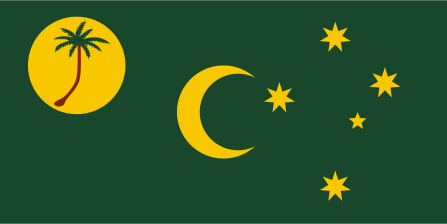
What the flag of the Cocos (Keeling) Islands looks like
The flag is a dark green field with gold symbols and no other colors. A gold disc with a palm tree stands in the canton. A gold crescent is in the center of the flag, and the gold Southern Cross is in the fly. The proportions are 1:2.
The Cocos (Keeling) Islands flag emoji keeps the green field and gold shapes. The territory also flies the flag of Australia.
Cocos (Keeling) Islands flag colors
Color codes measured from the official design. Use HEX for the web and CMYK for print.
HEX
#19472CRGB
25, 71, 44CMYK
65, 0, 38, 72 HEX
#F8C700RGB
248, 199, 0CMYK
0, 20, 100, 3 Cocos (Keeling) Islands flag meaning
The palm tree stands for the islands' tropical flora. The crescent is a symbol of Islam, the religion of the Cocos Malays, who make up most of the population. The Southern Cross is a symbol of Australia and the southern hemisphere. Green and gold are Australia's national colors.
History of the Cocos (Keeling) Islands flag
Captain William Keeling sighted the atolls in 1609. The Clunies-Ross family settled them in 1827 and held them until the 20th century. The islands were annexed by Britain in 1857 and transferred to Australia in 1955. Australia bought out the family's holdings in 1978, and in a 1984 referendum islanders voted overwhelmingly to integrate with Australia.
The flag was designed by a teenager, Mohammed Minkom, who won a flag competition in 2003, and it was formally declared on 6 April 2004 by the Administrator of the Australian Indian Ocean Territories. It is used in the territory, although the Australian Government does not officially recognise it.
About the islands
The territory is made up of two atolls with 27 coral islands. Only Home Island and West Island are inhabited. Home Island is the center of the Cocos Malay community, while West Island has the airport, the administration and most visitors. Charles Darwin visited in 1836, and his study of the atolls helped shape his theory of how coral reefs form. Malay and English are both spoken.
Cocos (Keeling) Islands flag facts
| Country | Cocos Islands |
|---|---|
| Flag adopted | April 6, 2004 |
| Proportions | 1:2 |
| Colors | #19472C, #F8C700 |
| Symbols | Crux, five-pointed star, seven-pointed star, crescent, roundel |
| Flag emoji | 🇨🇨 |
| Country code | CC, CCK (ISO 3166) |
| Capital | West Island |
| Continent | Oceania |
| Population | 602 |
| Area | 14 km² |
| Currency | Australian dollar |
Cocos (Keeling) Islands flag: frequently asked questions
Who owns the Cocos (Keeling) Islands?
Australia. They have been an Australian external territory since 1955, and the 1984 vote confirmed integration.
What do the symbols on the Cocos flag mean?
The palm tree stands for coconuts, the crescent for Islam, and the Southern Cross for the southern hemisphere and Australia.
How many people live on the Cocos (Keeling) Islands?
About 600, mainly on Home Island and West Island. Most are Cocos Malay Muslims.