Flag of Idaho
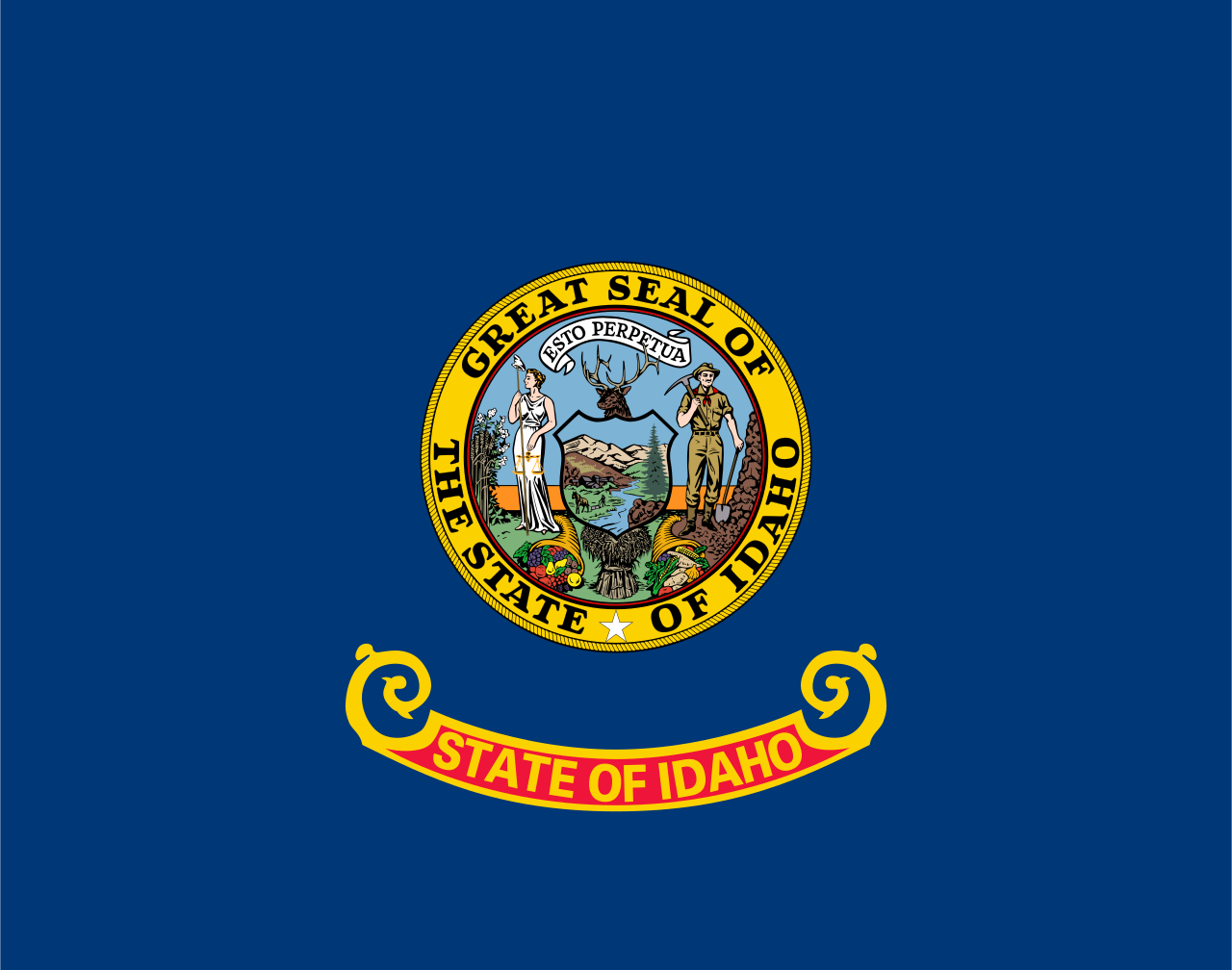
The Idaho flag places the Great Seal of the State of Idaho on a field of dark blue, with the name of the state in gold letters on a red band below. The seal was designed in 1891 by Emma Edwards Green, the only woman to design a U.S. state seal.
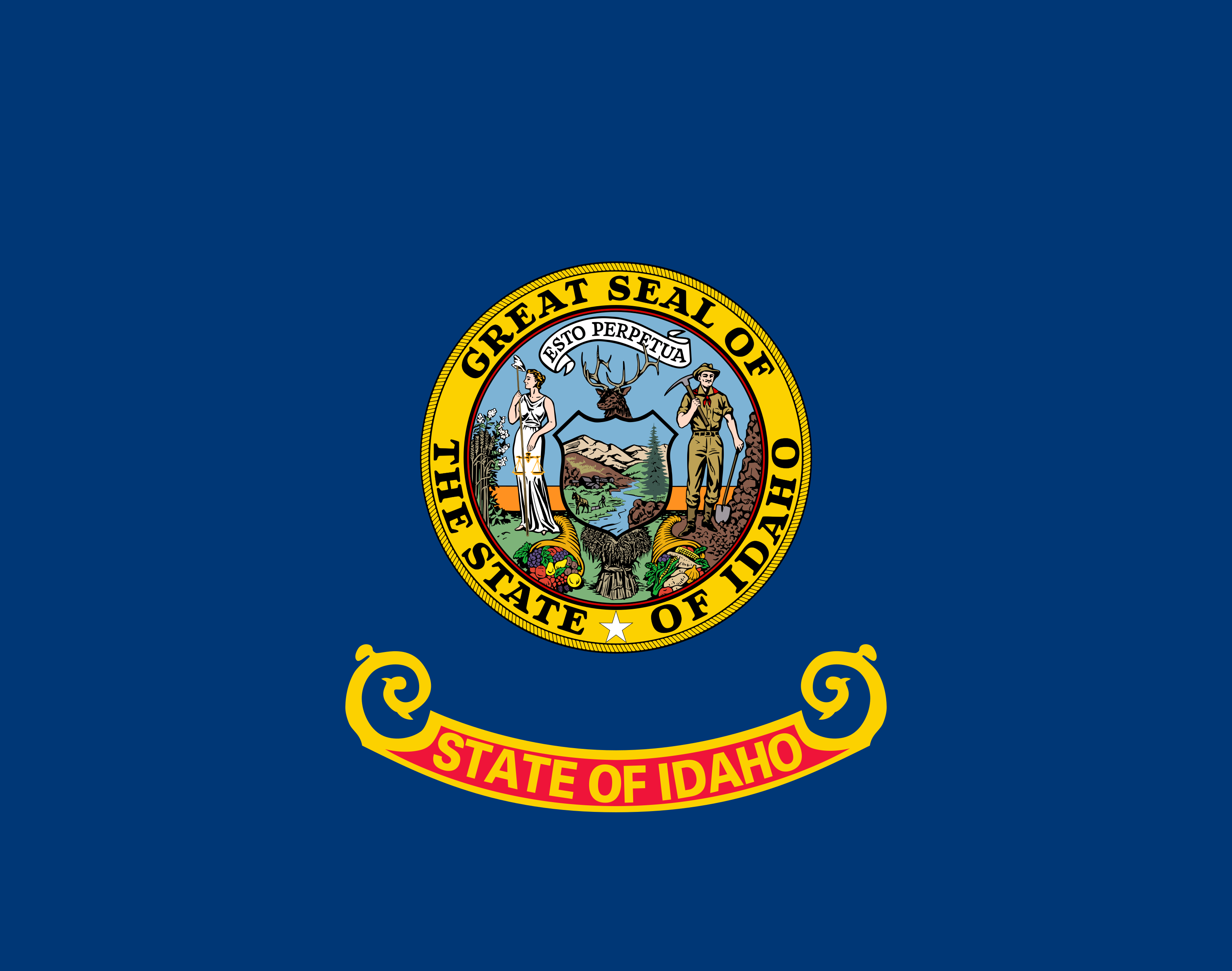
What the Idaho state flag looks like
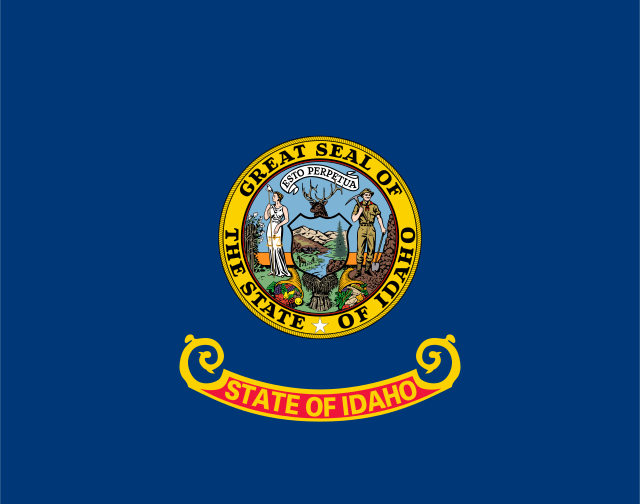
The Idaho state flag has a solid dark blue field with the full-color state seal in the center. A red band with the words STATE OF IDAHO in gold capital letters sits directly under the seal. The flag is a rectangle only slightly wider than it is tall.
The seal is a detailed scene. At its center is a shield showing a river winding through mountains, a pine tree, and a farmer plowing a field, with the sun rising behind the peaks. Standing on either side of the shield are a miner on the left and a woman on the right who represents liberty, justice and equality. At the top is the head of an elk, and at the base a pair of cornucopias hold wheat and the state flower, the syringa. A banner above the seal carries the Latin motto Esto Perpetua, which means "Let it be perpetual."
Idaho flag meaning and symbolism
Each part of the seal stands for an aspect of the state. The miner recalls the mining industry that drew settlers to Idaho in the 1860s, and the farmer in the shield and the sheaf of grain point to agriculture. The pine tree represents the timber industry, and the mountains and river stand for the state's natural resources. The woman in the seal is often said to represent liberty as well as justice, and her place beside the miner expresses the equality of men and women. Idaho gave women the right to vote in 1896, which was a point of pride, and the seal reflects it.
The elk head stands for the state's wildlife, the cornucopias symbolize abundance, and the wheat stands for farming. The motto Esto Perpetua expresses the hope that the state will last. The blue field is a common choice on U.S. state flags and has no separate official meaning.
History of the Idaho flag
The first seal of Idaho was created for the Idaho Territory in 1863. After statehood in 1890, a new seal was needed, and the legislature adopted the design by Emma Edwards Green, a young artist from California, in 1891. She is the only woman credited with designing a U.S. state seal.
Idaho's state flag, a blue banner with the seal and a red band reading State of Idaho, was officially adopted in 1907, and later laws set the details of the design more precisely. The flag in use today keeps this basic look: the seal on blue, with the name below.
You can compare Idaho's flag with its neighbors on our U.S. state flags page. Oregon, next door, is the only state whose flag looks different on each side.
Interesting facts about the Idaho flag
- Like many state flags, it is a seal on a blue field, one of the most common styles in the country.
- Idaho's seal is the only U.S. state seal designed by a woman.
- The seal's woman and miner together reflect Idaho's early recognition of women's suffrage.
Idaho flag colors
#003776RGB
0, 55, 118CMYK
100, 53, 0, 54#FCD100RGB
252, 209, 0CMYK
0, 17, 100, 1Idaho flag facts
| Adopted | 1957 |
|---|---|
| Proportions | 11:14 |
| Symbols | Seal of Idaho |
| State capital | Boise |
| State motto | Esto perpetua |
| Population | 1,839,106 |
Idaho state flag FAQ
What does the Idaho state flag symbolize?
The flag shows the state seal, which represents Idaho's mining, farming and timber industries, its wildlife, and the equality of men and women. The motto Esto Perpetua means "Let it be perpetual."
Who designed the Idaho state seal?
Emma Edwards Green designed the seal in 1891. She is the only woman credited with designing a U.S. state seal.
What is the only two-sided state flag?
Oregon has the only state flag with a different design on each side. Idaho's flag shows its seal on the front only, like most others.
What does the writing on the Idaho flag say?
The red band under the seal reads STATE OF IDAHO. The banner at the top of the seal carries the state motto, Esto Perpetua.
Why are flags at half-staff in Idaho?
Flags are lowered when the governor or the president orders it to honor someone who has died or to mark a day of remembrance. Check official announcements for the reason on a given day.