Flag of The Gambia
The Gambia flag has three wide horizontal bands of red, blue and green, with the blue band separated from the others by thin white stripes. The blue represents the Gambia River, which runs through the middle of the country.
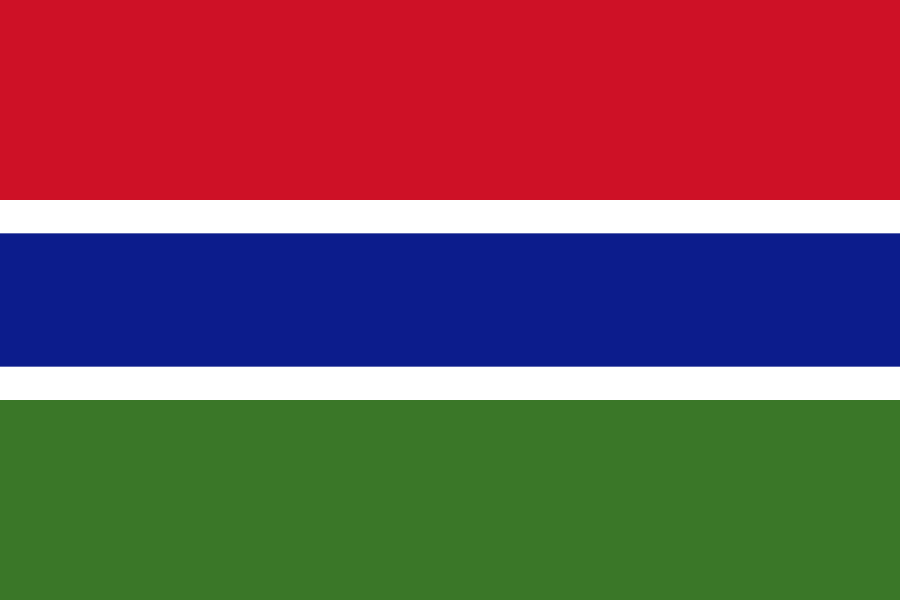
What the flag of The Gambia looks like
The national flag of the Gambia has five horizontal stripes. Red is at the top, then a thin white stripe, a blue band, another thin white stripe and green at the bottom. In proportion the stripes are 6:1:4:1:6, so red and green are the widest, blue is about two-thirds of that, and the white stripes are narrow dividers. The flag is 2:3.
There is no emblem or text on it. Blue is rare as a main color on African flags. The coat of arms, with two lions and the motto “Progress, Peace, Prosperity”, is used on government flags but not on the national flag. See also the Gambia flag emoji.
Gambia flag colors
Color codes measured from the official design. Use HEX for the web and CMYK for print.
HEX
#CE1126RGB
206, 17, 38CMYK
0, 92, 82, 19 HEX
#3A7728RGB
58, 119, 40CMYK
51, 0, 66, 53 HEX
#0C1C8CRGB
12, 28, 140CMYK
91, 80, 0, 45 HEX
#FFFFFFRGB
255, 255, 255CMYK
0, 0, 0, 0 Gambia flag meaning and symbolism
The meanings given for the colors are:
- Red for the sun and the savanna, and sometimes for the blood of the nation's struggles.
- Blue for the Gambia River, the country's main waterway and the origin of its name.
- Green for forests and agriculture.
- White for peace and unity, the two stripes that keep the other colors apart.
The country is a narrow strip of land on both banks of the river, so the blue band running through the center of the flag is a map of the nation in miniature. These readings are the ones usually taught in schools; the constitution describes the flag but does not list the meanings.
History of the Gambia flag
Britain established a settlement at the river mouth in 1816, and an inland protectorate followed in 1894. The territory used a British blue ensign with a badge showing an elephant and a palm tree, used during the colonial period.
The Gambia became independent from the United Kingdom on 18 February 1965, and the present flag was raised on that day. It was designed by Louis Thomasi, a Gambian. The country became a republic within the Commonwealth in 1970.
The flag survived the 1994 military coup led by Yahya Jammeh and 22 years of his rule, and it was kept after Adama Barrow won the 2016 presidential election.
Gambia flag facts
| Country | Republic of The Gambia |
|---|---|
| Flag adopted | February 18, 1965 |
| Proportions | 2:3 |
| Colors | #CE1126, #3A7728, #0C1C8C, #FFFFFF |
| Symbols | field, fimbriation |
| Flag emoji | 🇬🇲 |
| Country code | GM, GMB (ISO 3166) |
| Capital | Banjul |
| Continent | Africa |
| Population | 2,639,916 |
| Area | 11,300 km² |
| Currency | dalasi |
| National anthem | For The Gambia Our Homeland |
Gambia flag: frequently asked questions
What is the meaning of the Gambia flag?
Red stands for the sun and savanna, blue for the Gambia River, green for forests and farmland, and the white stripes for peace and unity.
What was Gambia called before?
It was a British colony and protectorate known as the Gambia Colony and Protectorate until independence in 1965. The name comes from the Gambia River.
Who designed the flag of The Gambia?
The flag is credited to Louis Thomasi. It was first raised on 18 February 1965, the day the country became independent from the United Kingdom.
Is Gambia an African country?
Yes. The Gambia is in West Africa. It is the smallest country on mainland Africa and is almost entirely surrounded by Senegal. Browse flags of Africa.
Which language is spoken in Gambia?
English is the official language. Mandinka, Wolof, Fula and other local languages are widely spoken in daily life.