Flag of Djibouti
The Djibouti flag has two horizontal bands, light blue above light green, with a white triangle at the hoist holding a red five-pointed star. It was first raised when the country became independent from France on 27 June 1977.
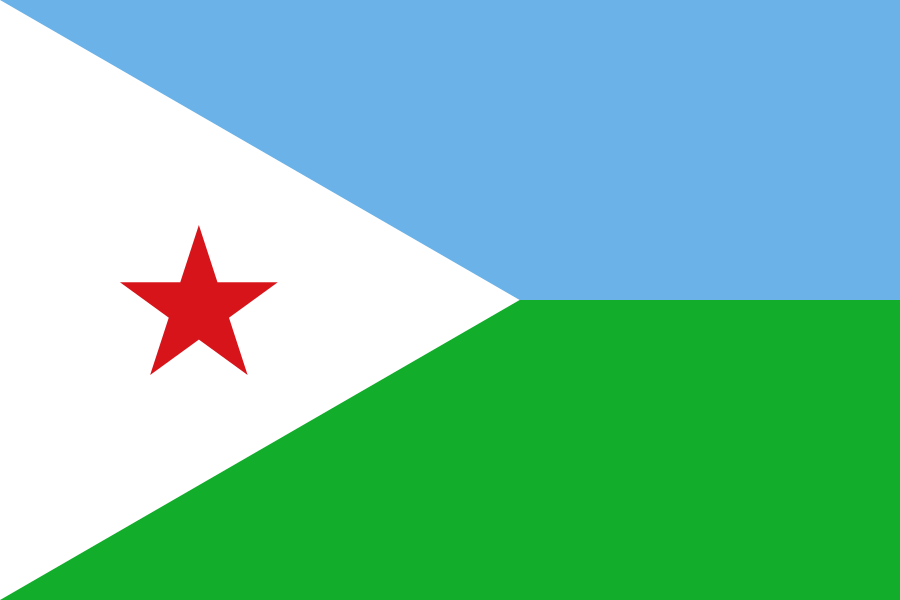
What the flag of Djibouti looks like
The flag of Djibouti is divided into two horizontal bands of equal height. The upper band is light blue and the lower band is light green. A white equilateral triangle sits at the hoist, with its base along the pole and its tip reaching toward the middle of the flag. In the center of the triangle is a red five-pointed star. The flag has a ratio of 2:3.
The triangle is fairly large, so the blue and green bands are visible mostly toward the fly. The shade of blue is a sky color rather than a navy blue, which helps tell the flag apart from many others.
Djibouti flag colors
Color codes measured from the official design. Use HEX for the web and CMYK for print.
HEX
#12AD2BRGB
18, 173, 43CMYK
90, 0, 75, 32 HEX
#6AB2E7RGB
106, 178, 231CMYK
54, 23, 0, 9 HEX
#FFFFFFRGB
255, 255, 255CMYK
0, 0, 0, 0 Djibouti flag meaning and symbolism
The meaning of the Djibouti flag is simple to remember and is widely repeated:
- Light blue stands for the sea and the sky. It is also associated with the Issa people, a Somali clan.
- Green stands for the earth and for nature. It is also associated with the Afar people, the other main community of Djibouti.
- White stands for peace.
- The red star stands for unity, and is also said to remember the blood shed for independence.
The link between the blue and green bands and the two communities is a common reading, though it is not part of a legal definition. Some sources add that the five points of the star refer to the five regions inhabited by Somali people, in line with the star on the flag of Somalia. This reading is disputed and is not an official explanation.
History of the Djibouti flag
The territory was a French colony from the late 19th century, first called French Somaliland and, from 1967, the French Territory of the Afars and Issas. During this time the French tricolor was the official flag. Pro-independence movements, notably the African People's League for Independence, used a blue and green banner with a white triangle and red star, which is the origin of the present flag.
After a referendum in 1977, Djibouti became independent on 27 June, and this design was adopted as the national flag. It has stayed the same since. The flag is flown by the government, the armed forces and at sea, and appears on public buildings and during celebrations of Independence Day.
Djibouti flag facts
| Country | Djibouti |
|---|---|
| Flag adopted | June 27, 1977 |
| Proportions | 2:3 |
| Colors | #12AD2B, #6AB2E7, #FFFFFF |
| Symbols | five-pointed star, equilateral triangle, field |
| Flag emoji | 🇩🇯 |
| Country code | DJ, DJI (ISO 3166) |
| Capital | Djibouti |
| Continent | Africa |
| Population | 1,152,944 |
| Area | 23,200 km² |
| Currency | Djiboutian franc |
| National anthem | Djibouti |
Djibouti flag: frequently asked questions
What does the Djibouti flag mean?
Light blue stands for the sea and sky, green for the earth, white for peace and the red star for unity and the blood shed for independence. Blue and green are also linked to the Issa and Afar peoples.
What country did Djibouti used to be?
Djibouti was a French colony, called French Somaliland and later the French Territory of the Afars and Issas. It became independent on 27 June 1977.
Is Djibouti an African country?
Yes. Djibouti is in the Horn of Africa and borders Eritrea, Ethiopia and Somalia. It is also a member of both the African Union and the Arab League.
What does Djibouti mean in English?
The origin of the name is uncertain. It is often said to come from a word in the Afar or Somali languages, and it is used for both the country and its capital.
What flag is the Djibouti emoji?
The emoji shows the same flag: light blue over green with a white triangle and red star. You can see it on the Djibouti flag emoji page.